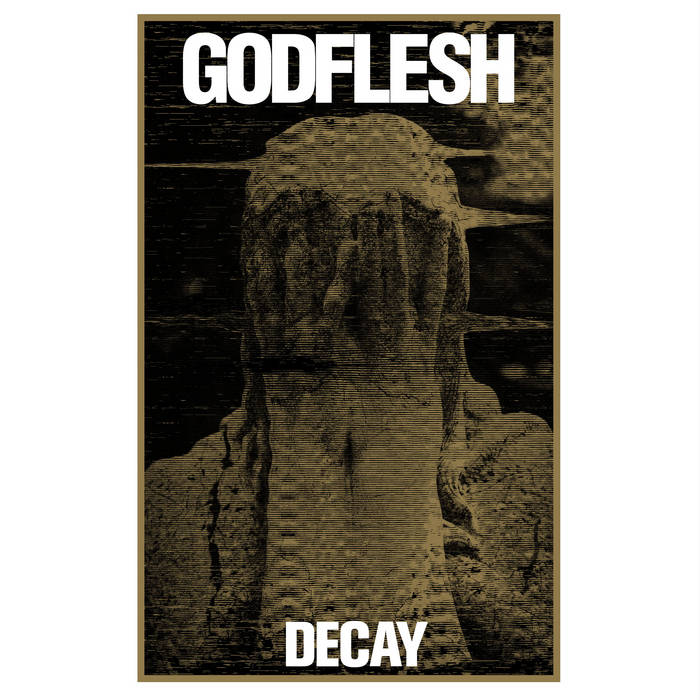
Decay
Out 25th September on Relapse Records
Hellfest 2010 was a pretty special festival. John Garcia got 75% of the band back together as Brant Bjork and Nick Oliveri took the stage for a few numbers during his Kyuss classics set. Immortal, Asphyx, and Carcass were all in their post revival pomp, affording a younger generation a glimpse of early 90s extreme metal arcadia in the live setting. And, following their breakup in 2002, Godflesh were booked to play their first reunion show, only to arrive hours late and deliver a brief, thirty minute set savagely cut short by the festival organiser’s unbreakable loyalty to their curfews. But what a half hour it was. I’ve seen Godflesh many times since, and although they’ve never delivered a duff set, they have never quite recaptured the dusty intensity that was generated in that sweaty tent, deep in the nocturnal crush of Clisson’s baking vineyards.
It’s odd to look back on all this in 2026. By this point, Godflesh’s post revival career is longer (if you discount the Fall of Because days) than their pre-revival run, and has delivered nearly as much material to chew over. Although it doesn’t stack up against the rich intensity (and deviations in quality) of their work throughout the 80s and 90s, post 2010-Godflesh has its own creative arc, phases, and ripples. Reading the tea leaves behind this material, it seems that Broadrick has been struggling to reconcile his more eclectic self, articulated across the drone/shoegaze of Jesu and the industrial electronica of JK Flesh, with the more metallic demands made of the Godflesh name.
Following the promising ‘Decline and Fall’ EP, 2014’s ‘A World Lit Only by Fire’ felt forced. An attempt to bottle the magic of Godflesh at their peak and keep up with their many extreme metal peers undergoing similar reappraisals of their legacy at the time, with new material from vintage acts emerging from all corners. This first effort from Godflesh felt procedural and restrictive, words previously anathema to this enigmatic artist. In stark contrast, 2017’s ‘Post Self’ was proof that, unlike their death metal counterparts, one should never write this one off. A more experimental, electronic, noise driven direction was still tempered by a shudderingly heavy backbone in an album that found a way to integrate Broadrick’s cosmopolitan inclinations into something that was still recognisably Godflesh.
Following a lengthy gap in new material, 2023’s ‘Purge’ seemed to take us back a few steps, as if in the interim between ‘Post Self’ punctuated by a global pandemic Broadrick needed to reset himself creatively and drag Godflesh back to first principles. I relistened to the album for the first time since its release in writing this piece, and although it’s not as tiresome as I remember, there remains a peripheral suspicion that ‘Purge’ was the result of cycling through the material from 88 to 94 in an attempt to rediscover what made it tick so crushingly. I’m reminded of Carcass’s post reunion albums which, for all the praise they’ve received, look to me like desperately excavating the bones of their most popular material from ‘Necroticism..’ and ‘Heartwork’ in an attempt to stay part of the conversation.
And so we come to what we are told will be Godflesh’s penultimate salvo in the form of ‘Decay’. After one more album, Broadrick will once put the project out to pasture on account of his health. But true to the bipolarity of post reunion material, I am once again forced to admit that one should never count Broadrick and Green out. At a princely forty minutes, but made up of a mere six tracks, this is Godflesh at their most longform, bookended by two monolithic numbers, the last of which, ‘Consume Me’, indulges in pure and much welcome Swans worship before dissolving into a contemporary trial of industrial noise.
Stylistically, this looks like a more focused rerun/redemption of the noble experiment that was ‘Us and Them’. The rockist grooves are present and correct, but are ultimately sidelined in favour of an exercise in soundscaping. This feels more like a suite of interconnected pieces than it does a collection of tracks. This in turn allows the material to breathe in a more natural way than what we found on ‘Purge’, which felt like an attempt to force ideas into a certain expectation of what Godflesh should be. Here, the entity that is Godflesh is allowed to exist free of such burdens. Repetitive, droning, dissonant, each piece pivots on a simple hook, driven through a rudimentary sequence of evolutions, but all anchored by a confident rhythmic base. Development comes at the textural level, as waves of static and guitar noise gradually accrue, imbuing the percussive backbone with a cumulative dread. The physical self striving to persist in the face of nebulous external pressures.
Signature riffs abound, but the music is not beholden to them. And this ultimately gets to the heart of what has kept this machine ticking over for so long. ‘Streetcleaner’ is stuffed with iconic riffs, but that’s merely the foundation, the flour in the cake. Similarly, ‘Decay’ is bound together by a familiar, groove based metallic mortar, only to wander and deviate into broad, exploratory sojourns of intensely dynamic, harsh ambience. Broadrick has stated that his health problems are in part due to the intense vocal demands this project has made of his body over four decades. Here the material seems to be adapted to account for this new limitation. Some barks remain in place, but for large sections across this album’s underbelly Broadrick sticks to a distant, clean howl of semi-melodic intent. The music wraps around this framework, furnishing us with rich textural layers that make use of sustain and a subtler dynamic range when compared to the tight, percussive interchanges that define much of Godflesh’s signature material.
Despite the austerity inherent to the Godflesh philosophy, when they are on form it feels like anything can happen. ‘Decay’ opens out a broad, expansive horizon of possibility from its relatively limited raw materials. When an artist of this vintage flounders (as Immolation have done recently), the likelihood of a bounce back diminishes. Broadrick and Green continue to be the exception that proves the rule here, releasing an album that will seal their legacy if such a thing were even required at this point. What the final album will hold is anyone’s guess, but at this point it hardly matters.


Leave a Reply