Immolation: Descent
Out 10th April on Nuclear Blast
Some Morbid Angel fans argue that they lost something following the departure of Richard Brunelle. Trey Azagthoth, for all his talents, benefited from a grounded counterweight, marrying flamboyance with efficiency perfectly. Opinion may be divided on the direction of MA following ‘Blessed are the Sick’, especially from ‘Domination’ onwards, but there’s no denying that Trey’s is fallible genius. A similar case could be made for Rob Vigna, a guitarist I’ve long championed as every bit as distinctive and unique, matching Trey for both his labyrinthine lead work and unmistakably idiosyncratic riffing.
But just like Trey, Vigna’s genius is not unconditional, it requires checks and balances to keep it focused on a target. Looking at Immolation’s near flawless run from ‘Dawn of Possession’ through to ‘Unholy Cult’, I’d argue this came chiefly from offsetting Vigna’s energy with drummers Craig Smilowksi and Alex Hernandez. The former bringing a jazzy fluidity that reached its fruition on ‘Here in After’, the latter the mechanistic, tugging rhythms that gave the three albums he contributed to that sense of unravelling vertigo.
And then we have Steve Shalaty who took up the baton from ‘Harnessing Ruin’ onward. It would be deeply unfair to lay everything since then at his feet. ‘Harnessing Ruin’ itself continues to divide opinion, namely for the fact that Immolation trimmed the song lengths, going for a more direct and basic approach in the hope of – one can only assume – pulling in fans from the “core” subgenres that were in the ascendancy in the mid-2000s. But it was still recognisably Immolation. ‘Shadows in the Light’ arguably rebutted any criticism by achieving a similar stripped back, efficient approach but with sharper riffing arrangements and tighter complexity.
And then we have the material from ‘Majesty and Decay’ onwards. What went wrong? A Nuclear Blast kiss of death is one answer. But Immolation, the nicest, hardest working and most consistent band in death metal deserved a break by 2010. They all but carried the genre through its absolute nadir at the turn of the century with some of its strongest material. But they were condemned to relative obscurity compared to their reliably unreliable peers in Cannibal Corpse, Obituary, or Morbid Angel. Resenting Immolation for receiving a belated recognition and the larger budgets that come with a Nuclear Blast signing would be churlish.
But ‘Majesty and Decay’ was the first album Vigna wrote all but entirely from his desk, including the drum arrangements, leaving Shalaty to merely flesh them out remotely for the final cut. The fact that the material was all but complete before the line up even got together to play it gave Vigna complete creative freedom, which is not always a good thing. Shalaty, with all due respect to his talents, just doesn’t have any identity to set him apart from the ever expanding pool of technical death metal drummers, all of whom could easily replace him as Vigna’s percussive stenographer.
And where’s Ross Dolan in all this? you ask. Having given his all to Immolation for the best part of forty years he was only able to quit the day job as a truck driver around the release of ‘Atonement’ in 2017, and is no doubt happy to dispense with the hassle of extra travel and studio time required to actually write material in the same room together. Let Vigna beaver away in his office, a few pre-tour rehearsals are all that’s required now, leaving Dolan to pen lyrics from the comfort of home. He’s earned this small respite.
This is the riddle of Nuclear Blast era Immolation. A fantastic musical mind left to ossify in the absence of any dynamic co-collaborators who would be keen to insert their own opinions. So Vigna’s style, as distinctive as ever, is left to circle around the same handful of touchstones, growing stale on the diminishing returns of each rerun. The resultant Immolation brand never declined in the way many of their peers did. Just a quiet retreat into the night. The albums since 2010 aren’t entirely worthless, they have their own identity despite some deviations in quality (I still can’t remember a single thing about ‘Kingdom of Conspiracy’).
2022’s ‘Acts of God’ felt like an attempt to build on the success of ‘Atonement’ (the most popular of the NB era), expanding the vision whilst bringing a more organic sound – a nod to the OSDM trend that dominated the 2010s – that nevertheless felt more grandiose and orchestral. The main critique levelled by Immo’s faithful champions was its significant length. Whatever truth there was to this, the main issue was the same that plagued ‘Harnessing Ruin’. Vigna’s distinctive style is delivered in microcosm. His signature techniques, tonality, and rhythmic lurches are all present and correct, but they don’t lead anywhere. Gone are the intricate narrative threads of ‘Close to a World’ below, all is clipped back for the sake of delivering these basic, episodic suggestions cut together with crowd pleasing signature melodies.
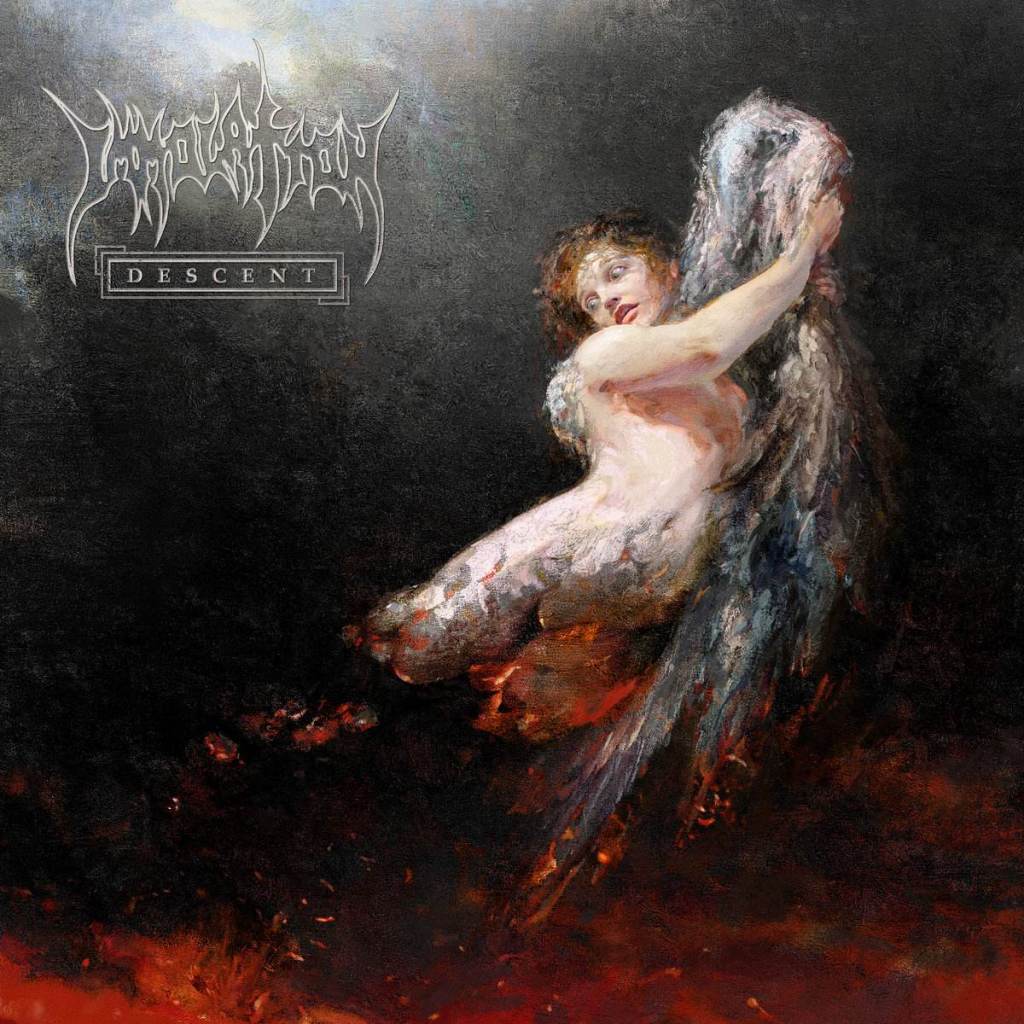
‘Descent’ hardens this trend. They seem to have taken the comments on the length of ‘Acts of God’ to heart by trimming things down to an industry standard forty minutes. But this is just rearranging the furniture on the Titanic at this point. Vigna’s riffing still lacks any motion. Which is hardly surprising given not only the near total control he wields over the project, but also being rewarded for this by the additional fans they’ve pulled in on the Nuclear Blast roadshow. Individual passages are serviceable if generic Immolation offcuts, but they are arranged in such a way as to make them legible to a casual listener to the detriment of any substance. There is no journey of discovery, Immolation are reduced to another interesting item on your newsfeed, a momentary enjoyment, dispensed with at the end of this release cycle.
Compare this with earlier material which beckoned the listener in with its surprisingly catchy riffing and unique atmosphere, only to slowly unfurl its odd tonality and rhythmic approach, gradually revealing a rabbit warren of complexity, demanding attention and analysis. Take the lead single on ‘Descent’, ‘Bend Towards the Light’ (that incidentally came replete with an AI drenched music video). Excluding lead guitar material and vocals, I counted seven distinct parts. With the first half of the track alternating between two ideas with the brief addition of a third. The finale of the track continues to add new sections, but there is no return to the opening material, just a showcase of supplementary content that is all but unrelated to what had preceded it.
I did a similar exercise with ‘Nailed to Gold’ from ‘Here in After’, a track of a similar length, and came up with at least ten distinct parts, with the first minute of the track moving through four transitions before taking the listener on an expansive journey of about six distinct yet complementary sections before pulling us back to the main theme towards the close the track, thus recontextualising the material in some way following these extended breakout motions. It feels like a journey, a dynamic, living, breathing entity that pulls the listener in. ‘Bend Towards the Light’ feels like a static showcase, it asks us to remain fixed in place whilst we receive the duly homogenised content.
This is the riddle of modern Immolation. Vigna can do this on autopilot by this point. The new fans they’ve roped in – and indeed their Nuclear Blast paymasters – don’t require them to paint with any degree of detail anymore. Fans will likely applaud this album after a few cursory spins, and move on to the next flavour of the month. It’s designed to catch your eye, give you a dose of what Immolation do well in easily digestible form, and maybe pull in some newer fans who will – rightly – be dazzled by the idiosyncrasies of their style. But for anyone that was enamoured by the pre-Shalaty material, Immolation in their current guise will continue to disappoint as a matter of inevitability. The engine room of this band was never solely Vigna’s magic touch, it was how this touch was applied across a spread of different templates, aided and abetted by an assertive rhythm section that forced Vigna to contort and stretch his approach, allowing us to scrutinise it from multiple angles and frameworks. All this is now reduced to a single, easily reproducible form, and metal is poorer for it. Fans desirous of bands carrying this legacy forward are better off looking to the likes of Dissidence, Moral Putrefaction, or Plague Bearer.


What an awful review. Yawn.
LikeLike
I feel like I got dumber reading this…
LikeLike
Good article. Given the history of nearly all bands on Nuclear Blast over last 25 years, I still suspect the label imposes some restructions on bands’ creativity. NB model seems to be for bands to put out clones of whatever album was successful. In essence it is a cookie cutter steady cash flow model designed to sell albums based on familiarity. All the albums have similar production irrelevant of style and even similar artistic style in covers. It clearly works for bands too – steady income plus benefit of NB’s distribution and marketing system. All this is very good for NB artists who are usually in their 40s/50s and have mortgages and kids and who probably used uo their artistic hunger decades ago. But it kills creativity and it helps keep metal in a zombie state of stasis.
LikeLike
Dear Hope I was your fan on Metal Archive(sadly was banned from forum)expecially on your bm reviews..
I completely disagree with you,Descent is a return to Smilowski,Hernandez album,same with atmosphere(more dark).
Maybe I’ll write you a more detailed message later, but Vigna has basically been the only songwriter since the demos (even “Failures” and “Close” were recorded as a trio), and honestly, you should listen to the album again in a while with a clear head. I’m a huge fan of “Harnessing Ruin.” I really don’t understand how anyone can criticize that original album, so full of new things (how the hell could a normal band make a follow-up to “Close” or “Unholy Cult”?) If you’re a fan of the Dawn of Possession I’ll I recommend “Degraved,” a truly interesting debut. Regards, Lee Harrison
sorry for my grammar but here are 2:19 am so be mercyful
LikeLike
I’ve been a fan since Here In After and this new album is absolute top tier death metal. Don’t know how anyone remotely into death metal can think otherwise.
LikeLike
Spot on really, and in a broader sense an excellent diagnosis not only of Immolation but of much modern Metal.
LikeLike
Low IQ yapfest.
LikeLike