Apocalyptic Steel
Out 26th June on Season of Mist Underground Activists
Say what you like about Nargaroth, but the guy dances to the beat of his own drum. In his earliest period Ash was simply content to write Nordic black metal fanfic, resulting in a surplus of flat, bloated material that bored more than it enraged despite its charms. This era will forever be remembered for the ‘Black Metal ist Krieg (A Dedication Monument)’ episode however, establishing Nargaroth’s reputation as a third wave court jester. Setting that aside, there were many apparently sincere efforts from this time right into the 2000s that are worth exploring, culminating in 2009’s ‘Jahreszeiten’, an ambitious conceptual nod to Vivaldi’s Four Seasons amongst other things. After a long gap, the project returned in 2017 with ‘Era of Threnody’, a sprawling, ambitious work that could be read as Ash attempting to digest his increasingly eclectic tastes into a recognisably Nargaroth template.
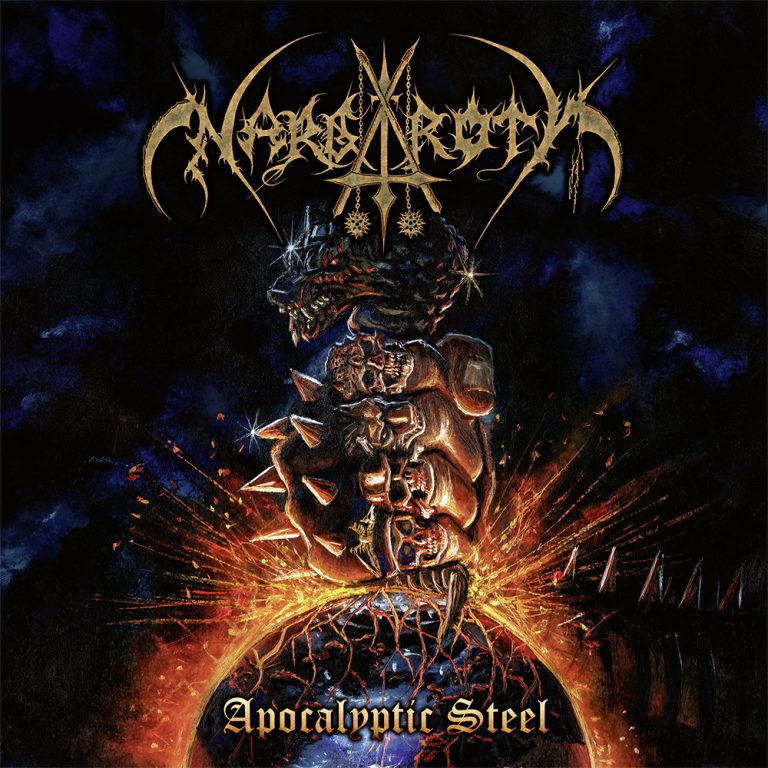
Despite remaining active on the live circuit, the follow up ‘Apocalyptic Steel’ is the first we’ve heard from this project in nearly a decade. A quick gander at the cover art and title and one could easily assume this is a dedication monument to Judas Priest. I honestly wouldn’t put it past Nargaroth at this point. But no, whilst ‘Era of Threnody’ stretched across time and space (with many earlier works easily exceeding an hour), ‘Apocalyptic Steel’ is a crisp forty minutes of tightly constructed, aggressive black metal, albeit delivered with a rock ‘n’ roll swagger that permeates even its most epic moments. The material was originally conceived back in 2014, but following some reworking is only now seeing the light of day. But this still puts it very much in the latter, more expansive and ambitious era of Nargaroth.
Since 2009 the cult posturing was all but abandoned, allowing ambition to run away with itself. But, to their absolute credit, it’s an ambition always out of step with expectations. The music expanding off into leftfield realms anathema to the puritanical combativeness of their first era. As far as ‘Apocalyptic Steel’ is concerned, this is felt in the production as much as anywhere. The mix is quintessentially modernist black metal, deep, rich, fat. The guitar is centre stage but not dominant. Plenty of room is left for light keyboard lines, throbbing bass, and assertive, linear drumming. Samples and interludes contextualise the material, threading together stylistically divergent tracks into a single, clear narrative.
Of the material itself, despite the stark contrast it feels contiguous with ‘Era of Threnody’. A fan of metal and punk digesting the older vintage of these styles into the distinctively Nargaroth black metal mould. A d-beat punk number ruminating on alcoholism complements the ambient fluidity of blasting black metal. A haunting, cleanly sung ballad to the bombing of Dresden at the hands of the allies in WWII, punctuated by siren wails and church bells, is immediately followed by the dominant heavy plod of ‘Shelter the Faithless’. ‘Man of Mayhem’ works like a black metal version of ‘My Way’, bringing an odd gravitas and dignity to what could have been another Mutiilation ‘Black Metal Cult’ eyebrow raiser.
The Mutiilation comparisons could go beyond this however. Given that both artists are of a similar vintage, and both have recently returned with albums reflecting on the process of aging, they make for useful companion pieces. From a certain angle, ‘Apocalyptic Steel’ is a surprisingly eclectic rumination on growing old, German identity, and of course metal as a lifestyle (or more accurately rock ‘n’ roll). Ash has lost none of his flair for black metal, but this is a rock album through and through, precisely because it places him, or rather a facsimile of the aging rocker, as the central character. But it does so with dignity and vulnerability despite the blind fury and energy of the music. In this sense Ash proves more successful than Meyhna’ch in attempting to metabolise aging, precisely because he is of a more rockist mindset, able to write dynamic and compelling music that works with and not against its rather personal thematic material.
Further, the lengths Nargaroth have gone to on this album, technically, creatively, performatively, really does put the Darkthrone content mill to shame. Both projects have, in some sense, become about updating musical identities in response to growing older by rediscovering the music of their early, pre black metal adolescence, but Nargaroth are able to articulate this childlike naivety with a degree of sobriety that proves more instructive than the one-dimensional love letters Darkthrone keep pushing out, which look if anything like denialism by comparison. It’s ok to accept that the spark of youth has long since departed. Finding a new voice befitting of one’s vintage is the challenge all metal acts eventually face, based on this material Nargaroth have found a way to take joy in renewing their vows with metal in a manner befitting someone in their fifties.


Leave a Reply