Words by Jason Kiss
Jacques Rancière’s notion of the “distribution of the sensible” offers a productive theory for probing the black metal phenomenon. Rancière defines the distribution of the sensible as “the system of self-evident facts of sense perception that simultaneously discloses the existence of something in common and the delimitations that define the respective parts and positions within it.”[1] Put more simply, it refers to the overarching cultural partition that structures what is perceptible and thereby shapes shared knowledge and participation in a society. Within our contemporary aesthetic regime of extreme metal, this partition is enacted through common threads of circulation and visibility: record labels, PR apparatuses, extramusical narratives, and a disseminated network of media outlets configure what counts as worthy of attention. Works that fail to inscribe themselves within these distributions of visibility risk falling outside perceptibility altogether and are potentially consigned not merely to rot in obscurity but to sheer silence within the regime.
For Rancière, those who sustain this order are not “police” in the literal sense but participants in what he calls the police logic, which comprises the common practices of the distribution of the sensible by determining what is legitimate. As he stated: “The police is thus first an order of bodies that defines the allocation of ways of doing, ways of being, and ways of saying, and sees that those bodies are assigned by name to a particular place and task; it is an order of the visible and the sayable that sees that a particular activity and another is not, that this speech is understood as discourse and another as noise.”[2] Thus, policing need not be conscious nor intentional; it operates through modes of perception with what is already familiar, which in turn sustains the existing distribution of the sensible.
This is why legacy bands in extreme metal thrive so much: they are the most recognizable within the logic of the police and thus function as stable references of what is most commonly familiar. Their band names operate less as isolated artistic outputs than as instituted nodes of what’s perceptible within the broader apparatus of extreme metal culture. Even music critics contribute to this police logic, as they often describe new music in relation to what the distribution of the sensible allows to be known, which is usually defined by how similar or dissimilar an expression is or where it falls between already familiar bands, which in turn assimilates new expressions into the existing order. Therefore, music criticism itself, even if it positions itself as antagonistic to the distribution of the sensible and the logic of the police, remains dependent on it for the sake of intelligibility.
The event that dismantles policing is what Rancière calls dissensus, which he also ascribes to true political activity itself. As he put it, dissensus is “whatever breaks with the tangible configuration whereby parties and parts or lack of them are defined by a presupposition that, by definition, has no place in that configuration – that of the part of those who have no part.”[3] Moreover, it “makes visible what had no business being seen, and makes heard a discourse where once there was only place for noise; it makes understood what was once only heard as noise.”[4] As Gabriel Rockhill further explains, dissensus “creates a fissure in the sensible order by confronting the established framework of perception, thought, and action with the ‘inadmissible.’”[5]
Before black metal exploded onto the scene in the early 1990s and challenged what constitutes extreme metal expression, death metal had already been part of the distribution of the sensible, and perhaps the music was never outside of its province to begin with, as its expression was the next logical evolution of extremity following speed metal bands such as Slayer, and thus it never truly embodied the eventful rupture of genuine dissensus. As Michael Moynihan explained in Lords of Chaos, “Between 1989-93 Death Metal had become immensely popular worldwide, with bands drawing crowds in the thousands on an average night.” It was thus institutionalized by the police: “As greedy record labels tried to cash in on the Death Metal trend by signing up untalented bands and releasing an endless stream of mediocre and remarkably unoriginal albums, the market was quickly swamped in a morass of interchangeable sludge.”[6]
While the extramusical crimes associated with the second wave of black metal bands brought them and their music into public consciousness in the early 1990s, and gave the perception that they were more “real” or “true” in their ideology than merely death metal’s lyrical content and imagery focusing on blasphemy and homicide,[7] what matters most is what renders black metal as dissensual tension; the rupture it brought to the existing regime of the distribution of the sensible. Black metal functioned as an intentional negation of the commercialization and popularity of death metal. This is why numerous bands rejected the death metal they themselves had made. Darkthrone abandoned their debut death metal album Soulside Journey in favor of black metal expression. Old Funeral and Amputation were disbanded, and Burzum and Immortal later emerged from their ashes, and similar death metal-rejecting transformations occurred across Europe. The music drew much of its influence from albums like Bathory’s highly primitive 1985 The Return of the Darkness and Evil, which is a record generally regarded as the first true black metal release.
Black metal rejected the jock culture that had begun to shape death metal as fans of speed metal bands such as Metallica and Slayer flooded its scene. It even rejected the idea of having fun at concerts. It also rejected polished productions, such as those associated with Scott Burns and the Floridian death metal scene. Most importantly, it rejected the emphasis on coherence that defines much of death metal expression. Black metal instead stripped the music down to its most basic elements and reshaped them into something highly melodic and expressive under “raw” productions,[8] often utilizing fast tremolo picking,[9] not merely to be brutal or extreme, but to redefine what constitutes extreme metal expression.
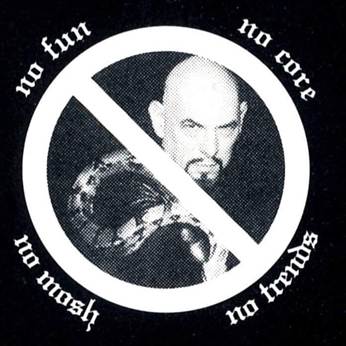
While negation of death metal played a crucial role in black metal’s formation, negation itself isn’t dissensus. What made the expression embody dissensual tension is that it disrupted the distribution of the sensible by introducing something so unfamiliar that did not fit the established rules of what is communicable within metal. It was not a logical evolution of stylistic progressions like death metal emerging from speed metal, but a complete radical redrawing of the boundaries of what is even expressible as “metal.” As Spinoza Ray Prozak from the American Nihilist Underground Society (A.N.U.S.) elucidates: “This new form of metal was more vivid and emotionally evocative than the thunderous assault of death metal, and also less concerned with the immediate social values around it; it embraced independent thinking, a dislike for all social dogmas and humanism, a Romanticist love of nature and predation, and a penchant for fantasy and thoughts of ancient times.”[10] It remained for a while as “noise” in North America while it gained its footing in Europe, with many listeners shaped by speed metal and death metal arriving late to accept it as a valid form of extreme metal. In fact, black metal was often mocked in the United States of America before it became accepted as a genuine metal expression.[11]
This brings us to the kernel of the problem of lasting dissensual tension in black metal. Black metal emerged as dissensual tension; “noise” that defied metal’s policing. Its event radically redrew the boundaries of what could be communicated in metal. But is its true nature inherently that of dissensual tension? Given how commercialized black metal has become, even being reduced to pop entertainment in webcomics,[12] it seems that if black metal were truly dissensual in nature, it would remain as “noise” ignored by most, and it would not have been so readily assimilated into the insatiable broader extreme metal world. Prozak addresses this shift from dissensual tension to police logic:
When the mainstream bands such as Dimmu Borgir, Cradle of Filth and Marduk that attracted hundreds of thousands to black metal are confronted with the ideology of the founders of modern black metal, they quickly shake their heads and walk away. “Not for us, thanks.” In addition, their music is fundamentally different from that of the underground bands; where the originators of this style used diatonic and chromatic riffs and melodic modes, most of the “aboveground” black metal uses pentatonic scaling and much of the same riffs and rhythms of metal bands from the 1970s. Thus is exemplified a split in the genre: the bands who are doing what metal bands always have, and the bands who are moving away from traditional metal toward a more neoclassical, less rock-n-roll, more intricate musical form.[13]
This “split” that Prozak brings up is important. There is an “aboveground” in black metal which is certainly part of the distribution of the sensible, yet another expressive domain exists in the margins: that which is ignored; a “proper-improper.”[14] While it is not entirely accurate to call this domain an “underground” as the term has pretty much lost all meaning, as any dingbat local band can claim such a designation, there still exists “a part with no part” in black metal, what is still considered by most to be “noise.”
Such is the case with the band Ildjarn. While the project has gradually received slight recognition after it had disbanded, it remains in the margins.[15] It is thus the task of music critics and reviewers to help render the expressions intelligible to the broader metal community. As Prozak remarked about Ildjarn’s release Det Frysende Nordariket: “As if capturing pure motion from the majestic presence of wind, Ildjarn crest the wave of trance black metal with something so essential and unprocessed through social filters that it exceeds the limits of emotional directness for most individuals.” With the album Strength & Anger, Prozak concluded it went even further by becoming “a ferocious assault on music itself.” However, with Ildjarn’s Forest Poetry, the music transgresses the boundaries of what can be communicated at all in black metal. Prozak’s insight here is unmatched:
For most listeners this music is almost unlistenable: unrelenting and mostly unchanging basic flickbeats through a drum machine trot past a fiercely, cheaply, grossly distorted guitar power chording riffs built of the same basic ideas and reacharound counterpoint tendencies. Barring that aesthetic restrainer, a careful listener will find the insecurity of a will behind seemingly random, simplistic music; with interpretation, one can see why this music walks heir to the throne of Hellhammer, Bathory, and Burzum: it breaks down in order to show melody and structure in the cracks of an aging order, and retaliates with a virulent nihilism and ideological anti-aesthetic textural synthesis. Where it is brilliant it is, and where else it is nonetheless reflective.[16]
Fortunately for this project, but unfortunately for the reader of it, Ildjarn wrote a manifesto when they officially disbanded, informally titled “Final Statement,” which appeared in the 2005 compilation album Ildjarn Is Dead released by the record label Northern Heritage.[17] While the manifesto appears more like an antisocial stream of consciousness which spans 25 pages rather than a systematic philosophical work, it nevertheless gives us a glimpse into the mind of someone who argues that the count is a miscount. Moreover, Ildjarn explicitly states that the manifesto itself isn’t for everyone in the black metal scene. In his own words: “The finished text may be regarded as nonsense, and chances are it will turn out to be mere words of insanity to you. If it appears incomprehensible, you should continue living your miserable life in blissful ignorance among the rest of the mindless crowd and forget about my antihumane manifestations of life and death.”
Most importantly, the manifesto itself, much like Ildjarn’s music, is a total rejection of the black metal scene. According to him: “I’m not even into the scene anymore, and to my knowledge, I never quite was.” In regard to the commercially successful bands in the scene, such as what Prozak outlined as “aboveground” like Dimmu Borgir, Cradle of Filth, and Marduk, Ildjarn concurs by stating that those “so-called extreme bands… are acts aimed at the masses, aka pop(ular) music.”[18] And this is exactly what Ildjarn despises, and he establishes his split from this “aboveground;” the police logic standing in stark contrast to Ildjarn’s own antisocial expression. As he vulgarly put it: “The music industry consists of whores sucking the cocks of whoever may put some dirty cash up their money loving shitholes.”[19] To clarify, Ildjarn uses the word “whore” in two different contexts. While he spends much of the manifesto talking about having sex with who he considers to be whores, including one questionable statement about teenage girls,[20] the connotation of commercially successful bands being whores is not something he himself would want to be a part of. In regard to those “whores,” Ildjarn hints that he will exact his retribution in the afterlife: “I hereby put a spell of merciless death on the money-loving whores and rip-offs I’ve encountered throughout the years, who disrespected me and thus chose an opponent not very desirable to acquire through life, and most importantly, through death.”[21]
As can be gleaned from the foregoing excerpts, the Ildjarn manifesto is extremely antisocial; it goes against the grain of polite society by deliberately deploying vulgar language ad infinitum; and it “makes visible what had no business being seen” perhaps in the most literal sense. As such, being that Ildjarn found its home in the margins and nowhere else, he remains a “black sheep” within black metal, as Shelley from the website Hate Meditations, its name taken from Ildjarn’s Strength & Anger album, once put it.[22] Even after two decades, the manifesto exists as a “proper-improper.” Many dismiss it as “try-hard” vulgarity, but it remains consistently dissensual alongside Ildjarn’s musical expression itself. It exists in the margins in defiance of police logic.
Ildjarn’s music and manifesto sit comfortably within the concept of dissensus. Another, more recent attempt at dissensus comes from the band Liturgy, who also authored a manifesto. Before examining that text, it is important to situate Liturgy within the prevailing police order. A brief search on Google returns a wide range of reviews of Liturgy’s most recent album, 93696 from 2023. Even the popular, industry-friendly YouTuber Anthony Fantano, on the YouTube channel theneedledrop, writes in the video description that “93696 not only stands as one of the best avant-garde metal albums you’ll hear this year, but also serves as a conceptual retrospective celebrating 10+ years of music from Haela Ravenna Hunt-Hendrix’s Liturgy.”[23] Notice that “black metal” isn’t mentioned here. This is because, while Hunt-Hendrix’s manifesto is titled “Transcendental Black Metal,” the music of Liturgy is more often described as broadly “avant-garde” by fans or “hipster” by haters. While Rancière holds a positive view of avant-garde music,[24] there is hardly anything truly black metal about Liturgy’s iteration of it beyond some surface level stylistic choices borrowed from the genre. More often than not, depending on the song, Liturgy is closer to shoegazing indie rock, rap, noise, ambient drone, and minimalist classical music.
Black metal is not a defining element of Liturgy’s music. Playing devil’s advocate between fans and critics, it is at its core experimental music. Sure, there is plenty of experimental black metal, but Liturgy only draws from black metal as one of many influences it uses for experimentation alongside other genres. In Fantano’s review of the newest Liturgy album, he mentions that Liturgy has been “boldly pushing the boundaries of black metal.”[25] Being the project has received massive commercial success, which Ildjarn would decry as whorish, it is safe to assume that what Fantano means is that Liturgy has been experimenting within what is allowed by police logic by drawing from already familiar aspects from other genres to create a kind of sonic synthesis of the commons.
While some people dismiss Liturgy’s “Transcendental Black Metal” manifesto as a mere art project, it is important to dig into the text to see that since the music itself isn’t dissensual, perhaps there is a disruption being attempted in theory and not in practice. The fact that Hunt-Hendrix is often called a philosopher in addition to a musician, means that we shouldn’t dismiss what is stated in the manifesto as something not to take seriously, but to probe it to find out what it is trying to accomplish.
Central to the manifesto is the notion of affirmation through negation. For Hunt-Hendrix, this begins with negating European black metal and its nihilism, which she also calls Hyperborean. In her view: “The time has come for a decisive break with the European tradition and the establishment of a truly American black metal.”[26] From here, we Americans are to negate the latent nihilism in black metal, which Hunt-Hendrix ascribes to the Hyperborean, to bring about an American affirmation of black metal without relying on European expressions. While this has the stench of a pseudo-Hegelian dialectic, it is more like how some Mahāyāna Buddhist Sutras, such as the Diamond Sutra, use negation as a means for affirmation. An important line about affirmation in the manifesto is thus: “What we affirm is the facticity of time and the undecidability of the future. Our affirmation is a refusal to deny.”[27] Facticity in most contexts means a Heideggerian thrownness and the Sartean “in-itself” rather than the “for-itself.” So, while the for-itself is often viewed as transcendental, the temporal inevitability of facticity, or the non-transcendental in-itself, presents a possible existential rupture, not unlike Heidegger’s being-towards-death, which involves acknowledgment of the possibility of our own impossibility, something that Hunt-Hendrix argues we should first affirm by negating European nihilism.
Thus, being that this anti-transcendental theory does indeed contain ideas of existential disruption, it wouldn’t be outside Rancière’s notion of dissensus. It certainly creates tension by attempting to redraw the boundaries of what is communicable in black metal by negating the heavily influential European tradition. However, this stops at theory itself and doesn’t quite become praxis due to the artistic output of Liturgy being the opposite of dissensus; it draws from police logic to create its expression, and the police order of the metal and adjacent medias have thrusted the project as one of its greatest darlings.
While the Liturgy manifesto espouses theoretical dissensual tension, the music itself fails to put it into practice. Ildjarn, in contrast, shows in a twofold manner of theory and practice, not unlike Rosa Parks’ dissensual event and the birthing of black metal itself, that the margins hold the potentiality to disrupt and redraw the boundaries of what is legitimate. While such theoretical and practical expressions exist as “noise” in the margins, the distribution of the sensible is not a fixed phenomenon. All it takes is a dissensual event to rupture the prevailing doctrine of the day. And, as many major metal media outlets struggle to stay afloat and curate what is valid,[28] the margins themselves are susceptible to expansion and thereby render the conditions for dissensual events more possible.
References
Anon. “Ildjarn – Forest Poetry – Reviews – Encyclopaedia Metallum: The Metal Archives.” Metal-Archives.com. https://www.metal-archives.com/reviews/Ildjarn/Forest_Poetry/2848/. Accessed: May 1, 2026.
Anon. “Ildjarn’s Final Statement.” 2018. Black Metal Chronology. February 7, 2018. https://blackdeathmetalhistory.wordpress.com/2018/02/07/ildjarns-final-statement/. Accessed: April 29, 2026.
Anon. “Sony Lays off Staff from Metal Injection, MetalSucks, and Blast Beat Network.” 2026. Lambgoat.com. Lambgoat. April 29, 2026. https://lambgoat.com/news/52874/sony-lays-off-staff-from-metal-injection-metalsucks-and-blast-beat-network/. Accessed: May 1, 2026.
Burke, David. Persistence, Coherence and Vernacular Practice in 2020s Heavy Metal Culture. Doctoral Dissertation, Bath Spa University. Accessed: May 1, 2026. https://researchspace.bathspa.ac.uk/17726/1/17726.pdf.
Masciandaro, Nicola. 2014. Hideous Gnosis: Black Metal Theory Symposium 1. Place of publication not attributed.
Moynihan, Michael, and Didrik Soderlind. 2003. Lords of Chaos: The Bloody Rise of the Satanic Metal Underground. Los Angeles, California: Feral House; London.
Prozak, Spinoza. “Black Metal History.” Anus.com. Accessed: April 30, 2026. https://www.anus.com/metal/about/metal/black_metal_history/
Prozak, Spinoza. “Ildjarn.” Anus.com. Accessed: April 30, 2026. https://www.anus.com/metal/ildjarn/
Rancière, Jacques. 1999. Disagreement: Politics and Philosophy. Minneapolis: University of Minnesota Press.
Rancière, Jacques. 2013. The Politics of Aesthetics. Bloomsbury Publishing.
Shelley, Charles. 2018. “Ildjarn – the Black Sheep of Black Metal (a Word on the Namesake).” Hate Meditations. January 26, 2018. https://hatemeditations.com/2018/01/26/ildjarn-the-black-sheep-if-black-metal-a-word-on-the-namesake/. Accessed: April 30, 2026.
theneedledrop. 2023. “Liturgy – 93696 ALBUM REVIEW.” YouTube. April 11, 2023. https://www.youtube.com/watch?v=bm5TJIFvggg. Accessed: May 1, 2026.
[1] Rancière, The Politics of Aesthetics, p. 7.
[2] Rancière, Disagreement, p. 29.
[3] Rancière, Disagreement, pp. 29-30
[4] Ibid., p. 30.
[5] Rancière, The Politics of Aesthetics, pp. 88-89.
[6] Moynihan, Lords of Chaos, p. 31.
[7] Prozak, Black Metal History, “The genre that came seemingly last of all the metal genres was the one that considered its ideals the most seriously and consequently, produced a radically distinctive form of music.”
[8] Burke, Persistence, Coherence and Vernacular Practice in 2020s Heavy Metal Culture, p. 140, “Numerous influential black metal bands such as Darkthrone and Burzum used low-fidelity production techniques and emphasised a ‘raw’ performance style which resembles the live-sounding ‘garage’ approach favoured by grindcore bands, while rarely performing live, if ever: many lesser-known black metal bands are solo ‘bedroom’ projects.
[9] Ibid., p. 130. “References to musical features or techniques were much less common, although distinguishing features of subgenres were occasionally mentioned or described, such as ‘tremolo’ picking regarding black metal”
[10] Prozak, Black Metal History.
[11] Ibid. “The reaction of the death metal boy’s club was unanimous: ‘fags!’”
[12] Burke, Persistence, Coherence and Vernacular Practice in 2020s Heavy Metal Culture, p. 221. “The webcomic Belzebubs (over 300,000 Facebook followers) extends this relation between black metal and banality further: the strip’s principal cast are a tight-knit family of black metal enthusiasts, all of whom are nearly always portrayed in corpse paint (Belzebubs 2025).”
[13] Prozak, Black Metal History.
[14] Rancière, The Politics of Aesthetics, p. 89.
[15] Ildjarn – Forest Poetry – Reviews – Encyclopaedia Metallum: The Metal Archives. Reviews are split down the middle; people either like it or completely despise it.
[16] Prozak, Ildjarn.
[17] Anon. Ildjarn’s Final Statement.
[18] Ibid.
[19] Ibid.
[20]Ibid.. “But then again, I’m not able to explain fully why it’s a great feeling fucking teen cunts either; it just is… or was, although that hole never seems to stop bleeding.” This may have been stated just to shock the readers. At least one would hope so.
[21] Ibid.
[22] Shelley, Ildjarn – the Black Sheep of Black Metal (a Word on the Namesake).
[23] Theneedledrop, Liturgy – 93696 ALBUM REVIEW.
[24] Rancière, The Politics of Aesthetics, p. 24. “The notion of the avant-garde defines the type of subject suitable to the modernist vision and appropriate, according to this vision, for connecting the aesthetic to the political.”
[25] Theneedledrop, Liturgy – 93696 ALBUM REVIEW. 0:00:23 into the video.
[26] Masciandaro, Hideous Gnosis: Black Metal Theory Symposium 1, p.54.
[27] Ibid. pp. 61-62.
[28] Anon at Lambgoat.com. Sony Lays off Staff from Metal Injection, MetalSucks, and Blast Beat Network.


tldr
LikeLike
Respect for managing to read those two manifestos without suffering permanent brain damage
LikeLike