Kirjad sõgedate külast
Out 25th April on Antiq
Five years since their debut and a very different beast has wriggled free of the Kõdu moniker. Where ‘Unusta kõik’ unfolded a jagged, dissonant array of plodding black metal, at once surreal and haunting despite the cold, mechanistic approach, the long awaited follow up broadens the aesthetic spectrum whilst bringing a tighter conceptual unity. Kõdu are that rare thing in black metal, an artist able to toy with ambiguity via dissonance, a tangential momentum, and non-linear composition, yet at the same time furnishing us with an enthralling, immersive journey clasping at the spirit if not the form of classicalist black metal.
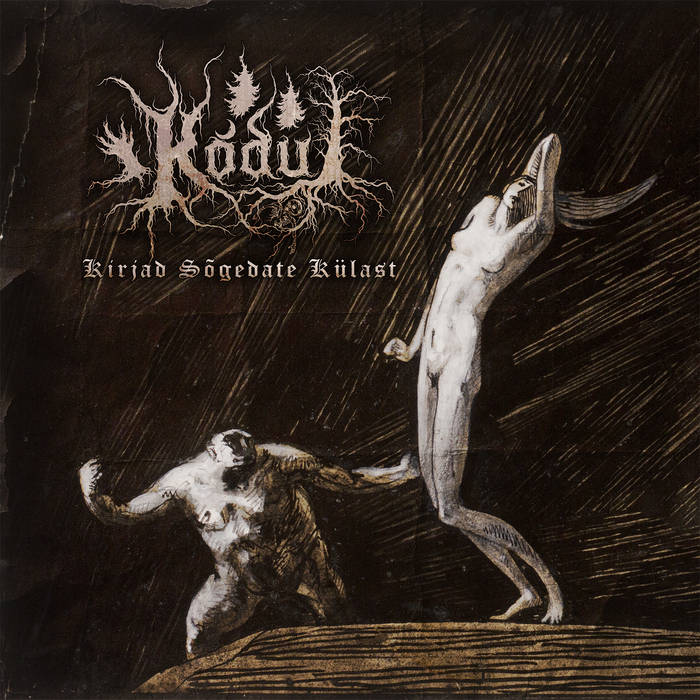
Here the template has been updated. Idiosyncratic riffs abound, but they are now relegated to mere commentary, an antagonist to the central flow of the material, which pivots on a dynamic concoction of folk, prog, and psyche, stitched together with a defiantly traditional melodic core. This is a formula that shouldn’t work on paper, but comes to vivid and gripping life through its execution in a manner reminiscent of early A Forest of Stars.
The production is clear and crisp. A polished and cinematic mix with a clean drum tone cutting through with confidence, the only nod to its black metal lineage being the harsh guitar tone. But such choices seem to be made out of necessity in order to make room for the expanded timbral palette Kõdu are taking in here, with sharp synth lines, acoustic guitars, and other additional string tones often taking the lead across expansive outcrops of this album. Harsh, scornful vocals remain in place to tie this to the more primal ancestry of this material.
Mournful folk refrains find their develop through loose tremolo runs, which then guide us into more expansive sections of prog adjacent tangents as the guitars and keyboards engage in a developmental call and response, picking up the central theme whilst adding their own opinions, allowing the material to compound and coalesce until brought to a finale. In this context, structurally it makes more sense to think about this as a folk informed progressive album that just happens to use the vocabulary of black metal. The tracks flow more like constructed jams than they do holistic compositions, as different instruments exchange ideas within a set of parameters clearly prefigured within each opening section.
Although the entirety of this material embodies the same oddly defiant poise despite the clear melancholia expressed throughout, each track, named simply in numerical order, is remarkably distinct from the last. In this sense Kõdu are reaching for dual traditions in metal. The first and older of which harkens back to the heyday of the album as an artistic medium in the 1970s, whereby a single creative statement contained a series of distinct chapters or acts, each forming a single unit in its own right whilst feeding into a greater superstructure. The second is the norm for extreme metal albums from the mid-80s onwards, which dramatically narrowed the scope for variations in timbre, texture, mood, and dynamics by foregrounding form, construction, and flow as the key – and sometimes only – metrics of quality composition. Kõdu indulge both instincts here, as a clear linear thread is discernible through its black metal self, but it is a thread decorated and adorned with all manner of cultural ephemera as the album progresses, seemingly freeloading on the substantive metallic waves, enhancing but not disturbing them in the process. In this sense ‘Kirjad sõgedate külast’ finds the balance that so many psyche or prog adjacent extreme metal acts appear unable to achieve, in tempering the eccentricity behind this impulse it manages to paint in bright bold colours without collapsing into absurdism for its own sake.


Leave a Reply