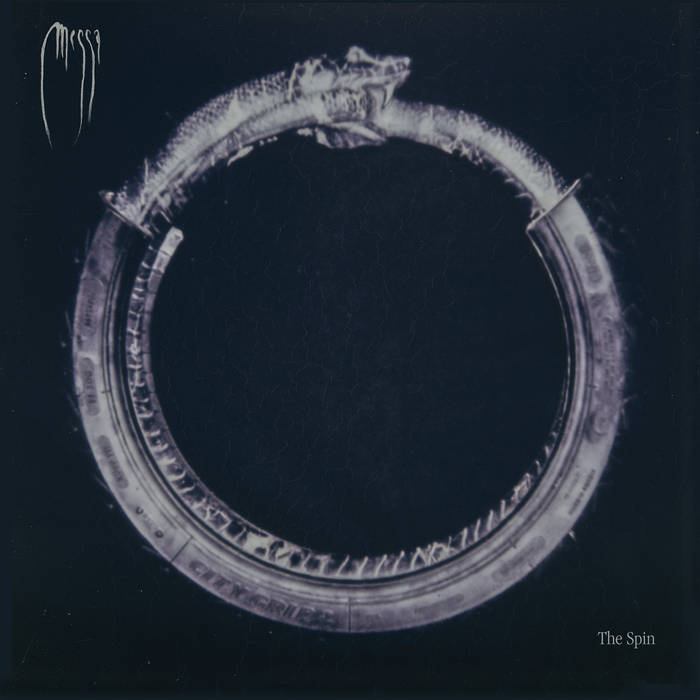
Metal Archives got itself into a bit of a state recently over its poll for album of 2025, seeing an Italian goth/prog/yacht rock/grunge album make the top spot by quite a significant margin. Many were quick to point out the irony of a site like MA, with a reputation for being highly selective about what “counts” as metal, electing Messa’s ‘The Spin’ as album of the year. You expect the drooling pondlife over at Decibel or Metal Hammer to gurn over this sort of thing like carp over damp bread. But this is an elite metal forum. They hold themselves to a higher standard, surely? User responses formed a predictable, agonising holding pattern around two urgent questions. Is ‘The Spin’ a metal album? And if not, what does it mean that it topped a poll of apparently discerning metal fans? To save time, the answers are no, and everything actually.
I’d never heard of Messa prior to this scandal. It’s a rock album. It’s not aimed at me. How do I know it’s a rock album? Because I have developed a bullet proof mechanism for determining if something is metal. Let me share it with you. I call it the Four Subgenre Theory (FSGT). I soft launched the FSGT late last year, here’s the link if you’re interested. But briefly, my contention is that there are only four subgenres of metal: heavy, thrash, death, and black. That’s because they are the only subgenres that leave observable traces in the music theory of metal. They are metal’s hardware, onto which a whole array of software and additional modules can be installed. These modules – like folk, goth, Viking, battle, stoner, glam – are either purely aesthetic (pirate, suicidal), or external to metal (neoclassical, avant-garde), they have no distinct body of theory within metal that isn’t reducible to one of the four pieces of hardware. Mistaking them for subgenres creates the illusion of variety, and flatters metalheads into believing themselves to be worldly and eclectic.
Most Messa apologists argue that ‘The Spin’ is clearly a doom metal album. So I ran it through the FSGT processer to test this, the results are in, and it’s pretty clear that these people are wrong. According to the FSGT, doom metal is not a metal subgenre. It’s an affectation. A piece of software ultimately reducible to one of the four actual subgenres. Nothing connects doom metal bands together that isn’t reducible to heavy, death, and occasionally black metal. But there’s no mistaking the trace heavy metal elements in the qualifying riffs across ‘The Spin’.
Trace elements does not a metal album make, however. Sometimes it really is just a numbers game. ‘The Spin’ is a series of ingredients placed neatly into separate bowls, enticing but never mixed together. Pink Floyd-esque guitar solos follow chorus laden goth rock arpeggios, traditional heavy metal riffs lapse into chunky grunge grooves. It’s eclecticism, not fusion. Messa have organised their influences into an attractive spread, but they are arranged rather than fused, curated not remoulded. And what’s the mother genre sitting behind each element of this spread? It’s not metal, it’s rock. Compare this to the literal fusion of punk and heavy metal hashed out by early thrash bands in the 80s. Or the open string tremolo picking of second wave black metal compared to the staccato atonality of death metal. Each was a step away from the rock mother genre rather than a mere rearrangement of mother’s wears.
That’s the genre mess cleared up for you MA, happy to help as always. But of course this is just a proxy war. A way for people to argue that ‘The Spin’ is just a bit shit without actually having to say it. Because if you just straight up say it you risk being called an elitist. And elitism is metal’s Godwin’s law. Call someone an elitist and the debate ends there. This forces any Messa detractors to adopt a rather tributary tone. A music chat version of “I’m not racist but…”. “I enjoyed Messa but it doesn’t belong on this list”, “I respect what they’re doing but…”, “I liked their last two albums but this isn’t as good”. Their task is doubly challenging because this isn’t an editorial line they’re arguing against, it’s literally the result of a vote. A vote within a population that regards itself as pretty discerning when it comes to metal. To dispute the result is to dispute the collective taste of a population deeply embedded within metal’s mores. I’m sorry but this is just what the people wanted.
I think for the majority of responders it’s not the quality of ‘The Spin’ they find upsetting (despite it being utterly beneath me it is quite a good album), but how far away it is from what they understand to be metal. This speaks to a deeper trauma we inflict on ourselves every Album of the Year Season. It’s not that these lists are self-indulgent, or arbitrary, or that we forget about them in a month. I think people’s real contention, even if they don’t know it, is the annual reminder that we are completely atomised from each other, even within tight knit communities like metal and its even tighter online fanbase. Every December we are struck by how different everyone else’s year has been. And how far away we are from people we took to be peers.
This doesn’t bother me personally. I would be genuinely ashamed if there was any crossover with my AOTY list and MA’s (I checked, the first overlap falls at 109 on MA’s list, Lethal Prayer’s ‘Sacrilege Infernus’, which was actually my number 1, all is well with the world). But a significant number of responders seem deeply confused as to how Messa qualified for the list at all, let alone how it reached the top spot. The trauma is of a different order this time. Not only does your year look very different from your fellow metalheads, it’s not even clear that your fellow metalheads even like metal.
Output from legacy acts are one of the few nodes the fanbase can still bind itself around. But even MA users acknowledge that their output in 2025 was shitter than usual. That Coroner’s half baked comeback made it to number three was a source of concern for many, just as Testament reaching number ten was agreed to be borderline scandalous. But these inclusions are hardly surprising, in lieu of any new collective experience to latch onto the shared symbols of the past are all people have.
Or are they? From a different angle, Messagate isn’t a symptom of some fundamental cleavage within the fanbase, quite the opposite if we look at the relative consensus around them. It wasn’t just Metal Archive, ‘The Spin’ appeared pretty high up on multiple lists across what counts for the metal press these days. This isn’t an outlying piece of data. And if anything it represents continuity with 2024’s collective crowning of ‘Absolute Elsewhere’. From the extent and enthusiasm of the coverage, it’s clear that both Messa and Blood Incantation are that rare thing in metal, newer artists capable of generating enough clout to create a shared moment across its fanbase, and gain a decent amount of attention outside of metal. The fact that they did so by adopting the same “citizen of nowhere” approach may add insult to injury for some, but it’s no mystery why these albums chimed with such a broad audience. It’s not just that we praise these ostensibly metal bands for the extent to which they don’t play metal. It’s not just that we praise them for refusing to engage with and develop the artistic techniques of metal qua metal. It’s not just that they receive plaudits for presenting a prepackaged metal taster within a smorgasbord of other genres. It’s that this is exactly what people want from their music in the 2020s. They want it to have everything except artistic clarity.
Naturally I’m above all this. Ants squabbling over jam. But if I were forced to weigh in I must admit that Messa are far more adept at this than Blood Incantation. There is a nice pace to ‘The Spin’, the expressive range is broad, the musicianship impressive but not self-indulgent, it’s emotive but not crass, the production is polished but not sterile. Blood Incantation’s reach may be shorter, their curation clunkier, their imagination more limited, but they too are a cut above the competition here. Most comparable mile-wide-inch-deep efforts end up sounding like brainstormed slop fresh from a focus group by comparison.
Blood Incantation and Messa have perfected the dark art of playlist music. And it’s exactly what the people want in the 2020s. A mix of genres, eras, aesthetics, techniques, and moods, handily spoon fed to you from the same disgustingly convenient trough. No more cosmopolitan than a TikTok scroll. A sign of vanishing attention spans. Of empty spectacle disguising itself as a real experience. A feast of the temporary, a feeding frenzy of variety utterly anathema to my long cherished monomania. Whether signposted by democratic vote or editorial line, the tastes of 2025 demonstrate that the kids are in fact wrong.
 Hate Meditations
lmao you are a fucking loser
LikeLike
“But this is an elite metal forum. They hold themselves to a higher standard, surely?”
They haven’t been an “elite metal forum” in over a decade at this point. Now it’s a bunch of hipsters who like ’80s New Wave more than metal who haven’t yet gotten the memo that Liturgy and Dawn Ray’d aren’t “cool” anymore and it’s time to move to the next trend.
LikeLike
Also:
“Or the open string tremolo picking of second wave black metal compared to the staccato atonality of death metal.”
I guess you’ve never heard Incantation? Or Immolation? Or even “Blessed Are the Sick” by Morbid Angel? Or “Legion” by Deicide? Unmuted tremolo picking (which I think is what you meant, there’s fairly little open string tremolo picking in second wave black metal outside of “Transilvanian Hunger” and “Pentagram”, usually open chords are slowly arppegiated when deployed because of how intermodulation distortion behaves on an electric guitar) is a key part of death metal’s toolkit (yet another reason why the number of subgenres you say exist is twice as high as it actually is; there’s heavy/speed and death/black, only two).
LikeLike
Agreed on everything except Testament comment. I think it’s awesome they’re still trying to expand their sounds into more heavier realms. Sure it’s not going to appeal to the deep underground. But it’s pretty damn good and at times even excellent for older style metal. Especially given most old school metal bands are now just pure nostalgia.
LikeLike
This is why your wife left you
LikeLike
IF YOU CAN AFFORD A WEB DOMAIN YOU CAN AFFORD TO BUY DEODERANT.
LikeLike
I had never heard of that Messa band before. After checking them out, I agree, it is not metal.
I do, however, find your thesis of there being only 4 metal genres oversimplified and lacking. Because what constitutes a genre is not purely the musical elements or the sounds that one hears, but the whole package: artwork, ideas, aesthetics, etc. Even more so, if a group of bands, fans, etc. constantly refer to themselves as a genre or subgenre, then they are exactly that. Because culture is comprised of shared experiences and if a bunch of people think they are genre x, then they are just that. The notion that only 4 metal genres actually exists is the same as believing that musical genres are some form of god-given elements from above such as fire or water. When in fact, a genre is just unwritten rules among a group about what we are. There is no point in arguing that doom metal does not exist and refer to some arbitrary musical theoretical standpoint and at the same time argue that one of the archetype genres is black metal based on the music. Because the latter can mean both Blasphemy and Drudkh, which pretty much only share distorted instruments as far as musical ground goes.
LikeLiked by 1 person
Funny you say that his musical analysis is arbitrary right after saying that “if a group of bands, fans, etc. constantly refer to themselves as a genre or subgenre, then they are exactly that.”
I also disagree with the 4 subgenre thing, but for observable musical reasons, not because a bunch of people arbitrarily declared themselves that way
LikeLike
test
LikeLike
this is why your wife left you.
LikeLike
this is why your wife left you.
also your website design is terrible, hmu.
LikeLike
weak
LikeLike
Interesting, and retarded…but still interesting. This raises the question is short form slop better than deeply though out analytical slop. I let Spotify autoplay curate my music tastes like an adult.
LikeLike
“Whether signposted by democratic vote or editorial line, the tastes of 2025 demonstrate that the kids are in fact wrong.”
The whole time I kept swinging back and forth on the question of “is this satire?” and the final sentence made it perfectly clear.
LikeLike