Dire Garden of the Ages
Out 29th May on Naturmacht Productions
The second album from this Irish solo project could be framed as a transfer of styles from one zone to another. Whilst the debut behaved like an epic fable heavily rooted in Viking and Celtic metal stylings, the follow up offers a rather dramatic volte-face into industrial and electronic territory. But both expressions are characterised by a swirling, atmospheric panorama that creates a clear continuity within this project despite the sharp pivot in direction. Here we are presented with plodding, epic black metal in a futurist guise, mirroring Midnight Odyssey, Benthik Zone, or Lustre, albeit with a more assertive gait, emphasising the rhythmic physicality of industrial over any explicit ambient quality.
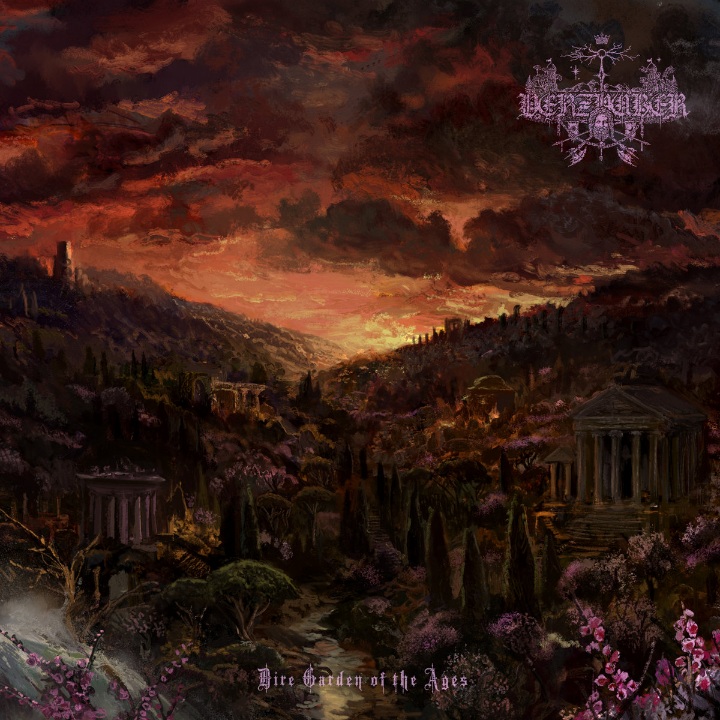
The production bears this continuity out, offering a dense cacophony of sound that makes plain Verzauber’s maximalist approach. Drums, keyboards, and vocals all serve the dual function of pure musicality whilst constructing an overbearing wall of texture, at times bleeding into each other in monolithic waves of noise. Drums are perhaps a little more tentative, despite clearly cutting through the mix they appear to buckle under the burden of forcing the music forward. The tempos are kept relatively low for black metal, offering stilted, lilting rhythms that seem to forever throw the music off balance. Everything feels heavily compressed, deliberately artificial as if to distort the music into an uncanny version of itself, a sui generis sonic expression running parallel to garden variety metal mixes.
A latent doom influence sits behind many of the riffs, but remains fully integrated into what is, at heart, a black metal expression, in this sense it wouldn’t be unwarranted to also compare this to The Ruins of Beverast. There are frequent breaks into pure ambience, and this is where the meshing of arcane and futurist styles becomes even more explicit. As the freeform organicism of choral tones and folkist melodies are blended into the synthetic regularity of electronic pulses and ordered industrial sequences. But there is an overarching fluidity to the music, a symphonic freedom that allows it to ebb and flow in progressions that emerge naturally. As the album progresses the structure becomes looser, as different angles of Verzauber’s stylistic milieu are given more space to elaborate their position, resulting in an episodic medley effect.
In this sense it may be helpful to understand ‘Dire Garden of the Ages’ as a Progressive album, capital P. Not so much from a technical point of view but certainly in terms of structure. There is a quite literal narrative development from start to finish. But more importantly the music is beginning to move away from the tight compositional unity one might expect from a metal album. What we get instead is an ensemble cast providing the backdrop, with different instruments and tones bursting into the foreground at different times, only to fade into the backdrop once again. Equally, the electronic elements are given a full hearing as opposed to merely providing some flavour as they so often do in a metal context. This works as a useful counterpoint to the lumbering metallic segments. The motion and complexity on display goes some way to justifying the considerable bulk of this album, more so than many comparable releases. Further, Verzauber have achieved that rare thing for a second album, a clear development on aspects of their identity, caveated by a strong continuity with the entity as established on the debut.


Leave a Reply