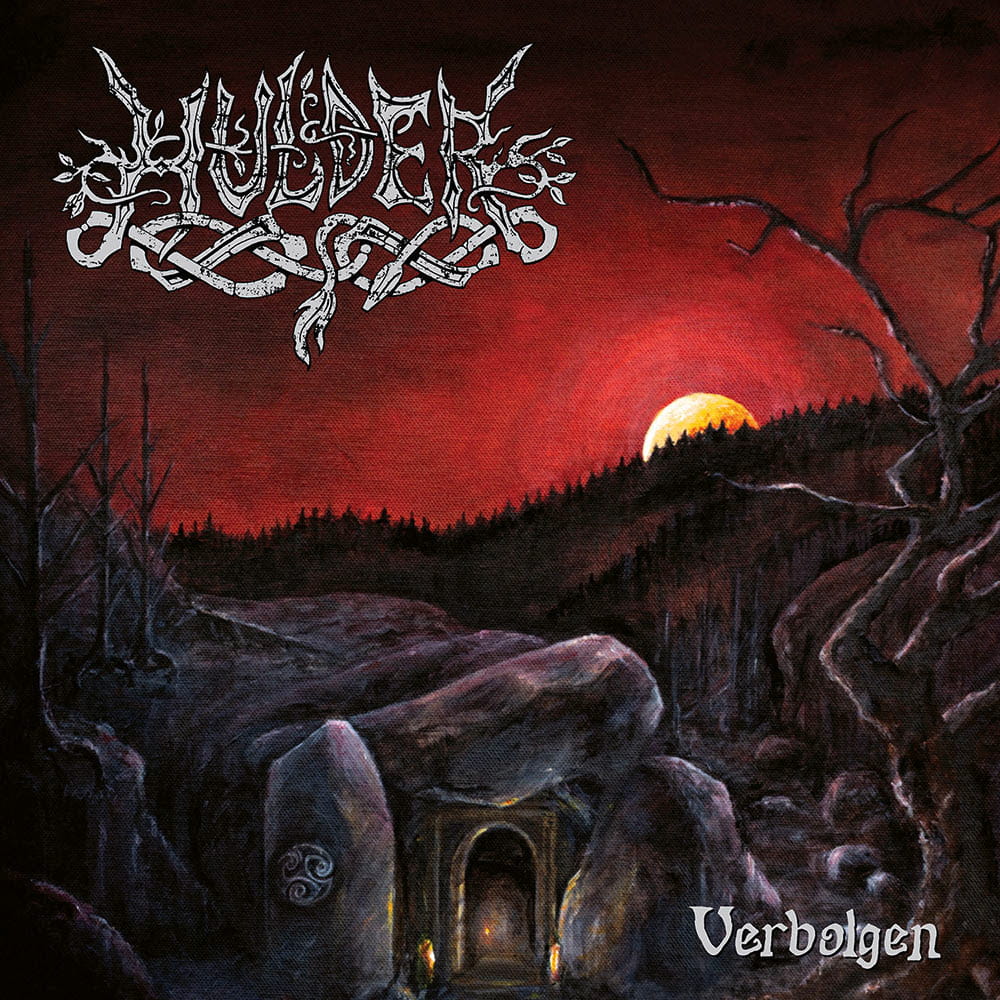
Hulder: Verbolgen
Out 7th August on Season of Mist/20 Buck Spin
Arranging the history of black metal into waves is a method as arbitrary as it is useful. The first wave being a retrospective concept imposed on a small group of early extreme metal artists who operated at the peripheries of the underground, only loosely related to one another. The second wave being the tipping point, the moment black metal became self aware, its musical traits codified, and where the thick layers of lore were laid down as bands exploded across Scandinavia and Finland, Central and Eastern Europe, France and Greece amongst others. Third wave black metal is where things get murky, at least as far as definitions are concerned due to the inevitable proliferation of different sounds that were evolving by the turn of the century. A fair but incomplete framing would say that this is where the Anglosphere finally begins to assert itself, with the US seeing the emergence of depressive/ambient black metal at one end and the loose, post rock infused Cascadian wave at the other, who in turn were echoed in the UK by acts like Wodensthrone, Fen, and Winterflylleth. Despite the entropy, the enormous expansion of stylistic real estate that black metal was now occupying, this was also the moment the genre, against all odds, became a little boring.
At its best it really did build on the legacy of the 90s, expanding on the naturalism and extraordinary atmospheric potential of the genre, whilst maybe also acting as a corrective to the gauche excesses of the keyboard driven symphonic black metal that was popular at the time. At its worst it neutered black metal of its fearlessness, converting it into understated alt rock and all the ironic detachment this implied. Bands dressed like dull bureaucrats or mild mannered beer enthusiasts, the music flattened off entirely into drab, predictable chord sequences and trite melodic contours, any jeopardy or daring jettisoned for the sake of a reserved indie chic. Little did we know at the time, but what would follow by the 2010s would arguably be far worse: every historical trend in metal being played on repeat, churning through cycles of popularity at a predictable rate, a chaotic anti-narrative indistinguishable from utter sclerosis. Distinctive artistic development would be relegated to tweaking at obscure experimental borders. Tracking historical motion from the 2010s onwards becomes an unwieldy process of guesswork, development taking the form of gentle ripples of unthreatening homogeneity falling on the shore. For all my vitriol toward bland third wave black metal, it was still something new, and, along with depressive black metal, will likely be what the genre in the 2000s is most remembered for. Any quality releases from the 2010s onwards aside, to talk of eras, waves, or even just popular favour, all started to make little sense by this time.
Formed in 2018, Hulder are a product of this fourth wave non-time. But their growing popularity, at least amongst more strident black metal “watchers”, perhaps reveals a growing appetite for a return to third wave values, specifically a noble but flawed attempt to mature black metal into the new century, but one contiguous with, not antagonistic towards, the legacy of earlier eras. And as a redraft of this historical moment, Hulder convincingly salvage the best of the 2000s whilst remaining true to the genre’s intangible essence that was largely established at the apex of the second wave.
Listening to the far from perfect latest offering ‘Verbolgen’ it’s clear that Hulder, by means fair or foul, are beneficiaries of the hype machine that comes with a Season of Mist signing. Long stretches bleed into one, with little to distinguish one moment from the next whilst lacking a solid ambient core that would justify such sparsity. But as a piece of soulful, open, naturalistic black metal it outdoes much of the competition, both historic and contemporary. It is aided by a strong melodic signature informed by subtle but effective folk touches, alongside an aggressive underbelly, evoking images of the wilds as a uniquely dangerous place. Respectful and reverential yet also threatening and imposing.
This is perhaps the closest black metal can get to a “commercial” sound without sacrificing its core essence. To that end, the production is polished and full bodied so as not to alienate any curious passersby. Highly orchestrated drums give the music girth without losing clarity, as double bass throbs its way through the low end without piercing the music with distracting clicks. The drums are mixed neatly into the pocket of the lavish guitars, which adopt a tone true to the spirit of the Nordic second wave whilst applying several licks of paint (and the layering of multiple tracks) to create a scene at once immersive, heavy, yet easily accessible even for fans not “of” the underground. Vocals veer from generic black metal fodder to clean chants, aided by modest but effective melodic leads, with woodwinds interjecting to expand the timbral range. These elements stay true to the folkist spirit of black metal, paying reverence to the importance of pure song in the context of highly landscaped music without falling into the carnival tendency of folk metal.
Hulder stipulate a relatively limited compositional ambition, but this allows them to succeed within these modest confines. Whilst the majority of riffs draw on the sparse, accessible tremolo chord runs that defined the third wave, many call back to a pre-1990 lineage, alongside some more adventurous wanderings as individual guitar lines range further across the tonal palette. This, alongside the understated but fully realised drum performance furnishes us with a totalising experience. There is structure and body here. The tracks stretch out into the distance but they are easily navigable despite their austerity. Each embodies its own character and purpose within the overall flow of the album. There is an intentional sequencing of this material that will leave one feeling satisfied. It conveys size and substance. This is where the generic approach of Hulder works in their favour. It feels like we have witnessed an actual event as opposed to another niche footnote to styles that have been spliced into microscopic, isolated ecosystems.
Although far from the best thing you will hear this year, Hulder represent a beacon of, if not hope, then optimistic intrigue. In the stratification of popularity they operate at that intermediate level between the underground and the mainstream within extreme metal. A tier often overlooked by those operating at the grass roots, regarded with wary cynicism owing to the degree to which media hype drowns out measured critique. But the fact that imaginative, dynamic, and tightly crafted black metal still has the ear of a broader audience is a somewhat rare occurrence worth drawing attention to.


I was interested to hear what you thought of this band. I’ve seen them live a few times and while I feel like I missed out on their heyday as a truly underground one-woman project in the COVID era, the last couple albums have still managed to barely walk that tightrope of maintaining quality on a lineup ascension.
LikeLike