Ὅρκος ἐκλεκτῶν
Out 30th April on Zombi Danz Records
After five years of silence, Greece’s Caedes Cruenta return with an unprecedented document dump of material, spanning an hour and a half in length, a runtime only permissible after the extended period of silence they have subjected us to since the celebrated ‘Of Ritual Necrophagia and Mysterious Ghoul Cults’. More than any Greek act, Caedes Cruenta appear capable not only of revitalising the style championed in the genre’s halcyon days but of expanding the formula itself. They do this first and foremost by linking the dirty ritualism of Necromantia or Medieval Demon with its formative roots in early death metal (a cover of Morbid Angel’s ‘Angel of Disease’ solidifying the connection), and using this as a jumping off point to expand on the bright, heavy metal informed melodicism of Rotting Christ, Varathron, Agatus, and Zemial.
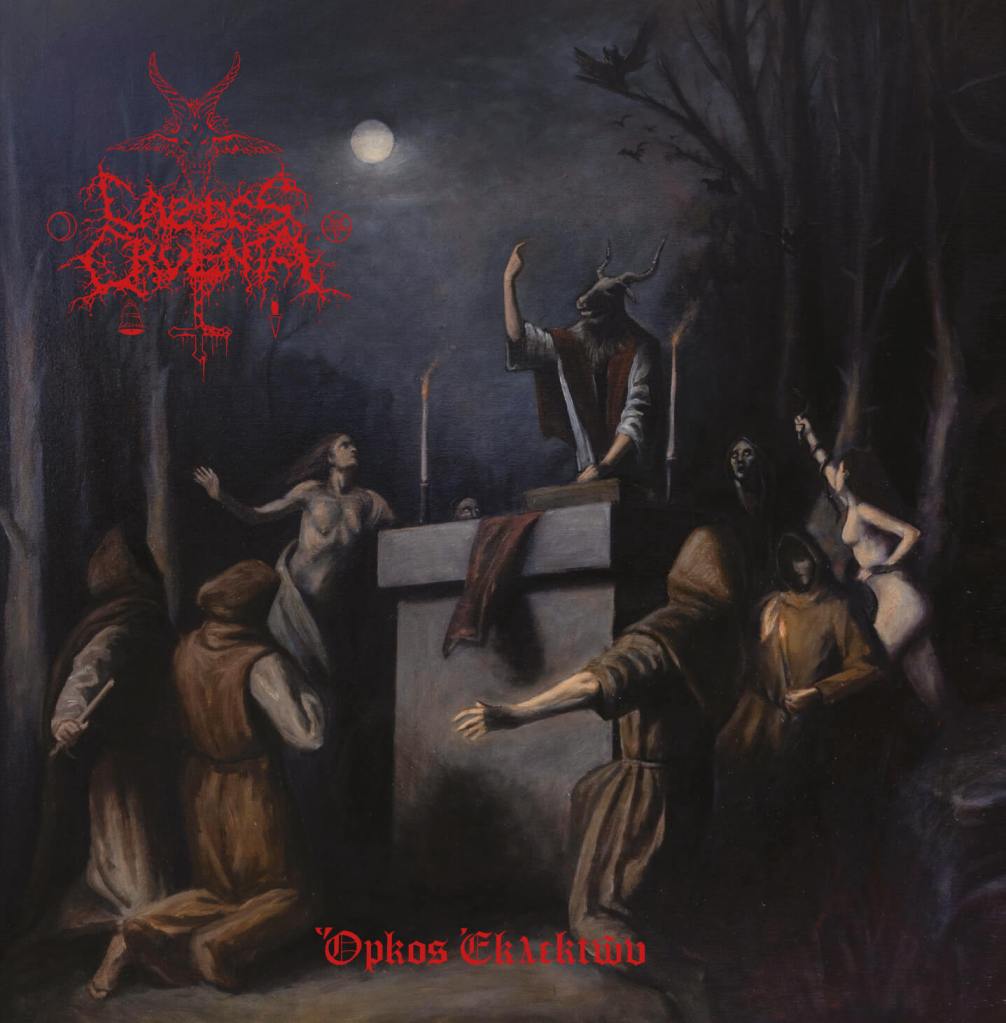
The contemporary crop of “Hellenic” black metal is prone to flamboyantly theatrical outbursts, something that Caedes Cruenta aren’t immune to. But here this impulse is tempered with gradations of focus that can only come from solid riffcraft despite the bloated length of this album. On that, ‘ Ὅρκος ἐκλεκτῶν’ is arguably too long to digest in one sitting, and is perhaps better treated as a broad survey, a literary review of the current landscape not to be absorbed in its totality. It treats dirty occultist metal as a piece of software, studying how it behaves when installed onto the differing hardware of thrash, heavy, black, and death metal. This allows Caedes Cruenta to explore their sound from diverse angles and contexts. All of which is bookended by a spread of interludes ranging from minimal dark ambient to fully fleshed out instrumental darkwave pieces which act as triangulation points across this significant work.
The production is warm and organic but lacks the clunky charm of early Rotting Christ. The guitar tone and drums appear deeply embedded in each other’s aesthetic, emphasising a form of metal that is at once immediate, spontaneous, and human, yet emboldened by a more spiritual, aspirational, and undeniably epic ambition (in the literal sense of the term). Keyboards function as a bonding agent, cementing the raw organicism of the traditional metal segments with the heady esotericism to be found at the macro level. They allow the guitars to take centre stage, the mix giving full voice to the technically modest yet richly realised riffs, the additional brushwork of chaotic guitar solos adopts the warlike stance of early Bathory as if to imbue the material with a grounded physicality.
There is a dramatic contrast between motion and stasis expressed across ‘ Ὅρκος ἐκλεκτῶν’. It is perhaps worth exploring it in episodic form in light of the extent of material on offer here. Chapters feed into one another but will invariably offer a striking juxtaposition of moods despite the journey undertaken throughout, something that stands out far more than the gentle marriage between various traditions and techniques at work across this album. Extended metallic passages fashion a typography of melodic expressions, at times optimistic to the point of euphoric, emboldened by the persistently galloping drum patterns. But these will invariably give rise to periods of quiet reflection. Sometimes through techniques traditional to metal, dropping the tempo to allow for the expansion of a particular theme as it branches out into multiple directions only to be brought to an incidental finale via brief lead material. Other times the music brings itself to a near total stop, the urgency and thrum of the battlefield giving way to a moment of profound reflection, drums cut out and the timbral palette is widened by acoustic guitars, bells, pianos, and a range of synth string textures that create a low, meditative atmosphere, fixing the listener in place after the excessive motion of the previous passage.
Greek black metal in its heyday was admirable for taking the primal energy of its Nordic counterpart into a brighter direction replete with a sense of adventure and arcane energy via its striking use of melodicism as much as its rampant histrionics. But as the originators of this style fell away or dramatically shifted gear it failed to renew itself, and was thus, despite the greater degree of musicality across its formative works by extreme metal standards, confined to a rather limited package of ideas. As a result, for the longest time it has been relegated to pastiche fodder with no sign of development in sight. In this context, ‘ Ὅρκος ἐκλεκτῶν’ represents something of a provocation. A bloated yet ambitious attempt to inject the style with a degree of ambition, broadening its horizons and daring it to build upon foundations laid over three decades ago.


Leave a Reply