The dark satanic content mills vs. Angine de Poitrine
Never try to go viral. There’s a unique embarrassment that comes with trying to go virality. The kind reserved for TV ads that appropriate internet meme culture. An abyssal exercise in the pathetic stemming from the fact that virality, by its very nature, is a freak of circumstance, grabbing our attention with unfiltered abandon. An accidental one liner captured on TikTok that somehow cuts to the core of the popular mood. This is distinct from popularity. Pop music, for example, is designed to be popular in the traditional sense. Top down by nature, orchestrated, financially backed. Pop music attempts to be part of the scenery whilst simultaneously groping for attention. The procedural sequencing of a release schedule replete with PR campaigns, interviews, and media backed hype is mundane, part of the furniture. We regard it with all the curiosity of a plane passing overhead. Virality, by contrast, is a proverbial flying pig.
Virality is immediately followed by a feeding frenzy of parasitic content. Orbital platforms begin piggybacking on the moment, desperately harvesting stray clicks. This turns large swathes of the online ecosystem into a mangle, squeezing every last drop of cultural significance out of things like the Hawk Tuah girl. It’s an undignified, demoralising slog. As a result, there is nothing the content creator craves more than the black swan event of a viral moment with nuance. And for the musical branch of the online influencer complex that’s precisely what they got with Angine de Poitrine’s performance on KEXP. Theirs was an anomalous virality. This was no mere vox pop or comedy skit punted into the algorithmic headwinds at random, this was rich in sonic and visual information, this had layers. Strap in lads, there’s theory in them there hills.
Angine de Poitrine didn’t get popular, they went viral in that neither they nor anyone else had control over the narrative for a time. This meant that the plebiscite was suddenly exposed to the concept of microtones, time signatures, and loop pedals with no framework to interpret what they were seeing. It was quite literally a virus unleashed into the population. Exposing the drooling masses to music outside of the twelve tone, 4/4 paradigm was like introducing pigs to an island of ground nesting birds. They had no means of defence against it. And sure enough an insufferable wave of hype bubbled up beneath Angine de Poitrine’s feet. It was a musical transmission from another planet. A bold statement of human ingenuity in defiance of AI slop. A revolution for guitar music. A mesmerising showcase of musicality and showmanship.
For the aristocracy of online music influencers, such hyperbole will simply not do. For them, the walls separating popular and alternative music had been breached without their permission. A demon from the experimental netherrealm was suddenly at large, terrorising a general public unable to understand what they were seeing. And sure enough, in response the cogs within the dark satanic content mills ground into gear. A slew of takes, explainers, and reactions were thrown out in a desperate attempt to seize the narrative around Angine de Poitrine.
But being a musical content creator is a delicate balance. They are, in some sense, elite, in that they have mastered the arcane ways of music theory. But in their capacity as content creators they are also populists, driven by the need for clicks and exposure, alive to online trends and the sensibilities of their audience. As a result, the output of music content creators is a bizarre cocktail of superiority and contrition. They must pay respect to the fickle whims of their audience whilst simultaneously imparting their specialist wisdom. Every single piece on Angine de Poitrine must pay them tribute, before going on to explain how the tropes they have popularised are actually commonplace, trite even.
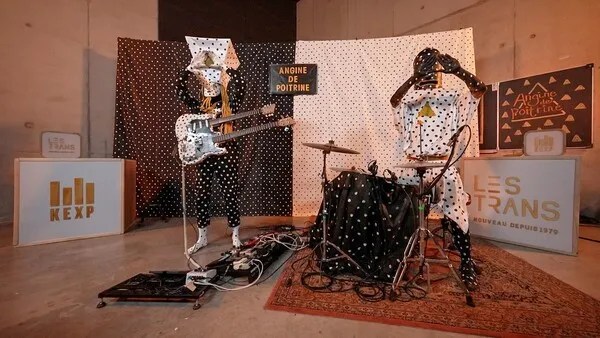
This is the Saint Vitus dance of the music YouTuber. Give Angine de Poitrine their flowers whilst explaining that microtones, loop peddles, and time signatures are all very much precedented. Rate Your Music nerds were racing to summon King Gizzard (no?), Primus, King Crimson, anything to provide some context (I humbly submit Queens of the Stone Age’s ‘These aren’t the Droids you’re Looking For’ for consideration). Sure it’s great that something like Angine has broken out, but isn’t this just a sign of a general public in dire need of more and better music taste? Notably Antony Fantano could barely disguise his bitterness in playing catchup with this particular trend, throwing Angine’s new album a non-committal seven out of ten in an awkwardly tardy review.
Worst in this genre of content creation are the music theorists. For them, Angine de Poitrine is pure, obnoxious red meat. They’ve been waiting years for something like this. Something both viral and embedded in their specialism, the g-spot in their Venn diagram. They’ll waste days debating the modes, keys, time signatures, and whatever else they can mine from something like Angine de Poitrine, all the while forgetting that music theory, much like economics, is completely made up. This doesn’t mean it has no utility. But it’s a utility entirely contingent on abstractions. When music theory is called upon to explain culture, which it all too often is, it collapses into sophistry. Music theory can explain everything about Angine de Poitrine except why this band went viral at this moment when countless equivalent experimental/alternative acts languish in obscurity.
The modes, conventions, intervals, numbers, and precedents of music theory are phantasms, they have no reality beyond the realm of manuscript paper and instrumental mechanics. If required to explain a phenomenon sweeping through culture they all but dissolve. Music theory can explain the what of Angine de Poitrine, but remains utterly blind as to the why, when, and how of their virality. This is because music theory’s explanatory power is limited to a very specific field, and even within this field it can barely maintain an internal consistency. The high priests of music content creation remain so embedded in theory that their output wallows in this sophistry, however entertaining it may be. Music theory does not understand art. For that you need a musician. Someone able to recruit theory whilst subordinating it to an artistic impulse.
And this is essentially what Angine de Poitrine have done. There are plenty of artists who are more theoretically interesting. But none of them enjoyed the same luck (or exploited a bit of dress up). To draw an analogy with a sphere I know nothing about, it’s a little bit like high fashion and street fashion. The former is lavish, outrageous, bold, and impractical by design, but ideas and concepts from high fashion often find their way onto the highstreet. Experimental music, and we’ll use the term to loosely refer to any music written with no regard for popularity, is not pleasant to listen to. It too is impractical by design. Experiments by their very nature often fail. They are a bet. And even if they succeed there is data to crunch and interpret before the results can be released into the wild. That’s where pop music comes in. Sure a lot of pop music is written with nothing but naked cynicism. But some, arguably the best, manages to digest experimental ideas into something fun, dynamic, pleasant, something fit for mass consumption, the audience often unawares of its heady lineage.
The problem with Angine de Poitrine is that they bypassed this process on several different fronts. Firstly, there’s the virality of it all. Their fame is essentially the result of a single video, not the result of some protracted PR campaign. But more importantly the video was a thirty minute live performance. Meaning it was a virality that came with a side of authenticity and was all the more potent for the fact. Secondly, they are clearly not trying to write pop music in any conventional sense. It eschews too many of pop’s norms. It’s instrumental. It’s complex and wants you to know it. It behaves like musician’s music. Despite this it still has the gall to be genuinely catchy. The layperson can clearly follow it. But, and again precisely because of its virality, the pleb had no means of understanding Angine in context, there was no official narrative behind them, so they appeared as completely original and unprecedented, hence the sense of panic that spread across a web of musical content creators.
From the many, all too many, reviews and comment pieces I have digested on this band, the “correct” take amongst the influencer caste seems to be settling on a “they are cool but not unique” aloofness. Producing Angine content as a music influencer requires you to signal your awareness of the theory and ancestry behind them, but avoid open contrarianism, lest the audience sniff elitism and turn on you. A measured, sensible, and completely incorrect stance in my view. It’s probably a little predictable that died in the wool music fans north of 35 are rushing to signal their apathy toward Angine de Poitrine because they weren’t first to the party. They broke from containment into commercial success without our say so. But for my money, the fascinating thing about this band is how they have revealed an inability to understand our own cultural moment endemic in the very people that claim to explain things online. It should not be forgotten that we are in the midst of a moral and social panic. The stakes are nothing short of the possibility of music itself. Music as we know it faces a near existential threat. That an artist by means fair or foul has suddenly emerged that fulfils multiple requirements at once – is a) musical, b) complex, c) accessible – is the exact thing online music communities have been begging for. It goes against every fibre of my being to argue in favour of such reckless hype and hyperbole, but I can’t help but acknowledge that in this instance it may be the cattle prod in the side we needed, reminding us that things can still happen, things that appear organic, sincere, widespread, and genuinely exciting.
 Hate Meditations
Leave a comment