Overspace and Supertime
Out 27th February on Metal Blade Records
It’s been a slow rise for Leeds’s own Cryptic Shift. From clunky sci-fi thrash beginnings in the early 2010s to emerging as local scene darlings by the end of the decade. They were perhaps about to break into international renown by the time their debut dropped in 2020 had not a global pandemic hampered their momentum. But ‘Visitations from Enceladus’ nevertheless rose to the top as one of the better remembered albums of that year, and they were soon regarded as the flagship of UK death metal at large. As the world opened up their attentions turned to their other project Slimelord, whose debut album ‘Chytridiomycosis Relinquished’ dropped in 2023 along with a host of live appearances. All of which has meant we’ve had to wait until 2026 to see how Cryptic Shift would approach the difficult second album.
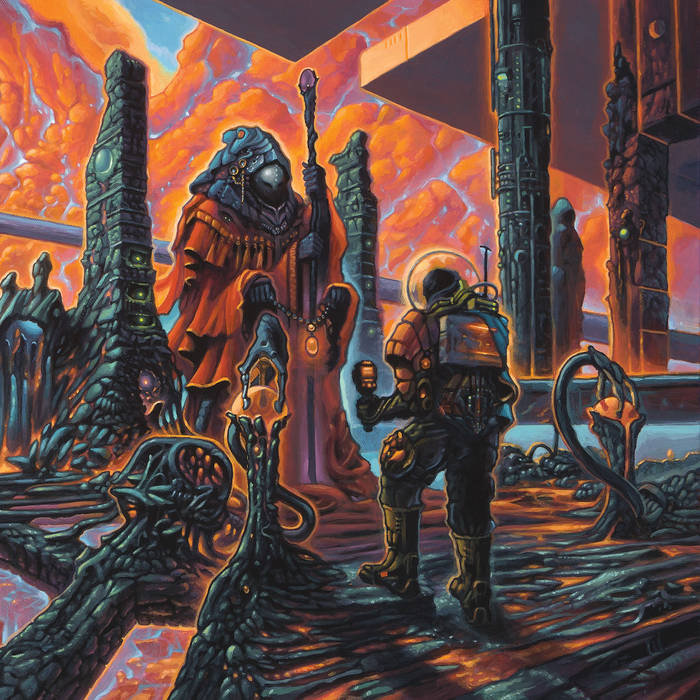
They are nothing if not ambitious. Graduating to Metal Blade has afforded them the chance to really spread their wings in the studio. And in the gap since the debut their musicianship as developed even further, as a wealth of material is lobbed at the listener from a range of genres and styles. Helmsman Xander Bradley remains the standout here, as he pushes his previously solid vocals into new and eccentric territory, all whilst bringing his three dimensional guitar work to bear alongside Joss Farrington. His long time ally Ryan Sheperson, whilst a solid drummer, was perhaps the weakest link in the evolution away from thrash, struggling to elevate himself beyond a solid but linear metal drummer into the breathable, fluid pacing required of progressive music. Whilst he’s still no Bill Bruford, his chops now match Riley’s ever impressive bass work and begin to interject with their opinions, defining rather than merely framing the music.
Having produced an album approaching an hour and twenty in length consisting of five lengthy tomes, the first thing that becomes apparent is the sway their high concept space opera material holds over the structure and pacing of the music itself. Each piece has an episodic flow, at times only occasionally referencing death metal when not indulging in Alan Holdsworth-esque tangents. As a death metal album this offers none of the coherence or flow one would expect (even from the playlist metal of scene darlings Blood Incantation), despite the obvious DNA stuffed into a good chunk of the riffs, from Atheist at their wildest to the genre’s earliest thrash rudiments.
But it’s clear that Cryptic Shift’s relentless passion for lifting and shifting sci-fi narratives into their beloved death metal is an order of magnitude above the precedents in a Nocturnus or Voivod. And in doing so they are beginning to move the dial of what we should expect from ostensibly death metal bands. Each lengthy track is structured like a cluster of chapters in a book, the fully scoped out concept material putting meat on the bones, as riffs, refrains, and themes return like leitmotifs in an opera, signalling narrative shifts as stakes rise and fall, and themes oscillate back and forth with abandon.
Jazz, doom metal, progressive metal, and even some playful punk iterations, all are paced out more like a piece of theatre than truly avant-garde death metal in the vein of Gorguts. For that reason, even listeners well accustomed to death metal at its most hair brained may find this a jarring experience. This is not a simple case of another death metal band drawing liberally from 70s progressive rock, but rather a full blooded progressive album only incrementally expressing itself through the vocabulary of death metal. The disjointed, episodic, cosmopolitanism is closer in spirit to something like ‘Close to the Edge’ than ‘Spheres’.
This also comes from the degree of fusion on display. An ambition not just musical or conceptual, but curatorial, as the musicians challenge themselves with marshalling these disparate elements and influences into a coherent musical statement. And whilst it’s not coherent by the standards of death metal, the degree of eclecticism, of freeform pacing contrasted with rigid structuralism, of melding metal elements even tighter onto jazz, it becomes quite clear that we have not yet heard anything quite like this. Each individual element, theoretically incongruous, makes for happy bedfellows on ‘Overspace and Supertime’, riffs befitting an early Master album prop up opulent chord work that could have easily been written by Robert Fripp.
In its bombast, unapologetic extravagance, the sheer calorie count of the experience, it will leave some fans behind. If for no other reason than the unfiltered gaucheness of it all. To that extent this album probably shouldn’t be regarded as death metal in the strictest sense but progressive music proper. A less formal but no less ambitious work attempting to marry a wealth of musical technique to its sophisticated conceptual material, and in the process writing the closest equivalent to a metal opera.
 Hate Meditations
I did not like this record at all. Great progressive rock, even at its craziest, never went for this “collage of moments” approach, Close to the Edge is expansive and broad but also cohesive, logical, well paced. This record, at least on the first couple of listens, is none of that. I will listen a few more times only because I respect your opinion deeply, but it was massively disappointing for me.
LikeLike
close to the edge lol
thanks gran
LikeLike
They sure can play their instruments but their composition is dog shit. Like any modern tech/progressive thing there is a million different ideas in here which results in tracks having no individual identity. As such the album blurs into nothingness and repetitive tedium over the course of near 80 minutes. Sometimes they so struggle to join ideas together they revert to near silence just so they can introduce a new totally unrelated idea. Sure it is better than last Blood Incantatiom but that doesn’t make it any more enjoyable. The one thing the old prog death bands ala Death, Atheist, early PestiIlence, Nocturnus and even Edge of Sanity did was write discernible songs that stood out and effectively communicated different ideas and even moods. Theae guys could learn a thing or two from the old masters.
LikeLike
This kicks ass!
LikeLike