Careful what you wish for
Following a turbulent start to the year, the constant rain finally relented this week and I got to see the sun for the first time in 2026, but this was conditioned on the temperatures once again dropping below zero. Despite the challenges, I’m determined to attack 2026 with gusto, stubbornly immersing myself in the latest releases on offer. When not listening to material for review I have been pouring over my best-of lists from the last five years and collating the artists in need of a closer look. The equal and opposite reaction to this impulse being a heavy dose of the familiar. When not on new music watch I’ve found myself falling even deeper into the classics, as if hoping to reawaken the muscle memory required for this sort of listening.
So, a little counter intuitively, rather than take a break from black metal and nudge at my horizons, I’ve decided to look it dead in the face with a reappraisal of classic era Darkthrone. Cryptopsy’s recent return to the fray and the pending anniversary of ‘None so Vile’ prompted me to re-inspect this death metal milestone. And finally a favourite closer to home in A Forest of Stars, a rare success story in the otherwise chalk and cheese marriage of black metal and English sensibilities, and an artist I’ve been following closely since at least the release of their second album ‘Opportunistic Thieves of Spring’ back in 2010.
Darkthrone are by far the most universally recognised standard within black metal, the benchmark and most obvious influence on a huge pool of artists both old and new. The long shadow of their so called black metal trilogy continues to all but define the modern genre. But as with a tree one passes every day on the way to work, it’s sometimes worth stopping to scrutinise it more thoroughly, to look at it anew. ‘Under a Funeral Moon’ is perhaps the toughest nut to crack of their back metal era, but is arguably the Platonic form of the genre to some extent, the image most people will conjure in their mind whenever black metal comes up.
It lacks the dramatic flamboyance of its predecessor ‘A Blaze in the Northern Sky’, along with the latent death metal riffing, a legacy not yet fully flushed out of their system by 1992. But for a wider audience the objectively more abrasive ‘Transylvanian Hunger’ continues to receive all the accolades for its trancelike, ambient pacing. Features that are somewhat anomalous in the Darkthrone discography, resulting in part from Varg’s proximity to the writing process, having furnished them with some of the lyrics. ‘Under a Funeral Moon’ by comparison, remains somehow more impenetrable for fans unaccustomed to black metal.
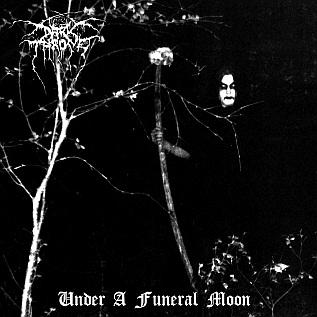
Sandwiched between these two more characterful offerings, it is easy to overlook. So this last week I’ve taken it upon myself to pay it closer scrutiny. This is partly because I’ve consumed so many contemporary albums feeding off its legacy since the last time I studied this source material. I wanted to gauge my response given what I know now, having subjected myself to the millions of imitators that have come and gone over the years (Nargaroth, Judas Iscariot, and Taake being the merest tip of a very large iceberg).
I think the conclusion I’m building towards is that this a litmus test album. To nurture an appreciation for it is to understand the very essence of Nordic black metal. The concoction of its key first wave antecedents in Bathory and Celtic Frost. The simple yet purposeful riffing. The loose, swaggering rhythms. The fact that the production is both bad and completely without character or atmosphere, which means the music comes across as somewhat naked. There is nowhere for the writing and arrangements to hide. And indeed the listener is given nothing by which to filter the raw sound of the album through beyond the tinny, building-site mix. The album’s icy, nightmarish disposition arising from the mechanics of the compositions themselves performed by musicians orders of magnitude above the capabilities required to deliver this austere material.
This last feature also goes some way to explaining my other litmus test for this style of black metal, how much the artist can communicate through very limited raw materials. Add Burzum’s ‘Filosofem’ as another benchmark for similar reasons. Compare this with death metal, which tends toward maximalism, and challenges itself to curate an excess of material into coherent thematic statements on the borders of chaos. Black metal in this style by contrast reaches beyond its rather basic component parts to communicate on a pre-conscious level.
It is remarkable how much Darkthrone of this time could get from 4/4 rhythms and two chord riffs, with only the slightest variations required to add an element of grandeur, of gravitas. Much like a walk in the woods on a cold night, it feels dangerous yet ripe with possibility, primal yet intentional, comforting yet tense. ‘Under a Funeral Moon’ provokes a heightened sense of awareness in contrast to the hypnotic sensory deprivation of its meditative follow up. It is, like all the output of their fellow Norwegians at this time, a good all rounder. But unlike their contemporaries, it maintains this status despite being imitated on a scale exponentially more intense in the decades since its release. So despite the fact that ‘Under a Funeral Moon’ is just part of the furniture for black metal fans now, and in spite of the sheer weight of imitations on offer, this album continues to offer new insights. There are still new and rewarding ways to approach it, something that separates merely great art from the genre defining.
Cryptopsy have been in the air again with the 30th anniversary of their second outing ‘None so Vile’, with a sudden uptick in reviews and revisits across the airwaves, so why not add to the noise? As far as technical death metal is concerned, this album is an important counterweight within this style, providing an alternative interpretation to the rigid structuralism of Suffocation, the bright revelations of Atheist, and the flamboyant percussive approach of Gorguts.
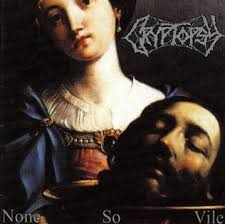
It takes the style’s angular machinations into a more spontaneous, freeform place thanks to a rhythm section steeped in jazz techniques. But more importantly, the album manages to pack a breadth of emotional and thematic range into its trim runtime. A visceral, calculating darkness sits happily alongside an amoral, animalistic aggression, each one playing off the other as the sheer physicality of the rhythmic punches gives way to flowing melodic material mutated from earlier heavy metal influences.
The drums adopt a playful, off kilter approach, often times deliberately slipping out of the pocket as if to unsettle the guitars mid-breakdown. Equally, they often speed up mid blast-beat, thus heightening the intensity and tension. The rubato approach to tempo is rare within metal, especially death metal. For anyone used to the precision timing of brutal death metal this makes for an interesting contrast, as if we are looking at a familiar face as minor details gradually morph and decay into an unknown effigy. Simply experiencing the album is an all out, razor sharp assault on the ears. This comes from the explicit grindcore influence in Cryptopsy lacking in some of their peers. But despite this, they maintain plenty of space for slower, calculating passages of malevolence. It’s the deployment of these atypical techniques for technical death metal, alongside the distinctive melodic barrages that assault the rampant chromaticism with a clear emotive intent that sets this album apart as a technical feat. But above this it is also a rumination on the horrific, both in the traditional gothic sense of the word and in a more primal, indifferently violent manner.
Lastly a look closer to home. A Forest of Stars from my native Yorkshire fulfil many roles in my musical diet. A touch of localism. A Victoriana aesthetic and artistic package that on paper is very hard to swallow but frequently slips down the gullet regardless. And on a rather personal level I find them oddly comforting, and were one of the few metal bands I could face listening to during my brief hiatus from the genre last summer. I think this is simply the fact that there is a whole smorgasbord of culture on offer across each of their weighty albums, which, if nothing else, is always distracting. They also have a long overdue album on the way this May.
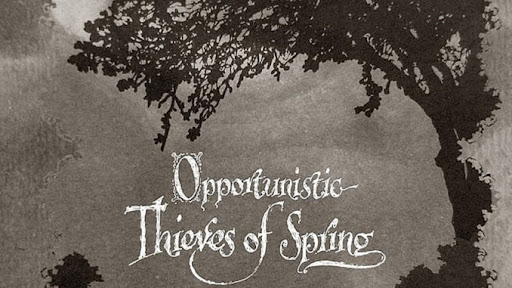
Their second album ‘Opportunistic Thieves of Spring’ is easy to overlook. It straddles the depressive folk and avant-garde black metal of their debut ‘Corpse of Rebirth’ and the more flamboyant, progressive psychedelia of their later period. But over the years I’ve come to regard it as their most fully realised album, and probably the one I would recommend to any preprogrammed black metal fans new to this artist. This is A Forest of Stars at their most longform. There is none of the impatience and cacophonous flurry of activity of their later works. But it remains an oddly chimerical experience.
Tonally it feels like depressive black metal, but there is a greater degree of activism and intentionality underpinning the music. Folk flourishes, most obviously articulated through the frequent violins and flutes cropping up like returning characters, combined with dark, understated black metal traversing the borders of atmospheric ambience alongside subtle progressive iterations. Distant, despairing vocals appear as a kind of evangelical harbinger. The guy on the street wearing a “the end is nigh” sign, crooning his message with a persistence bordering on prescience. Here somewhat restrained compared to the lengthy spoken word poetry permeating later albums.
‘Opportunistic Thieves of Spring’ also comes across as a more authentic iteration of the high minded Victoriana gimmick. Honky-tonk piano sits happily alongside vast celestial ruminations, melodramatic horror, histrionic proselytising on the supernatural, the occult, and the nature of being in the context of industrialism’s inevitability, science and rationality’s cold reengineering of the social strata. All expressed in this longform, patiently unfurled tapestry of musical legacies. Any hopeful tone delivered with a bittersweet caveat before plunging into deeper threads of irredeemable dread. A subtly implied yet thick cultural brew that, despite the rich level of detail, would be more obviously spelt out on a subsequent releases.
 Hate Meditations
Leave a comment