Understanding Sacramentum
I was as shocked as anyone to hear of the tragic passing of Nisse Karlén. Sacramentum were a very formative band in the development of my taste. I was lucky enough to catch them at the London Deathfest in 2022, and was looking forward to seeing them at Cosmic Void Festival in just a few weeks. Naturally, Karlén’s suicide has prompted a reappraisal of Sacramentum, an entity born of his longstanding partnership with guitarist Anders Brolycke.
The Stockholm and Gothenburg scenes have produced many giants of extreme metal whose reputation today extends well beyond the underground, Dissection, At the Gates, In Flames, and Entombed to name a few. Amongst such pedigree, Sacramentum were often regarded as a second or even third order operation. Comparisons to Dissection are perhaps a little tired by this point, but it continues to be an instructive lens to view not just the differing approach of each artist but the interesting divergent and convergent routes death and black metal took throughout the 90s.
The arc of 90s extreme metal is particularly visible in the Swedish scene, thanks in part to its explicit retention of a heavy metal influence throughout the decade. American death metal is in many ways a mutation of thrash. One that had, by around 1992, reengineered itself at the architectural level into a rhythmically multidimensional, amoral entity. Any continuity it holds with thrash is traceable only at the aesthetic level. Its evolution was conducted largely at the mechanical level, branching into lavish and aggressive statements of superfluously complexity. The superstructure, i.e. the aesthetic elements most listeners interact with, were broadly contiguous with the 80s.
The evolution of Swedish death metal by contrast, was much less stable. It carried over the technique of d-beat, NWOBHM, and thrash, thus making these older reference points all but explicit within its canonical works. But it added new aesthetic templates to these forms, either through the distinctive buzzsaw guitar tone of the Stockholm scene, or with various elaborate melodic explorations, tending toward a direct but thrilling heavy metal assault manifesting in entities as diverse as Therion, Dismember, and Dissection, or else engaging in a co-evolution with black metal through an expansion of the breadth and depth of dark, flowing harmonies in early At the Gates and of course Sacramentum.
Sacramentum’s trajectory mimics their Norwegian counterparts. From primitive death metal to majestic black metal, only to pivot back to thrash riffs played with extreme metal pazazz by the late 90s. But these evolutions always made more logical sense in the case of Sacramentum, probably because they retained a more explicit heavy and death metal influence, maintaining an internal consistency lacking in an Emperor or Enslaved, despite the equally dramatic stylistic pivots from album to album.
Although released in 1993, ‘Sedes Impiorum’ arguably belongs to the batch of early demos that anticipated the now lauded aristocracy of second wave European extreme metal. An oddball cousin of At the Gates’s ‘Gardens of Grief’ EP, it belongs alongside Thou Shalt Suffer, Old Funeral, Nihilist, Grotesque, and the early demos of Dismember as an anticipatory offcut of extreme metal before “the great divide” between death and black metal. A haunting, clunky, unfocused fifteen minute ritual of dark metal. The unapologetically demo quality production papering over the already intricate musicianship and compositional guile.
Late to the game yet gradations of sophistication ahead of the competition, ‘Sedes Impiorum’ was also par for the course for Sacramentum. This being a habit that would lead them to be repeatedly overlooked or dismissed as an also-ran by an inattentive listener base. Similar in many ways to early At the Gates whose early efforts have only recently been reappraised for their originality.
1994’s ‘Finis Malorum’ is where we see archetypical Sacramentum emerge. Despite being their debut EP, one could make a strong argument for this being their definitive statement. The production is cleaned up, but retains a muffled, obscurantist quality that marks this out as a unique iteration of occultist black metal alongside its obvious melodic traits. Studying this material is also key to understanding how they differed from both the anthemic riffing of Dissection and the stark contouring of a Dawn or Vinterland. The layered harmonies of early NWOBHM are resituated into a black metal setting, placed into flowing harmonic passages that, whilst still fashioned from the raw material of the riff, pivot on transferences of energy and theme.
Where Dissection constructed clear, teleological dialogues through effective sequencing of riffs, Sacramentum work at the level of theme. Like concepts emerging at different times and places throughout history, a theme will pass through several permutations, with riffs simply acting as the vessel by which to convey a thematic substance, forever accompanied by footnotes of lavishly foregrounded guitar leads. Drums pivot between cascading blast-beats and a latent percussive energy, undergirding the music with the threat of violence and creating a clear connection between this fundamentally black metal statement with its foundations in death metal.
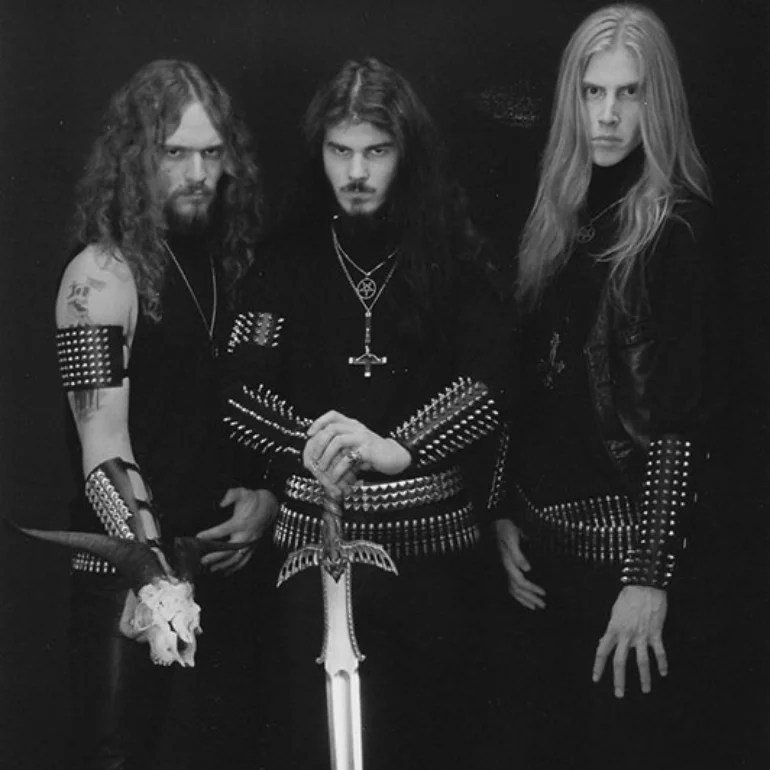
But ultimately, it is the sense of ritualistic occasion, the nocturnal revelry that burns brightest across this material. Both features – albeit abstract ones – that would become mainstays in the Sacramentum formula, and what sets them apart from being “just another” blackened death metal outfit. As Karlén himself explained in an interview given to Necropolis back in 2023, although he loved a lot of early death metal, much like his Norwegian counterparts he always felt that the music did not go deep enough. But unlike his Norwegian counterparts, and indeed his countrymen in the likes of Marduk or Dark Funeral, there is a reserved dignity to the music of Sacramentum despite the emotive intensity. It brings to bear the orchestral majesty of dark extreme metal at its most ambitious without ever giving the listener cause to back away from the music, to self-consciously brush themselves off and acknowledge that it’s all a bit silly, inserting words like comedy, irony, or “over the top” between themselves and the raw immediacy of the experience.
Signposting significance is an underrated facet of black metal composition. Which moments are pivotal to the musical statement, which moments are expositional or preparatory. The intense nature of the genre makes finding a balance between these elements a challenge. Placement and flow within a piece are every bit as important as substance. Overwork a finale and it will feel contrived, fail to prepare for it and it feels unearned. Sacramentum bypass these common pitfalls by creating a sense of flow and balance. Each moment is imbued with gravitas, it feels significant, but the intensity will subtly shift as a piece develops and themes shift their weight from one segment to the next, only to open out into expansive spaces in a manner similar to Romantic era symphonies, carrying forward themes in new contexts, like a landslide down a mountain building momentum and excess material as it cascades. Contrast a track like ‘Travel With the Northern Winds’ and its shifting permutations of energy, aggression, urgency, and reflection with the satisfying but ultimately one way traffic of ‘The Somberlain’, which orientates its entire flow around one inevitable anthemic goal. Nothing feels inevitable in Sacramentum, possibilities continue to unfurl as material compounds on itself to the point of blind euphoria.
‘Far Away From the Sun’ approached this technique from a different angle. In a sense, ‘Finis Malorum’ was baroque era Sacramentum, containing within it a wealth of polyphony and counterpoint. The first inroad to full length territory with ‘Far Away From the Sun’ saw the same ethos evolve into the classical and Romantic era through a version of high symphonics explored purely through multiple layers of legato guitar harmonies and more streamlined, fluid drum patterns. Dismissed at the time as “just another” version of Swedish melodic black/death metal, it has since been reappraised as a watermark of the genre.
Achieving something similar to Emperor on ‘In the Nightside Eclipse’ sans keyboards, it makes for the perfect companion to that album. Both are similar for their leveraging of the aesthetic of night, their sense of occasion, and obvious technical similarities through their use of flowing waves of harmonic guitar lines. Yet whilst ‘Far Away From the Sun’ is every bit as dark, mournful, and dramatic, it manages to contain gradations of hope and even bright euphoria at pivotal moments, shedding the gothic revelries of Emperor. Not least on the opener ‘Fog’s Kiss’, a masterstroke of incremental narrative development, but also on ‘Blood Shall be Spilled’ and also (rather ironically) on ‘Obsolete Tears’. It’s a subdued, muted hope, running more as a transference of energy between individual refrains and themes. In this regard the hope of Sacramentum is far more rewarding than the trite brightness common to many iterations of contemporary post metal.
Despite their presence in abundance, studying this album through the lens of the riff does not provide a suitable analytical framework. Rather, each track can be broken down into three or four chapters, identifiable through a clearly communicated mood or energy. The evolution of the narrative from one to the next is dramatic yet natural, developing the preceding themes whilst adding stark shifts in tone or intensity. Like a new generation absorbing the intellectual legacy of their forebears. It transcends the raw materials of sequenced riffs, such is Sacramentum’s ability to carry the listener through this narrative journey. Much like one forgets about the individual words when reading a novel, the content flows out of its component parts like magic from an incantation.
From this angle, ‘The Coming of Chaos’ released the following year in 1997 looks like a demotion. And taken as a whole it is true that this feels much closer to standard Swedish blackened melodeath fodder. Squint and you’re listener to ‘Storm of Lights Bane’ or even the downgraded At the Gates of the same era. But there remains a gravitas and pin sharp intentionality to these compositions that continued to mark Sacramentum out from the pack.
The distinctive harmonic manipulation is present and correct. The unusual flow to the thematic material, giving the music an intense ambience over and above the raw energy at the mechanical level also reports for duty. So why does it feel so different?
Fundamentally this is the same entity exploring itself through a different stylistic lens. The stream of heavy metal informed black metal energy has been replaced by Kreator riffs brought into sharp relief through an elevated melodic language. Melodic death metal stands in for the latent symphonic topography of ‘Far Away From the Sun’, making ‘The Coming of Chaos’ a more violent, choppy, anarchic affair. But step back from the immediate experience and one finds a beast every bit as meditative and considered. Sacramentum have simply chosen a more frenetic language through which to communicate their intentions.
Listening back to Karlén’s interview for Necropolis, he also discusses his issues with the original mix. The lead melodies were submerged beneath the rhythm guitar and drums, making for an imbalanced, murky final cut that he did not recognise as the music they had composed. In 2023 the album was remixed and remastered on Century Media, revealing the original vision conjured by Karlén and Brolycke. Listening back over this reissue next to the original certainly does bring to the fore the intricacy of this material. In some ways reaching back to the baroque of ‘Finis Malorum’, but still informed by the careless bombast of mid-90s Scandinavian death metal. A superficially generic album that only gives up its treasures – a detailed project of world building – on repeated listens.
Lastly we come to ‘Thy Black Destiny’, released in 1999. By this point the likes of Immortal and Emperor had returned to their childhood by different roads. Immortal taking a more direct route through a concoction of thrashing energy and epic heavy metal affectations. Emperor through a more explicit death metal influence supplemented by progressive rock, and the nods to Bathory or Mercyful Fate littering an album like ‘IX Equilibrium’.
Sacramentum walked a similar path. The guitars are down-tuned, the drums are more aggressive in their interventions, arresting the tempo and splitting apart the patented flow of previous material to a place of total anomie, vocals are undeniably more aggressive, as is the overall delivery. And the death metal influence, whilst perhaps no more pervasive than ‘The Coming of Chaos’ is certainly given greater emphasis. But as with everything this band does, there is more going on than meets the eye. The majority of the riffs are updated forms of Slayer or German thrash, decorated with the wears of Sacramentum’s unparalleled melodic forms. The tracks are more chaotic in their signposting. The savage grandeur of ‘Far Away From the Sun’ giving way to an atomised, polarised narrative form. Spiteful, disenchanted.
But the underlying melodic current fights its way to the surface regardless, rearing its head on tracks like ‘Overlord’ or ‘Demonaeon’. The connecting threads are harder to spot without those walls of harmonic guitar noise. These have been replaced by percussive barrages of atonal shrapnel. But the framework of coherence remains, through the all important flow of energy, here taken up chiefly by the rhythm section as it ensures the lifecycle of memetic forms through implied contouring as opposed to the explicit melodic language of earlier material. There’s no denying that this is the furthest Sacramentum strayed from their roots. But squint and one finds the same old beast exploring different guises and forms to see what may bear fruit.
It should be a cause for some celebration that Sacramentum finally started receiving their flowers in recent years. But in the Necropolis interview Karlén makes reference to having enough material for maybe another three albums. Whether these see the light of day or not, it brings me great sorrow to know he won’t live to see it. The work of Sacramentum is a unique statement of extreme metal, and I really do mean extreme metal this time. Because although they are largely understood within the death and black metal oeuvre, this material charts the evolution of extreme metal throughout its most significant decade. Their ability to retain an identity strong enough to survive such dramatic stylistic shifts is instructive for anyone wishing to understand not only the development of these forms, but how the traditions diverged and re-converged by the end of the decade. Further, how to use genre as a means to an end, the end being the communication of a vision, as opposed to letting genre norms dictate the vision itself.
But most importantly, this small collection of recorded material is a striking musical statement in its own right. Examples of metal at its most sophisticated, dramatic, powerful, reflective, and dignified.


A good retrospective that have made me re-listen to their back catalogue to see if I missed something the first time!
LikeLike