Words by Jason Kiss
The Deep
When we describe something as deep, we often imply that it goes beyond the surface and holds a kind of significance that eludes the realm of the superficial. Depth stands in opposition to shallowness and points toward a more reflective and nuanced reality than the socially accepted “truths” of mainstream society. In this regard, depth challenges convention by diverging from it in a manner that naturally becomes oppositional. What may at first seem obscure, difficult to understand, or even controversial can ultimately reveal something meaningful that lies beyond shallow mass conformity.
One example of “depth” is found in deep ecology, which is described as “above all a family of reflection whose principles are so broad that it is destined to have many sub-currents of thoughts.” [1] In this ecological context, “deep” signifies a reflective line that transcends the social approaches of mainstream environmentalist initiatives.[2] The Norwegian philosopher Arne Naess, one of the original thinkers behind deep ecology, believed that we must probe deeper and question the values of our society and develop a “total view” of ecological crises in order to truly grasp them.[3] For the deep ecologist, the degradation of the world is seen through a perspective that extends across multiple future generations, rather than being confined to the issues dominating current debates about the environment and social justice.
Like deep ecology, underground extreme metal embodies a form of depth, as it exists outside the constraints of commercialization and the shallow commodification that comes with it. This freedom from mainstream pressures allows for the expression of often unique perspectives, not unlike how deep ecology encourages a broader view beyond the arbitrary boundaries of contemporary social issues. As the only true forms of extreme metal, death metal and black metal possess a certain depth and continue to endure today, more than thirty years since their emergence.[4]
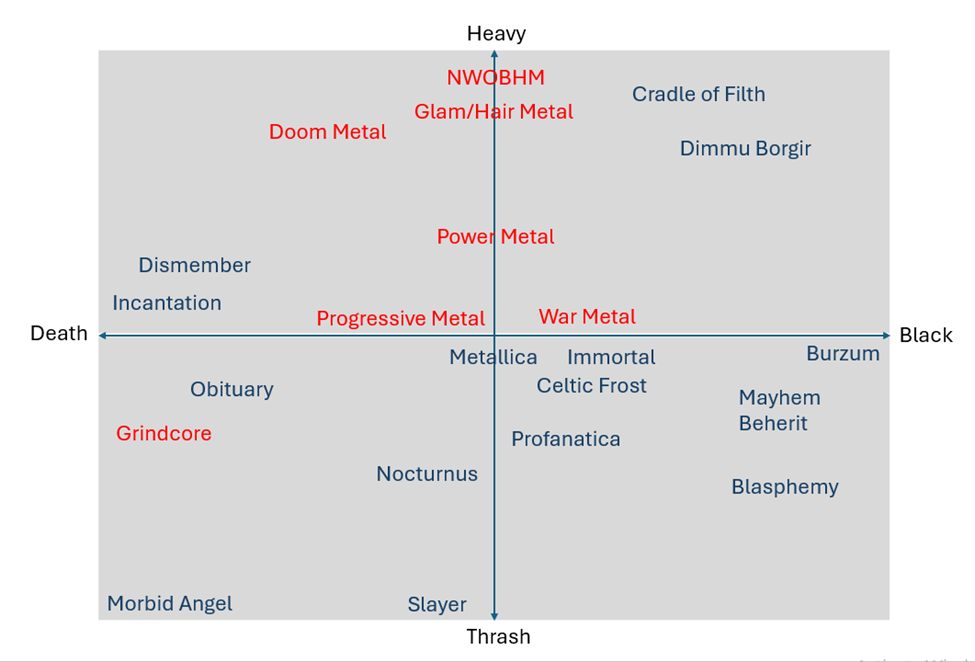
Figure 1. Reproduction of the Metal Alignment Chart from episode 90 of the Necropolis podcast. So-called “genres” are labeled in red; band names are in blue. According to the chart, there are only four true metal genres represented by their own axis positions: heavy, thrash, death, and black. All other “subgenres” are considered descriptive substyles of these primary genres. Not featured is the “rubbish bin,” which includes: slam metal, viking metal, djent, industrial metal, hardcore, metalcore, deathcore, stoner metal, nu metal, kawaii metal, gothic metal, avant-garde metal, post metal, groove metal, sludge metal, folk metal, and operatic/symphonic Metal. Grindcore is included because some bands in that genre, such as Napalm Death and Blood, have adopted, at some point, legitimate death metal styles.
The Deep Texas Extreme Metal Underground
Texas’s extreme metal underground developed in the late 1980s and early 1990s as a decentralized but very active scene, and it produced many respected death metal and black metal bands. San Antonio, Dallas, Houston, Austin, and smaller cities like New Braunfels all contributed noteworthy extreme metal bands. While Texas never developed its own regional sound like in Florida’s death metal scene and Norway’s black metal scene,[5] it remained a stronghold for extreme metal acts to thrive. Absu, from Dallas, became a household name in black metal.[6] Necrovore, from New Braunfels, released the legendary and influential demo, Divus de Mortuus, which influenced bands such as Morbid Angel[7] and Profanatica.[8] Thornspawn, originally from San Antonio and now based in El Paso, has performed across South America and Europe.[9] Imprecation and Blaspherian, both from Houston, have reached cult status internationally.[10] Alongside these bands, as well as extreme metal-adjacent thrash bands such as Rigor Mortis and Dead Horse, countless other bands helped to sustain Texan death metal and black metal in some form: Black Funeral, Divine Eve, War Master, Condemner, Averse Sefira, Hod, Plutonian Shore, Morbus 666, Adumus, Maiestas, Necrofier, Malignant Altar, Judas Goat, Gnostic, Dagon, Blasphemous Goat Vomit, Ceremony, Cleric, Nocturnal Wolf, Bael Occultus, Wyrm Chasm, Uruk, Votan, Cemetarian, Church of Disgust, Baptized By Fire, Crimson Massacre, Masochism, LaSanche, Pious Levus, Pneuma Hagion, Incest, Infernal Dominion, and Butchered Saint (later renamed Burial Shroud), just to name a few.
Moreover, the Texas metal scene once stood unmatched, with San Antonio hailed as the metal capitol of the world. From the late 1970s through the early 1990s, fans flocked to metal concerts in large numbers.[11] At the same time, a vibrant San Antonio underground scene took shape in the 1980s, as local amateur musicians formed bands and staged shows in backyards, parking lots, and other unconventional spaces.[12] This grassroots energy helped the city forge a deep identity as a major metal hub, an identity that endures to this day in some circles.
Deep Elitism
Labeling things as deep or shallow often leads to accusations of elitism. This issue arises not only in metal culture but also in environmentalist circles. Arne Naess called on deep ecologists and social ecologists such as ecofeminists to cooperate, as he viewed that the shared concern for the planet creates far more common ground than division. Because of his noted humble nature, many of his cohorts did not view him as an elitist, although critics of the deep ecology movement would certainly disagree.[13] Many people still scoff at the idea that this branch of ecology possesses greater depth than other more social approaches. Moreover, Arne Naess, like Finland’s controversial ecologist Pentti Linkola,[14] called for a drastic reduction in our numbers to help preserve nature.[15] This sentiment clearly has the potential to discomfort social ecologists who mainly focus on the epiphenomenal aspects of unbridled population growth rather than address the root causes of it.[16]
Discomfort is perhaps the most accurate word to describe the reaction many have toward views perceived as elitist, especially when those views challenge the assumptions of mainstream ethos. For people heavily conditioned by socially accepted prevailing norms, the implication that not all perspectives are equally valid can feel like a personal attack. Due to their knee-jerky reactions brought about by societal conditioning, they fail to understand that this is not elitism for its own sake but a refusal to consent to shallow interpretations that embody the so-called “wisdom of the crowd,” or what Nietzsche referred to as herd morality, which harnesses conformity, comfort, and mediocrity. Both the deep ecology movement and the deep extreme metal underground reject this shallow view of life and instead embrace a commitment to depth, as in the notion of quality against quantity (Latin: qualitas contra quantitas).
Let us now call the commitment to qualitas contra quantitas in extreme metal as “deep elitism” and embrace the deep alignment of ideology not unlike the deep ecologists do, regardless of any criticism that may arise by such a nomenclature. This is not a form of elitism based on showing off superficial encyclopedic knowledge about extreme metal, nor is it merely about collecting obscure demo recordings for the sake of championing rarity. Rather, it reflects a serious appreciation for expressions that capture the true spirit of extreme metal, which is anything but shallow. By holding on to the idealism of qualitas contra quantitas, this kind of elitism opens the way to a deeper aesthetic understanding. It welcomes expressions that may be difficult or uncomfortable but potentially reveal aesthetic truths that exist beyond what is popular.
This branch of elitism once flourished in the Texas underground. One such example known to much of the metal world is the American Nihilist Underground Society, or ANUS, now operating under the name Death Metal Underground (DMU).[17] DMU was once one of the major websites dedicated to extreme metal. Based in Houston, it provided a platform for many Texas extreme metal bands to reach a global audience. More than that, it embodied deep elitism by indorsing qualitas contra quantitas. Founded by the controversial far right writer Brett Stevens,[18] the ethos it embraced rejected the superficiality of the mainstream and instead sought a deeper loyalty with the true forms of extreme metal. This is not to suggest that all of Stevens’ readers are aligned with the far right. In fact, quite the opposite is true. The website Hate Meditations, run by Charles Shelley, a doctrinaire Marxist, expresses many of the same deep elitist sentiments found on DMU.[19]
Some of these deep elitist views can be difficult for the shallow extreme metal hobbyist to accept, as they sometimes manifest in intimidating sentiments that verge on Social Darwinism, where the Darwinian idea of those unfit to survive is applied in an abstract sense to “poseurs,” which basically means that they do not belong in the extreme metal underground because they dilute it.[20] Gatekeeping poseurs thus becomes imperative for the sustained strength of the underground. Moreover, what constitutes a poseur, in a deep elitist sense, is vast, approximating characteristics of “normies” chasing comfort and distraction, bourgeois consumers obsessed with appearance and convenience, trendy followers swept up in herd fascinations, superficial listeners who mistake outer traits for substance, reality-deniers who ignore deeper truths, vapid social climbers who use obscurity to seem wise, and self-serving individuals who adopt the aesthetics of metal while rejecting its philosophy and inner meaning.[21] All of this points to the fact that the poseur lacks a genuine commitment to qualitas contra quantitas and favors instead surface-level traits, novelty, or popularity instead of connecting with the deeper substances of extreme metal.[22]
Deep elitism is not limited to extreme metal websites like DMU and Hate Meditations. The influential figure Alan Moses, co-author of Glorious Times: A Pictorial of the Death Metal Scene (1984 to 1991), expressed similar deep elitist views. [23] However, he went even further than most deep elitists, stating that by 1993, “garbage bands” had begun to infiltrate the extreme metal underground, and the problem severely worsened by the late 2000s. In response, and aside from publishing his book on the early days of death metal, Moses chose to distance himself from the scene entirely, citing the pervasive presence of poseur bands proliferating like rabbits and the prevailing quantitas contra qualitas in the underground as the reasons for his departure.[24]
It is understandable that these deep elitist sentiments make poseurs uncomfortable. Much of the metal world holds a strong disdain for this kind of elitism, similar to the criticism often directed at the deep ecology movement. The popular website Vice once attacked black metal elitists and called them ignorant for refusing to accept the notion that Deafheaven and Liturgy are legitimate black metal bands.[25] However, the term “post black metal,” commonly used for these groups, refers to music that aligns far more with indie rock than with black metal, with black metal serving as just one of numerous influences, and a superficial construal of it at that. In fact, the bands Deafheaven and Liturgy themselves have publicly distanced their work from black metal, not because of elitist rejection, but because they don’t consider their music to be part of the black metal genre. As a result, the Vice article, written from a shallow understanding of black metal that even the featured bands disagree with, was ultimately proven wrong by the very elitists it accused of being ignorant.[26]
The Texas extreme metal underground did not remain silent when Liturgy was presented as black metal by the mainstream metal media. Jeff Tandy, a musician from the early grassroots days of the Texas underground who once covered a Madonna song in his band Averse Sefira, which was apparently a “piss-take” with limited distribution, publicly challenged Haela Ravenna Hunt-Hendrix, the main musician behind Liturgy, to a physical fight because he believed her interpretation of black metal was inauthentic.[27] While this reaction may seem immature, it reflects a deeper desire to preserve the essence of black metal. To be clear, this was not an act of transphobia, as the proposal for fisticuffs occurred before Hunt-Hendrix had formally transitioned.[28]
Another example of confrontational behavior from the Texas underground directed at the shallow nature of the mainstream metal world occurred when the band Hod from San Antonio was photographed reproaching a mural of deceased Pantera guitarist Dimebag Darrell. The photo showed two band members flipping off the mural and one member simulating urinating on it.[29] The backlash on the internet was intense, but Hod did not care. While this may seem immature, it once again underscores the desire to preserve the true essence of metal rather than follow what is trendy and popular, which Pantera certainly represents. The deep Texas extreme metal underground is known for its unapologetic rejection of the shallow mainstream and the poseurs who inhabit it.
Attrition
While metal remains a very popular genre of music even after many decades, as Teen Vogue labor union activist[30] and metal journalist Kim Kelly, also known as “Grim Kim,” once noted,[31] the issue of attrition plays a major role in the degradation of the underground, particularly in the loss of life. As prominent figures in the Texas underground pass on, such as Mike Scaccia of Rigor Mortis,[32] Wes Weaver of Blaspherian and Imprecation,[33] “Beer” of Hod,[34] as well as numerous others, their absence leaves noticeable voids in the Texas underground zeitgeist. Although younger musicians have the potential to rise and become new leaders, the current state of extreme metal is markedly different from what it was even a decade ago. Shallow interpretations now proliferate unchecked; slam death metal, so-called old school death metal revivalism (often abbreviated as OSDM), war metal, and other questionable subgenres clutter the scene and obscure the authentic expressions of the true extreme metal underground.
Perhaps the most glaring example of shallowness is slam death metal, a genre influenced by the band Suffocation[35] that prioritizes shock value over substance in an overwhelmingly narrow-minded manner.[36] Devourment from Dallas, one of the most prominent names in this subgenre, gained notoriety through provocative song titles and lyrics. Their tracks ‘Babykiller’ and ‘Anal Electrocution’ exemplifies this approach, which features graphic fantasies of sadistic violence and sexual assault designed primarily to disturb people.[37] Moreover, the emphasis on breakdowns in slam makes the music primarily percussive, much like rap, rather than following the narrative approach to riff-craft that defines true metal expression.
Another example of weak riff composition can be found in the inauthentic revival of old school death metal, OSDM. This style is typically influenced by the disjointed guitar riff structures characteristic of early to mid-period Death, with the riff salad-laden album Spiritual Healing[38] serving as perhaps the true foundational reference point, regardless of professed parallels to Timeghoul, Atheist, and so on. While the aesthetic elements of album artwork, lyrical themes, and general presentation of OSDM often align with early 1990s death metal, the music itself severely lacks coherence. Even fans within the broader extreme metal community, not just deep elitists, have noted this discrepancy.[39] Bands such as Blood Incantation and Tomb Mold are among the most prominent examples, with Gatecreeper and Frozen Soul from Texas representing another degradation, on a compositional level, of death metal. As such, the OSDM revival appears to function more as a transient trend and vibe promoted by mainstream metal media, similar to previous attempts to rebrand “post black metal” expressions as a genuine evolution of black metal.
Lastly, and perhaps most indicative of a deeper elitist discernment capable of recognizing superficiality within extreme metal, is the unraveling of war metal. While Kim Kelly once defined war metal as “a blasphemous, violent black/death metal hybrid so extremely fast, raw, and chaotic that it often borders upon grind,”[40] the foundation of this subgenre rests on two vectors that often coalesce. One vector consists of music that closely resembles grindcore and powerviolence, both of which are extreme offshoots of hardcore punk, and are represented by bands such as Revenge and Conqueror. The other source originates from an early lineage of foundational extreme metal bands that combined proto elements of what is now known as death metal and black metal, including Sarcófago, Blasphemy, Impaled Nazarene, Zyklon-B, and, to a much lesser extent, Angelcorpse, a band comically derivative of early Morbid Angel. There are, unsurprisingly, countless occurrences of war metal bands attenuating and commodifying the original spirit of this vector.
Although war metal may seem, on the surface, more authentic than both slam death metal and the revival of old school death metal, it remains burdened by an overwhelming influx of low-quality material because its artistic output prioritizes primitivism and aggression over compositional depth. Furthermore, the surrounding culture of war metal, with the vast majority of participants never having served in any military, often displays superficial tendencies similar to those found in slam death metal. However, rather than indulging in explicit fantasies of sadistic violence and sexual assault, war metal focuses on themes of warfare and satanic iconography. To those lacking critical discernment, it may appear as a legitimate fusion of death and black metal. Yet beneath the superficial layers of spikes, goats, gas masks, phallic imagery, and nuclear explosions lies a musical form more rooted in the ethos of extreme punk music than in the tradition of extreme metal.
It would be an understatement of the highest order to say that the Texas underground is oversaturated with such deficient forms of extreme metal. This oversaturation makes it increasingly difficult for those who are truly devoted to the spirit of extreme metal to find space and appreciation. As a result, newcomers are often forced to sift through a confusing array of trend-driven offshoots, with deathcore, for example, often being mistaken for death metal despite its obvious ties to hardcore,[41] and the fact that technical death metal, also known as “tek-deaf,”[42] while impressive in its displays of virtuosic dexterity, often falls apart when it comes to coherent composition.[43] Although many other superficial expressions contribute to this broader dilution, such as melodeath, groove metal, and others, along with verse-chorus song structures lifted from rock and pop music, which is antithetical to true extreme metal, the goal here is not to catalog every offender, but to draw attention to how these examples reflect the broader attrition of the essence of extreme metal.
Evidence of the attrition brought about by poseur subgenres oversaturating the underground can be seen in the failures of grassroots extreme metal festivals in Texas. While Destroying Texas Fest in Houston remains a modest annual attraction for local metalheads, festivals such as Goregrowler’s Ball,[44] organized by the late Aaron Mendiola,[45] and Rites of Darkness,[46] organized by Danny Serna, both held in San Antonio, became infamous for turning into financial disasters, with many international bands left unpaid and, in the case of one band, stranded.[47] Despite accusations of mismanagement, some would argue that if the San Antonio scene had stayed strong and concert attendance had followed, the festivals might have stood a chance to endure. As a result of these and other grassroots shortcomings, one of the biggest commercial metal festivals in the U.S., Hell’s Heroes in Houston, has moved in to fill the void. However, while a major annual Texas metal festival might seem like a positive development on paper, Hell’s Heroes has largely turned its back on the Texas underground by prioritizing international acts.[48] At least the much-maligned festivals Goregrowler’s Ball and Rites of Darkness had a better balance of Texas bands compared to international acts. Hell’s Heroes does nothing to support the Texas underground.
Inner Attrition
The aim here is not to advocate for sobriety, but rather to examine the factors that contribute to the decline of the Texas extreme metal underground. It is well-known that substance abuse is rampant in the music industry,[49] and this extends into the Texas extreme metal scene. Many musicians who die in their twenties through their forties often have no toxicology reports made public, which can lead to their untimely deaths sparking speculation about hard drug involvement, especially when the cause of death is not clearly stated; for example, a seemingly random and unexplained heart attack of a metal musician naturally raises questions about potential cocaine use.
Alcohol is the most prevalent substance in the underground, as there is usually a bar or two in the music venues, while hard drugs such as cocaine are typically kept backstage or behind the closed doors of bathroom stalls. Other than the convenient access to an abundance of alcoholic beverages, cannabis is the next most commonly encountered substance at music venues. Recent studies have indicated that prolonged cannabis use can create an illusory sense of creativity,[50] impair divergent thinking,[51] and considerably diminish cognitive sharpness over time.[52] This inner attrition is especially noticeable in older musicians who have been heavy users for much of their lives.
Social Media
It can be argued that power once resided with the bands themselves, while grassroots networks naturally formed around them. In the 1990s, as extreme metal became increasingly commodified for financial gain, that power shifted to record labels. These labels became the central force, surrounded by marketing and public relations firms, magazines, and even television programs like Headbanger’s Ball on MTV.[53] But with the rise of social media in the 2000s, the dynamics shifted once more, as social capital began to outweigh financial incentives. In this new digital environment, the underground extreme metal scene has been redesigned, with both bands and fans self-presenting and preserving idealized digital versions of themselves,[54] not unlike digital brands in ways that often resemble small businesses.[55]
The shallow craving for social capital within social media echo chambers is a vice of the weak,[56] and it is fundamentally opposed to the spirit of true extreme metal, which is by its very nature anti-social. It reflects a will to power where the weak impose a kind of ephemeral social tyranny that lacks any lasting strength.[57] In this sense, social media has become an even more destructive force against extreme metal than the commodification driven by record labels in search of profit.
Conclusion: The true death of extreme metal is in the ritual of social affirmation
In the end, the anti-anthropocentric force that once gave extreme metal its significance has been smothered to death by the shallow ritual of social affirmation. Its embrace of the harsh aspects of reality and the forces greater than the individual has been deposed. What was once indifferent to the collective gaze of the crowd now positions itself completely around it. Deep elitism, as it is correctly understood, was never about exclusion for its own sake. It was a mandate for standards, for excellence, for something higher than mere social involvement. But today, Nietzsche’s Last Man rules. He has no need for depth, no hunger for challenge. He is content with comfort and the approval of strangers on social media. In this regard, social media has done what record label commodification alone could not. It has reduced extreme metal to a superficial lifestyle accessory, a curated extension of the self, sealed within echo chambers and deprived of any power. What once demanded total commitment now asks only for social performance. Just as Zarathustra witnessed the death of “God,” we now witness the total disintegration of authentic metal values within the underground scene. What remains are people too weak to carry the weight of what this music once stood for.
Therefore, the only feasible path forward for true extreme metal is an existence on the fringes; not unlike the place Plato reserved for philosophers within democratic societies. To remain true to this path, one must leave behind all the deficiencies embraced by the poseurs of today’s extreme metal scene. The fruits of qualitas contra quantitas can only ripen away from the stifling humdrum of the inauthentic majority. It is in solitude and introspection, not in social spectacle, where the potential for excellence distills to its purest form. Only in a place further underground than the underground, in resistance to the tyranny of poseurs, can authenticity be preserved and depth be pursued without compromise.
This path forward mirrors what Ersnt Jünger referred to as the “forest passage.”[58] Our treasure chest of Being lies deep within, beyond the reach of the superficial norms and trends that dominate society’s subcultures. To live authentically is not merely a choice; it is an act of resistance that renders the rejection of poseurdom an eternal imperative.[59]
Notes
[1] Khalfaoui, Mathias. “What Is Deep Ecology? Definition, Critics, and Misunderstandings.” Earth.Org, July 25, 2023. https://earth.org/deep-ecology-an-often-misunderstood-theory.
[2] Robinson, Deena. “10 Companies Called out for Greenwashing.” Earth.Org, May 30, 2024. https://earth.org/greenwashing-companies-corporations/. Greenwashing is a superficial response to social expectations, but its actual environmental impact is minimal at best.
[3] Sessions, George. Deep Ecology for the 21st Century, 1995, p. 4-7. Shambhala.
[4] Kiss, Jason, and Charles Shelley. “Necropolis #90 – The metal alignment chart,” YouTube video. March 4, 2024, Hate Meditations, 1:37 to 2:38, https://youtu.be/UPC3rtQJm1I?si=6R9WFVeZxnXFXuSa. The full episode elaborates on why there are only four true metal genres (heavy, thrash, death, and black), the only two extreme root ones being death and black metal. All other so-called genres are considered but crumble under scrutiny.
[5] Swiniartzki, Marco. “Why Florida?: Regional Conditions and Further Development of the ‘Florida Death Metal’ Scene and the Local Public Response (1984–1994).” Journal of Popular Music Studies, 2021. https://online.ucpress.edu/jpms/article/33/3/168/118562/Why-Florida-Regional-conditions-and-further.
[6] Metal Injection. “10 Bands That Shaped the History of Black Metal.” Metal Injection, February 13, 2012. https://metalinjection.net/lists/10-bands-that-shaped-the-history-of-black-metal.
[7] Stevens, Brett. “Necrovore – Divus de Mortuus.” American Nihilist Underground Society, 2008. https://www.anus.com/zine/music/necrovore/divus_de_mortuus/.
[8] Göransson, Niklas. “Profanatica I.” Bardo Methodology, February 8, 2025. https://www.bardomethodology.com/articles/2024/10/23/profanatica-weeping-in-heaven-tormenting-holy-flesh-interview/.
[9] Teneke, Kanlı. “Thornspawn.” Extreminal Metal Magazine, November 24, 2019. https://www.extreminal.com/thornspawn/.
[10] Maarat, Daniel. “Blaspherian 2017 European Tour.” Death Metal Underground, August 3, 2007. https://www.deathmetal.org/news/blaspherian-2017-european-tour/.
[11] SBG San Antonio. “San Antonio Was Once the Heavy Metal Capital of the World.” KABB, November 1, 2018. https://foxsanantonio.com/news/our-city-our-history/san-antonio-was-once-the-heavy-metal-capital-of-the-world.
[12] Strew, Roque. “Downtown San Antonio in the 1980s Was Heavy Metal’s Eden.” VICE, July 27, 2024. https://www.vice.com/en/article/deep-dive-san-antonio-tobin-hill.
[13] Drengson, Alan. “Preface. In Selected Works of Arne Naess.” Preface. In Selected Works of Arne Naess, lxv–lxxi. the Netherlands: Springer, 2005
[14] Old Man’s Mettle. “Pentti Linkola – the Elephant in the Environmentalist’s Living Room.” Old Man’s Mettle, April 9, 2020. https://oldmansmettle.com/2019/10/06/pentti-linkola-points-out-the-environmental-elephant-in-the-living-room/.
[15] Orton, David. “Remembering Deep Ecologist Arne Naess.” Remembering deep ecologist Arne Naess, February 8, 2009. https://culturechange.org/cms/content/view/317/68/.
[16] Moody, James. “Population Is Only Part of the Environmental Impact Equation.” The Conversation, October 30, 2011. https://theconversation.com/population-is-only-part-of-the-environmental-impact-equation-4009. From the perspective of deep ecology, placing hope in affluence and technology, as outlined in the IPAT formula, creates a false sense of control. It is a view which assumes that technological progress and rising affluence can balance out the negative effects of population growth through social means. Philosophical works on technological progress such as Joseph Wood Krutch’s The Modern Temper, Jacques Ellul’s The Technological Society, Martin Heidegger’s The Question Concerning Technology, and Oswald Spengler’s Man and Technics reinforce the notion that placing hope in technology, such as with the IPAT formula, can lead to various disastrous consequences.
[17] Stevens, Brett. “Community Activism: Make Google Translate Recognize Our Motto.” Death Metal Underground, April 9, 2017. https://www.deathmetal.org/meta/community-activism-make-google-translate-recognize-our-motto/. Stevens refers to the original incarnation of DMU under the Dark Legions Archive, which was one of the main facets of the American Nihilist Underground Society.
[18] Nelson, Leah. “American Blogger Praises Oslo Shooter.” Southern Poverty Law Center, July 26, 2011. https://www.splcenter.org/resources/hatewatch/american-blogger-praises-oslo-shooter/.
[19] Shelley, Charles. “Growing up in the ANUS.” Hate Meditations, March 10, 2017. https://hatemeditations.com/2017/03/10/358/.
[20] Stevens, Brett. “Elitism Is Darwinism for Heavy Metal.” Death Metal Underground, September 15, 2015. https://www.deathmetal.org/article/elitism-is-darwinism-for-heavy-metal/.
[21] Stevens, Brett. “Celebrating the Spirit of Heavy Metal.” Death Metal Underground, June 13, 2017. https://www.deathmetal.org/article/celebrating-the-spirit-of-heavy-metal/.
[22] Stevens, Brett. “Why I Am a Douchebag Elitist.” Death Metal Underground, September 20, 2013. https://www.deathmetal.org/news/why-i-am-a-douchebag-elitist/.
[23] Kiss, Jason. “‘Glorious Times’ Co-Author Alan Moses (1968-2024).” Decibel Magazine, December 16, 2024. https://www.decibelmagazine.com/2024/12/16/glorious-times-co-author-alan-moses-1968-2024/.
[24] Devamitra, Sebastian. “Pages of Pure Fucking Damnation: Zines in the Death Metal Underground.” Death Metal Underground, July 7, 2012. https://www.deathmetal.org/zine/pages-of-pure-fucking-damnation-zines-in-the-death-metal-underground/.
[25] Bayer, Jonah. “Why Are Black Metal Fans Such Elitist Assholes?” VICE, January 21, 2014. https://www.vice.com/en/article/why-are-black-metal-fans-such-elitist-assholes/.
[26] Shelley, Charles. “Book Report: Black Metal – Evolution of the Cult.” Hate Meditations, August 1, 2024. https://hatemeditations.com/2024/08/01/book-report-black-metal-evolution-of-the-cult/. Near the bottom of the article, Liturgy and Deafheaven reject the categorization of black metal.
[27] Brooklyn Vegan. “‘Hunter Hunt-Hendrix, Come Fight Me’ Updated.” BrooklynVegan, February 8, 2012. https://www.brooklynvegan.com/hunter-hunt-hen/.
[28] Monroe, Jazz. “Liturgy’s Hunter Hunt-Hendrix Comes out as Transgender: ‘I Am a Woman.’” Pitchfork, May 12, 2020. https://pitchfork.com/news/liturgys-hunter-hunt-hendrix-comes-out-as-transgender-i-am-a-woman/.
[29] Pasbani, Robert. “New Details Surface on Alleged Dimebag Darrell Grave Desecrators.” Metal Injection, March 4, 2015. https://metalinjection.net/shocking-revelations/new-details-surface-on-alleged-dimebag-darrell-grave-desecrators.
[30] Kelly, Kim. “How Undercover Organizers Are Energizing the Labor Movement.” Teen Vogue, December 30, 2024. https://www.teenvogue.com/story/what-is-salting-organizing-tactic.
[31] Kelly, Kim. “Spotify Just Discovered That Heavy Metal Is More Popular than Pop Music.” VICE, June 1, 2015. https://www.vice.com/en/article/spotify-metal-listeners/.
[32] Prato, Greg. “Ministry Guitarist Mike Scaccia Dies after Onstage Collapse.” Rolling Stone, December 23, 2012. https://www.rollingstone.com/music/music-news/ministry-guitarist-mike-scaccia-dies-after-onstage-collapse-55540/.
[33] Stevens, Brett. “R.I.P. Wes Weaver (1972-2021).” Death Metal Underground, March 25, 2021. https://www.deathmetal.org/news/r-i-p-wes-weaver-1972-2021/.
[34] Nowlin, Sanford. “San Antonio Music Fixture ‘beer’ Left Indelible Mark on City’s Metal and Punk Scenes.” San Antonio Current, January 27, 2025. https://www.sacurrent.com/music/san-antonio-music-fixture-beer-left-indelible-mark-on-citys-metal-and-punk-scenes-36613301.
[35] The breakdown riff that begins at 2:50 in the song Liege of Inveracity from the 1991 album Effigy of the Forgotten gave rise to a legion of lowbrow imitators that brought about the slam death metal scene.
[36] Morsay. “The Slam Death Genre.” Morsay.net. Accessed April 20, 2025. https://www.morsay.net/slam. “[S]lam death metal features simpler song structures, fewer riffs, and more importance placed on rhythmic grooves and slamming breakdowns, from where the genre gets its name, than is customary in traditional death metal music.”
[37] Childers, Chad. “Why Are People Outraged over Cannibal Corpse Lyrics All of a Sudden?” Loudwire, August 7, 2024. https://loudwire.com/why-outrage-cannibal-corpse-lyrics/. Lyrics from ‘Babykiller’ and ‘Anal Electrocution’ are presented as some of the most disgusting in metal.
[38] DanielG06. “Spiritual Healing.” Spiritual Healing – Review by DanielG06 – Encyclopaedia Metallum: The Metal Archives, December 31, 2020. https://www.metal-archives.com/reviews/Death/Spiritual_Healing/602/DanielG06/953525. “Some of these songs are just ultimately disjointed and even indicate a sense of writer’s block.” Often held up as a flawless and timeless classic, Spiritual Healing by Death is compositionally confused, also known as “riff salad,” an unpopular truth echoed by people with discernment.
[39] FlightOfIcuras. “Modern OSDM Is OVERRATED (Gatecreeper, Sanguisugabogg & More!),” YouTube video. July 12, 2024, Metal Trenches, 0:11 to 0:20 https://www.youtube.com/watch?v=NDegncxGW_o. Even some of those who aren’t deep elitists don’t embrace the marketing ruse of OSDM.
[40] Kelly, Kim. “Microgenres: War Metal – A Primer.” Invisible Oranges – The Metal Blog, February 21, 2012. https://www.invisibleoranges.com/microgenres-war-metal-a-primer/.
[41] Richardson, Jake. “Is Deathcore Dead?” Kerrang!, October 16, 2019. https://www.kerrang.com/is-deathcore-dead. Deathcore is described as “a blend of death metal characteristics (blast beats, growled vocals) with the intensity and breakdowns of hardcore…”
[42] Bitterman. “Autotheism.” Autotheism – Review by bitterman – Encyclopaedia Metallum: The Metal Archives, September 26, 2013. https://www.metal-archives.com/reviews/The_Faceless/Autotheism/347367/bitterman/321549. Famed reviewer Bitterman brought “tek-deaf” into metal lexicon.
[43] Rosenberg, Axl. “Origin’s Antithesis: Super Technical Death Metal You Can Actually Listen To.” MetalSucks, May 25, 2008. https://www.metalsucks.net/2008/04/15/origins-aftermath-super-technical-death-metal-you-can-actually-listen-to/. “Here’s the reason I’m so often turned off by super-technical death metal: the bands just get lost up their own asshole showing off how amazingly skilled they are as musicians, and forget to, y’know, write a fucking song.”
[44] Cowan, Darren. “The Goregrowler’s Ball 5, Day 3.” MetalUnderground.com, November 27, 2011. https://www.metalunderground.com/news/details.cfm?newsid=74394. “The festival was such a disaster in so many ways for Mendiola that he announced it would be his last.”
[45] Castle Ridge Mortuary. “Aaron R. Mendiola Obituary (2024) – San Antonio, TX – Castle Ridge Mortuary – North.” Legacy.com, April 5, 2024. https://www.legacy.com/us/obituaries/name/aaron-mendiola-obituary?id=54807509.
[46] James. “CVLT Nation Interviews John Gossard of Dispirit.” CVLT Nation, March 16, 2015. https://cvltnation.com/cvlt-nation-interviews-john-gossard-of-dispirit/. “[…] despite the festival being one of the worst managed things I have been involved with, the fest still went on, and was a complete blast. In the end, a lot of the bands had to help each other out with borrowed gear, sharing hotel rooms, not getting paid and shit, but everyone had a blast, amazing lineup and met a lot of great folks.”
[47] Cowan, Darren. “The Goregrowler’s Ball 5, Day 3.” MetalUnderground.com, November 27, 2011. https://www.metalunderground.com/news/details.cfm?newsid=74394. “Much of the crowd knew of Rotteness’ dilemma—they never received their plane ticket home that was promised by [Aaron Mendiola]. Some of the vendors and other promoters, however, stepped up and raised money for the band to get home. That guitar that was never raffled was later raffled at a benefit show, so the band could make their way home.”
[48] Wookubus. “Complete Lineup Announced for 2025’s ‘Hell’s Heroes’ Festival.” Theprp.com, September 3, 2024. https://www.theprp.com/2024/09/03/news/complete-lineup-announced-for-2025s-hells-heroes-festival/. Out of the 44 bands at the 2025 edition of the festival, only five were from Texas, with four of them being well-known names from the 1980s and early 1990s: Absu, D.R.I., S.A. Slayer, and Gammacide. The fifth band, Night Cobra, features the organizer of Hell’s Heroes, Christian ‘Bakka’ Larson. He booked his own band for his festival.
[49] Riemer, Kelsey, and Ava Alsterlind. “Substances in the Music Industry.” The Pitch, February 1, 2023. https://awhspitch.com/6965/in-depth/music-industry/.
[50] Barnes, Christopher M., Yu Tse Heng, and Kai Chi (Sam) Yam. “Research: Does Cannabis Really Make You More Creative?” Harvard Business Review, October 24, 2022. https://hbr.org/2022/10/research-does-cannabis-really-make-you-more-creative. “it is clear that at least some commonly held beliefs about the effects of cannabis on creativity, perpetuated by the likes of Steve Jobs and Lady Gaga, may not hold true for everyone.”
[51] Kowal, Mikael A, Arno Hazekamp, Lorenza S Colzato, Henk van Steenbergen, Nic J A van der Wee, Jeffrey Durieux, Meriem Manai, and Bernhard Hommel. “Cannabis and Creativity: Highly Potent Cannabis Impairs Divergent Thinking in Regular Cannabis Users.” Psychopharmacology, March 2015. https://pmc.ncbi.nlm.nih.gov/articles/PMC4336648/.
[52] Meier, Madeline, Avshalom Caspi, Annchen Knodt, Wayne Hall, Antony Ambler, HonaLee Harrington, Sean Hogan, et al. “Long-Term Cannabis Use and Cognitive Reserves and Hippocampal Volume in Midlife.” Psychiatry Online, March 8, 2022. https://psychiatryonline.org/doi/pdf/10.1176/appi.ajp.2017.17060616. “Long-term cannabis users showed IQ decline from childhood to midlife (mean=−5.5 IQ points), poorer learning and processing speed relative to their childhood IQ, and informant-reported memory and attention problems. These deficits were specific to long-term cannabis users because they were either not present or were smaller among long-term tobacco users, long-term alcohol users, midlife recreational cannabis users, and cannabis quitters.”
[53] Schticky, Kenny. “Morbid Angel Released Covenant 30 Years Ago and We All Were Caught up in ‘Rapture.’” MetalSucks, June 22, 2023. https://www.metalsucks.net/2023/06/22/morbid-angel-released-covenant-30-years-ago-and-we-all-were-caught-up-in-rapture/. In regard to death metal being commercialized and ending up on MTV, Schticky writes: “I couldn’t believe that MTV allowed this video to air, given that it had censored so many other videos. In 2023, I can’t believe that MTV even still exists, but that’s a story for another day.”
[54] Hollenbaugh, Erin. “Self-Presentation in Social Media: Review and Research Opportunities.” Review of Communication Research 9 (2021): 86–87. “These protective self-presentation behaviors can be repudiative, such as adding another post or photo, or subtractive, such as deleting or untagging the content (Rui & Stefanone, 2013). Rui and Stefanone (2013) found that Facebook users who reported they based more of their self-esteem on external validation, appearance, and/or competence were significantly more likely to engage in protective self-presentation when they received unwanted other-provided posts and photos. Untagging oneself from less desirable content is frequently used by more experienced Facebook users, especially those with stricter privacy settings, to manage impressions (Birnholtz et al., 2017). In a large-scale content analysis of log data from 50 million Facebook photo tags, Birnholtz et al. (2017) found that users were most likely to untag photos that were close-ups, did not include food or landscape, and had fewer likes or comments. People were also more likely to untag themselves in photos posted by others who were significantly older than 20 years (Birnholtz et al., 2017).” Superficiality incarnate.
[55] Shelley, Charles. “Negative Press.” Hate Meditations, February 7, 2025. https://hatemeditations.com/2025/02/07/negative-press/. “I’ve argued at length that social media has made the entire metal fanbase behave like small business owners, managing a brand, selling products increasingly detached from any tangible value.”
[56] Sasahara, Kazutoshi, Wen Chen, Hao Peng, Giovanni Luca Ciampaglia, Alessandro Flammini, and Filippo Menczer. “Social Influence and Unfollowing Accelerate the Emergence of Echo Chambers – Journal of Computational Social Science.” SpringerLink, April 19, 2022. https://link.springer.com/article/10.1007/s42001-020-00084-7. “Echo chambers foster herding, which may lead to quick and premature convergence to suboptimal solutions of complex problems and simplistic interpretations of complex issues.” Herding, in a Nietzschean sense, is the epitome of weakness.
[57] Arendt, Hannah. The Human Condition. Chicago: University of Chicago Press, 2018. p. 203 “Power corrupts indeed when the weak band together in order to ruin the strong, but not before. The will to power, as the modern age from Hobbes to Nietzsche understood it in glorification or denunciation, far from being a characteristic of the strong, is, like envy and greed, among the vices of the weak, and possibly even their most dangerous one.”
[58] Jünger, Ernst. The Forest Passage, p. 37. “In truth, all the technical power that we see presently unfolding is but a fleeting shimmer from the treasure chests of being. If a man succeeds in accessing them, even for one immeasurable, instant, he will gain a new security – the things of time will not only lose their threatening aspect but appear newly meaningfully. Let us call this turn the Forest Passage, and the person who accomplishes it the Forest Rebel.” Although this passage is not entirely clear, Jünger’s reference to the ‘fleeting shimmer’ of the ‘treasure chest of being’ more than likely suggests that lasting authentic experience cannot be found in our artificial world, and that any sense of authenticity it offers is fleeting. Reaching the ‘treasure chest of being’ requires deep introspection and self-reflection, away from the insatiable constraints of our artificial world. Once we have reached the state of reconnection with true being, we are what he calls ‘Forest Rebels.’
Bibliography
Arendt, Hannah. The Human Condition. Chicago: University of Chicago Press, 2018.
Barnes, Christopher M., Yu Tse Heng, and Kai Chi (Sam) Yam. “Research: Does Cannabis Really Make You More Creative?” Harvard Business Review, October 24, 2022. https://hbr.org/2022/10/research-does-cannabis-really-make-you-more-creative.
Bayer, Jonah. “Why Are Black Metal Fans Such Elitist Assholes?” VICE, January 21, 2014. https://www.vice.com/en/article/why-are-black-metal-fans-such-elitist-assholes/.
Bitterman. “Autotheism.” Autotheism – Review by bitterman – Encyclopaedia Metallum: The Metal Archives, September 26, 2013. https://www.metal-archives.com/reviews/The_Faceless/Autotheism/347367/bitterman/321549.
Brooklyn Vegan. “‘Hunter Hunt-Hendrix, Come Fight Me’ Updated.” BrooklynVegan, February 8, 2012. https://www.brooklynvegan.com/hunter-hunt-hen/.
Castle Ridge Mortuary. “Aaron R. Mendiola Obituary (2024) – San Antonio, TX – Castle Ridge Mortuary – North.” Legacy.com, April 5, 2024. https://www.legacy.com/us/obituaries/name/aaron-mendiola-obituary?id=54807509.
Childers, Chad. “Why Are People Outraged over Cannibal Corpse Lyrics All of a Sudden?” Loudwire, August 7, 2024. https://loudwire.com/why-outrage-cannibal-corpse-lyrics/.
Cowan, Darren. “The Goregrowler’s Ball 5, Day 3.” MetalUnderground.com, November 27, 2011. https://www.metalunderground.com/news/details.cfm?newsid=74394.
DanielG06. “Spiritual Healing.” Spiritual Healing – Review by DanielG06 – Encyclopaedia Metallum: The Metal Archives, December 31, 2020. https://www.metal-archives.com/reviews/Death/Spiritual_Healing/602/DanielG06/953525.
Devamitra, Sebastian. “Pages of Pure Fucking Damnation: Zines in the Death Metal Underground” https://www.deathmetal.org/zine/pages-of-pure-fucking-damnation-zines-in-the-death-metal-underground/. Death Metal Underground, July 7, 2012.
Drengson, Alan. “Selected Works of Arne Naess.” Preface. In Selected Works of Arne Naess, lxv–lxxi. the Netherlands: Springer, 2005
FlightOfIcuras. “Modern OSDM Is OVERRATED (Gatecreeper, Sanguisugabogg & More!),” YouTube video. July 12, 2024, Metal Trenches, 0:11 to 0:20 https://www.youtube.com/watch?v=NDegncxGW_o.
Göransson, Niklas. “Profanatica I.” Bardo Methodology, February 8, 2025. https://www.bardomethodology.com/articles/2024/10/23/profanatica-weeping-in-heaven-tormenting-holy-flesh-interview/.
Hollenbaugh, Erin. “Self-Presentation in Social Media: Review and Research Opportunities.” Review of Communication Research 9 (2021): 86–87.
James. “CVLT Nation Interviews John Gossard of Dispirit.” CVLT Nation, March 16, 2015. https://cvltnation.com/cvlt-nation-interviews-john-gossard-of-dispirit/.
Jünger, Ernst. The Forest Passage. Telos Press Publishing, 2013.
Kelly, Kim. “How Undercover Organizers Are Energizing the Labor Movement.” Teen Vogue, December 30, 2024. https://www.teenvogue.com/story/what-is-salting-organizing-tactic.
Kelly, Kim. “Microgenres: War Metal – A Primer.” Invisible Oranges – The Metal Blog, February 21, 2012. https://www.invisibleoranges.com/microgenres-war-metal-a-primer/.
Kelly, Kim. “Spotify Just Discovered That Heavy Metal Is More Popular than Pop Music.” VICE, June 1, 2015. https://www.vice.com/en/article/spotify-metal-listeners/.
Khalfaoui, Mathias. “What Is Deep Ecology? Definition, Critics, and Misunderstandings.” Earth.Org, July 25, 2023. https://earth.org/deep-ecology-an-often-misunderstood-theory.
Kiss, Jason, and Charles Shelley. “Necropolis #90 – The metal alignment chart,” YouTube video. March 4, 2024, Hate Meditations, 1:37 to 2:38, https://youtu.be/UPC3rtQJm1I?si=6R9WFVeZxnXFXuSa.
Kiss, Jason. “‘Glorious Times’ Co-Author Alan Moses (1968-2024).” Decibel Magazine, December 16, 2024. https://www.decibelmagazine.com/2024/12/16/glorious-times-co-author-alan-moses-1968-2024/.
Kowal, Mikael A, Arno Hazekamp, Lorenza S Colzato, Henk van Steenbergen, Nic J A van der Wee, Jeffrey Durieux, Meriem Manai, and Bernhard Hommel. “Cannabis and Creativity: Highly Potent Cannabis Impairs Divergent Thinking in Regular Cannabis Users.” Psychopharmacology, March 2015. https://pmc.ncbi.nlm.nih.gov/articles/PMC4336648/.
Maarat, Daniel. “Blaspherian 2017 European Tour.” Death Metal Underground, August 3, 2007. https://www.deathmetal.org/news/blaspherian-2017-european-tour/.
Meier, Madeline, Avshalom Caspi, Annchen Knodt, Wayne Hall, Antony Ambler, HonaLee Harrington, Sean Hogan, et al. “Long-Term Cannabis Use and Cognitive Reserves and Hippocampal Volume in Midlife.” Psychiatry Online, March 8, 2022. https://psychiatryonline.org/doi/pdf/10.1176/appi.ajp.2017.17060616.
Metal Injection. “10 Bands That Shaped the History of Black Metal.” Metal Injection, February 13, 2012. https://metalinjection.net/lists/10-bands-that-shaped-the-history-of-black-metal.
Monroe, Jazz. “Liturgy’s Hunter Hunt-Hendrix Comes out as Transgender: ‘I Am a Woman.’” Pitchfork, May 12, 2020. https://pitchfork.com/news/liturgys-hunter-hunt-hendrix-comes-out-as-transgender-i-am-a-woman/.
Moody, James. “Population Is Only Part of the Environmental Impact Equation.” The Conversation, October 30, 2011. https://theconversation.com/population-is-only-part-of-the-environmental-impact-equation-4009.
Morsay. “The Slam Death Genre.” Morsay.net. Accessed April 20, 2025. https://www.morsay.net/slam.
Nelson, Leah. “American Blogger Praises Oslo Shooter.” Southern Poverty Law Center, July 26, 2011. https://www.splcenter.org/resources/hatewatch/american-blogger-praises-oslo-shooter/.
Nowlin, Sanford. “San Antonio Music Fixture ‘beer’ Left Indelible Mark on City’s Metal and Punk Scenes.” San Antonio Current, January 27, 2025. https://www.sacurrent.com/music/san-antonio-music-fixture-beer-left-indelible-mark-on-citys-metal-and-punk-scenes-36613301.
Old Man’s Mettle. “Pentti Linkola – the Elephant in the Environmentalist’s Living Room.” Old Man’s Mettle, April 9, 2020. https://oldmansmettle.com/2019/10/06/pentti-linkola-points-out-the-environmental-elephant-in-the-living-room/.
Orton, David. “Remembering Deep Ecologist Arne Naess.” Remembering deep ecologist Arne Naess, February 8, 2009. https://culturechange.org/cms/content/view/317/68/.
Pasbani, Robert. “New Details Surface on Alleged Dimebag Darrell Grave Desecrators.” Metal Injection, March 4, 2015. https://metalinjection.net/shocking-revelations/new-details-surface-on-alleged-dimebag-darrell-grave-desecrators.
Prato, Greg. “Ministry Guitarist Mike Scaccia Dies after Onstage Collapse.” Rolling Stone, December 23, 2012. https://www.rollingstone.com/music/music-news/ministry-guitarist-mike-scaccia-dies-after-onstage-collapse-55540/.
Richardson, Jake. “Is Deathcore Dead?” Kerrang!, October 16, 2019. https://www.kerrang.com/is-deathcore-dead.
Riemer, Kelsey, and Ava Alsterlind. “Substances in the Music Industry.” The Pitch, February 1, 2023. https://awhspitch.com/6965/in-depth/music-industry/.
Robinson, Deena. “10 Companies Called out for Greenwashing.” Earth.Org, May 30, 2024. https://earth.org/greenwashing-companies-corporations/.
Rosenberg, Axl. “Origin’s Antithesis: Super Technical Death Metal You Can Actually Listen To.” MetalSucks, May 25, 2008. https://www.metalsucks.net/2008/04/15/origins-aftermath-super-technical-death-metal-you-can-actually-listen-to/.
Sasahara, Kazutoshi, Wen Chen, Hao Peng, Giovanni Luca Ciampaglia, Alessandro Flammini, and Filippo Menczer. “Social Influence and Unfollowing Accelerate the Emergence of Echo Chambers – Journal of Computational Social Science.” SpringerLink, April 19, 2022. https://link.springer.com/article/10.1007/s42001-020-00084-7.
SBG San Antonio. “San Antonio Was Once the Heavy Metal Capital of the World.” KABB, November 1, 2018. https://foxsanantonio.com/news/our-city-our-history/san-antonio-was-once-the-heavy-metal-capital-of-the-world.
Schticky, Kenny. “Morbid Angel Released Covenant 30 Years Ago and We All Were Caught up in ‘Rapture.’” MetalSucks, June 22, 2023. https://www.metalsucks.net/2023/06/22/morbid-angel-released-covenant-30-years-ago-and-we-all-were-caught-up-in-rapture/.
Sessions, George. Deep Ecology for the 21st Century, p. 4-7. Shambhala, 1995
Shelley, Charles. “Book Report: Black Metal – Evolution of the Cult.” Hate Meditations, August 1, 2024. https://hatemeditations.com/2024/08/01/book-report-black-metal-evolution-of-the-cult/.
Shelley, Charles. “Growing up in the ANUS.” Hate Meditations, March 10, 2017. https://hatemeditations.com/2017/03/10/358/.
Shelley, Charles. “Negative Press.” Hate Meditations, February 7, 2025. https://hatemeditations.com/2025/02/07/negative-press/.
Stevens, Brett. “Celebrating the Spirit of Heavy Metal.” Death Metal Underground, June 13, 2017. https://www.deathmetal.org/article/celebrating-the-spirit-of-heavy-metal/.
Stevens, Brett. “Community Activism: Make Google Translate Recognize Our Motto.” Death Metal Underground, April 9, 2017. https://www.deathmetal.org/meta/community-activism-make-google-translate-recognize-our-motto/.
Stevens, Brett. “Elitism Is Darwinism for Heavy Metal.” Death Metal Underground, September 15, 2015. https://www.deathmetal.org/article/elitism-is-darwinism-for-heavy-metal/.
Stevens, Brett. “Necrovore – Divus de Mortuus.” American Nihilist Underground Society, 2008. https://www.anus.com/zine/music/necrovore/divus_de_mortuus/.
Stevens, Brett. “R.I.P. Wes Weaver (1972-2021).” Death Metal Underground, March 25, 2021. https://www.deathmetal.org/news/r-i-p-wes-weaver-1972-2021/.
Stevens, Brett. “Why I Am a Douchebag Elitist.” Death Metal Underground, September 20, 2013. https://www.deathmetal.org/news/why-i-am-a-douchebag-elitist/.
Strew, Roque. “Downtown San Antonio in the 1980s Was Heavy Metal’s Eden.” VICE, July 27, 2024. https://www.vice.com/en/article/deep-dive-san-antonio-tobin-hill.
Swiniartzki, Marco. “Why Florida?: Regional Conditions and Further Development of the ‘Florida Death Metal’ Scene and the Local Public Response (1984–1994).” Journal of Popular Music Studies, 2021. https://online.ucpress.edu/jpms/article/33/3/168/118562/Why-Florida-Regional-conditions-and-further.
Teneke, Kanlı. “Thornspawn.” Extreminal Metal Magazine, November 24, 2019. https://www.extreminal.com/thornspawn/.
Wookubus. “Complete Lineup Announced for 2025’s ‘Hell’s Heroes’ Festival.” Theprp.com, September 3, 2024. https://www.theprp.com/2024/09/03/news/complete-lineup-announced-for-2025s-hells-heroes-festival/.
 Hate Meditations
Leave a comment