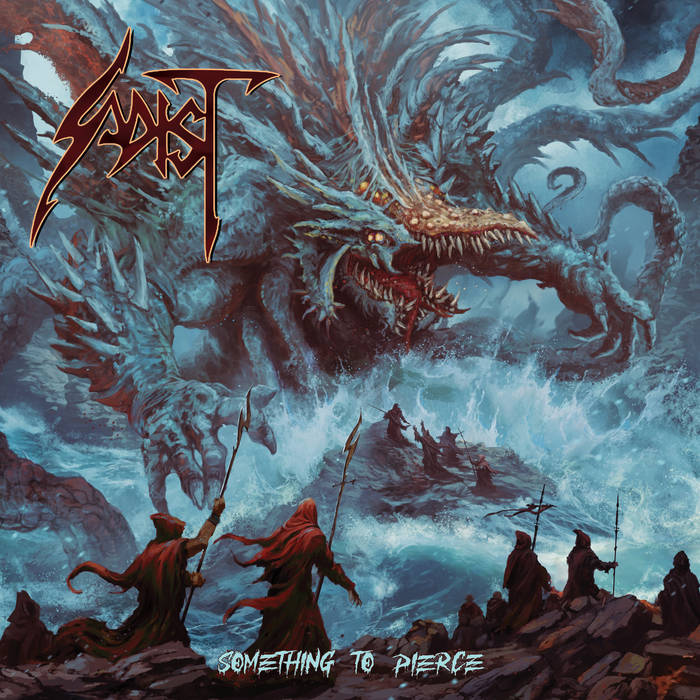
Sadist: Something to Pierce
Out 7th March on Agonia Records
If you want to understand the paradox of progressive metal, studying the career of Sadist can be highly instructive . The more influences the genre imbibes, the broader its expressive range, the march toward unchecked eclecticism, the more its core identity recedes into a distant memory. Sadist are a band that thrive on incongruity. Through their uncanny blend of modern metal ephemera and death metal, along with an expansive basket of “world” music traditions, they seem to almost pride themselves on alienating different branches of their listener base with each new incarnation. Incoherence, gaucheness, abrasive phrasing, sprinkling their albums with juxtapositions like confetti, revulsion is precisely the reaction a band like Sadist seem to be hoping to provoke.
The paradox being that, in terms of raw physical experience, Sadist’s first three albums are by far the most abrasive in terms of the raw, physical experience, yet are easily the most accomplished. They each, in their own way, manage to contain an equally broad range of musical reference points, but each rises above the three dimensional chess of its administrative project to convey an overarching message or impression. ‘Above the Light’ straddling the borders of death metal, thrash, neoclassicism, and traditional prog. ‘Tribe’ with its bizarre (and by now charmingly dated) keyboard leads and disarmingly bouncy reinterpretation of death metal at a time when the genre was dissipating under its own creative anxiety. Or the aggressive, almost desperate technical futurism of ‘Crust’.
Each clunky, and each endlessly enjoyable for their flaws. One can still catch the premise Sadist are attempting to convey in this early work, even if the execution was far from perfect. And that’s precisely the point of good prog. Flaws are made virtues if marshalled by some higher intelligence. For all its information overload, technical pretensions, and postmodern play with form, it appears as clumsy and overworked precisely because it is contemporary music attempting to reach beyond its agreed confines. It greedily hoovers up content and spits it out in new and garish forms, occasionally hitting the paydirt of profundity.
‘Something to Pierce’ is exemplary of Sadist’s run since the late 2000s. The ambition remains, but they have forgotten to say anything. It bristles with life, intelligence, and returning characters both familiar and unfamiliar to the listener, but the output is little more than a churn of content.
The album is bookended by arguably its best and worst material. The title track opening the album is riddled with echoes of progressive death metal appended by Slipknot riffs, a loose dough diluted further by mood swings and transitions that appear to be placed where they are for no other reason than to complicate a picture that never comes together. The closing number ‘Respirium’ by contrast is dominated by a single, clearly articulated theme that meets with a number of variations, counterpoints, and reiterations, echoing some of the best moments of ‘Tribe’ for its carefree disregard of genre.
And this, perhaps, is the problem. Sadist have always cultivated an ambiguous relationship to genre. Forever running from death metal whilst leaning on its raw materials as a foundation. This is notable not least in how Sadist have inculcated death metal’s many spinoffs since the mid-90s into their armoury. But here, for all the references to groove metal, Rotting Christ chantcore, pure prog, and world music, Sadist appear more than ever bound by the raw concept of “genre”.
The contours and flow of each track is determined by stylistic shifts as opposed to compositional necessity. Sadist are unable to shift the mood or flow of piece without shifting genre. For this reason, many individual molecules across ‘Something to Pierce’ are not without value. But they remain hermetically sealed off from the surrounding material, each passage is unable to develop beyond the borders of its compound. Themes are unable to transmit themselves across genres, meaning the only way Sadist can give these tracks the appearance of motion is by shifting genre. The result is an adept display of eclecticism totally absolved of any artistic purpose.
In this sense one could admit that Sadist have achieved their goal as agent provocateurs. This may be the album that, for all its striking clarity and apparent confidence, finally allowed me to articulate my misgivings toward prog metal since the 90s. Far from vaguely referencing the need for an identity over and above the parts. We can now say with a degree of precision that it is exactly this inability to extend a theme’s shelf life beyond a particular genre that makes so much modern prog metal little more than a series of content farms.


It is amazing and even moreso pleasing, to read such pedantic yet free thoughts circling around a concrete source of it, spinning it around into an interpretation where it really belongs to be, that even the creator of the source wasn’t aware of, no matter how in control and focus he thought to be himself while creating. For many years I read your writings, seeing them as the perfection of what I was trying to reach with my Skogen Magazine back in 93-96. Cheers to you, Sasha Falquet
LikeLiked by 1 person
lol. yes to the pleasures/art of criticism – as you say, creators aren´t always aware, and that includes critics.
LikeLike