At the Altar of the Horned God: Elements
Out 13th December on I, Voidhanger Records
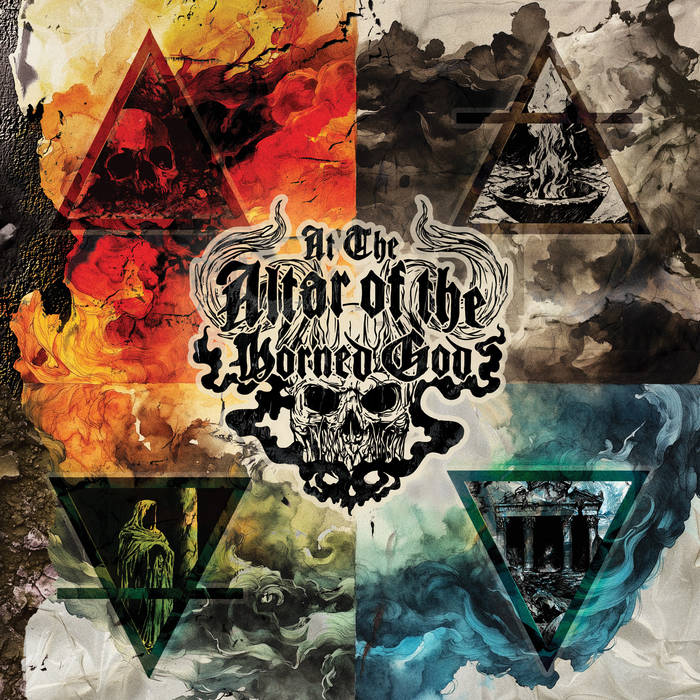
Having already signalled their love of various goth formulas through their manipulation of ritualistic melodrama and black metal furniture to create a kind of hybrid style that was appealing in concept even if it fell short in execution, it’s unsurprising to see this entity enter shapeshifting mode with a foray into full blooded goth territory. But despite this refined focus, the resulting EP is just as eclectic and directionless as before. Over the course of twenty minutes it ranges from trad goth (a laden term but read it as Fields of the Nephilim and early Sisters), Dead Can Dance, the industrial repetitions of early neofolk, to EBM evocative of Covenant or early Apop. It’s hardly surprising that these names come to mind given the explicit intent of this EP. But on the first track ‘Aqua’ for example, the stylistic shifts occur at such frequency and regularity that At the Altar of the Horned God appear lost beneath stylistic incontinence. Despite this, and some considerable theatrical bombast, it comes across as tentative, unsure of its identity or purpose, but keen to signal the range and depth of its knowledge of the loose collection of styles that fall under the goth/industrial/neofolk umbrella. As with the black metal informed ritualism of previous works, this entity is not short on ideas, originality, and the ability to realise them. But – counter intuitively for ritualistic music – there is no overarching vision, it appears to split apart in its eagerness to draw on as many influences as possible, and so we come away not quite sure what we experienced, or why we were asked to experience it.
Ainzemkait: was des lebens nicht wert
Out 25th December on Purity Through Fire
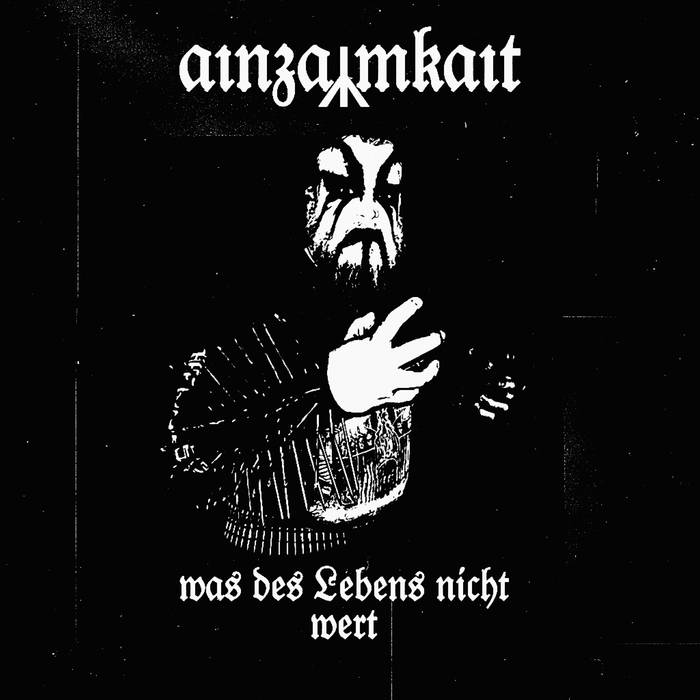
I added this album to the queue weeks ago based on a cursory listen to the title track, which contained an interesting harmony over what I took to be the track’s main theme. I had since forgotten about it. On unpacking it further, I was struck by the extent of this artist’s laziness. Each track plods along at the same sluggish tempo, each being a variation on roughly the same theme, a basic chord sequence used as a foundation for not unpleasant but decidedly obvious harmonic material, with the bare minimum of development to make the track feel like it has a process, a purpose, or telos of some description. Everything follows trivial rock tonal language, everything flows in rudimentary, linear sequences barely more sophisticated than a nursery rhyme. But equally, one can hardly attribute this to minimalist intentions, as there have been clear attempts to bring variety, contouring, and motion to these tracks. It’s just that all these things take place in the most obvious, mind numbingly generic fashion imaginable. I remain, as ever, amazed at the guile of some musicians and what they think they can get away with when expecting time and attention (and possibly money) from listeners.
Lament in a Winter’s Night: Whereunto the Twilight Leads
Out 27th December on Hell’s Headbangers
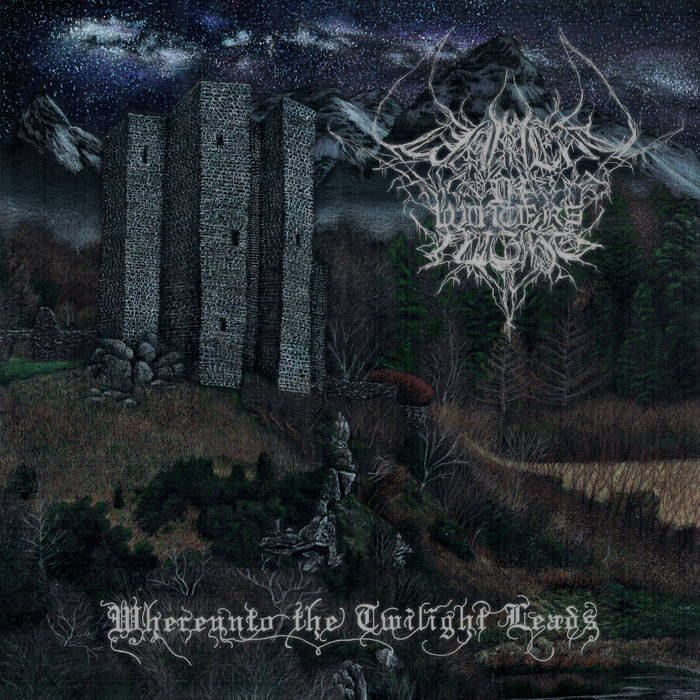
Naïve and sentimental via its folky, borderline poppy lyricism, but compensates for this through its longform ambitions. For instance, the second track ‘The Night Beckons in Yellow and Blue’ kisses ten minutes, opening with a fairly typical array of melodic black metal salvos, before devolving into a rock ballad by its end. Confusing, clunky, abrasive to those who are tired of rock trivialities being welcomed as innovative in black metal. But the poison is diluted by the undeniable imagination behind the bulk of this material. There is an innocence and childish daring to these tracks, constantly refreshing the picture as pieces progress in unexpected directions and forms, all held together by a busy lead guitar section which constantly throws out random ideas, but remains anchored to a coherent narrative thread. There is a sense in which this entity throws out too many suggestions and vignettes, threatening to collapse their project into incoherence at times. But all hangs together by a thread, offering idiosyncratic takes on black metal in its infant state, beholding the world with wonder and operating with little regard for the conventions of proper compositional forms.
The Cimmerian: An Age Undreamed Of
Out 10th January on Hyperborian Rage Records/BVR(fka Black Voodo Records)
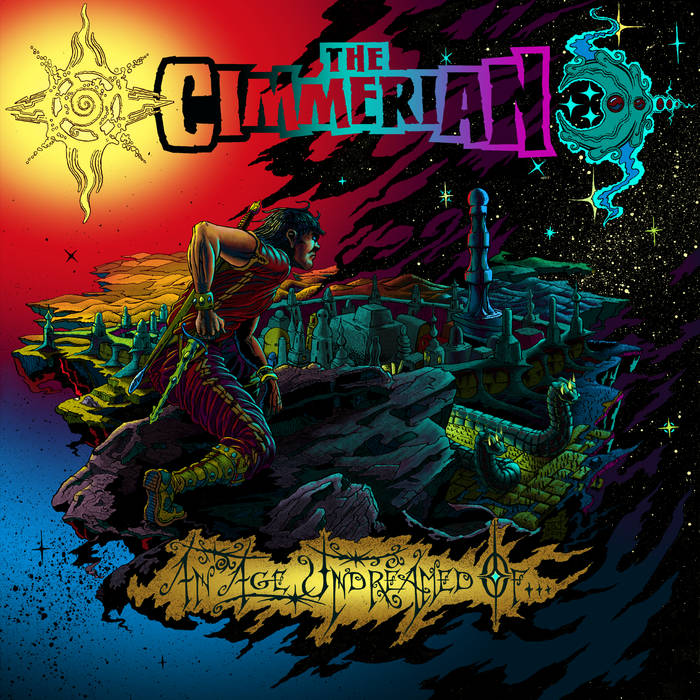
Long stretches of mindless sludge, underpinned by basic hardcore riffs, d-beat runs, and the occasional lapse into stoner doom by way of Conan, all of which would make this release entirely forgettable were it not for the fact that this is peppered with some imaginative lead guitar work. There is an obvious heavy/speed metal influence at play in the rhythmic topography, something that rarely stretches as far as the guitars which are happy to stick with a blast of rudimentary power chord riffs. But this does intermittently translate into wild bursts of character and teasing, epic narratives. The guitar work veers from fun classic heavy metal noodling, not afraid of indulging in the loose blues swing prevalent in Motorhead, through to more subtle textural work, as single soaring notes rise above the minimalism of the rhythm guitar, giving the effect of completing a picture with a dash of colour. Whilst there is much to be said for the raw physicality of the sludge angle here, it goes underdeveloped for the sake of articulating a more traditionally metallic identity. But at the other end, this latter feature appears all too sporadically to fully hold the attention, with The Cimmerian leaning too heavily on generic d-beat and hardcore holdovers without developing these elements with any sense of purpose or character. Whether the result will be crossover appeal or alienating two fanbases at once is yet to be seen, the result is pleasing enough for a listener from the more metal persuasion despite the shortcomings in pacing and arrangement.
Necrotech: Necrotechnology
Out 17th January on Sentient Ruin
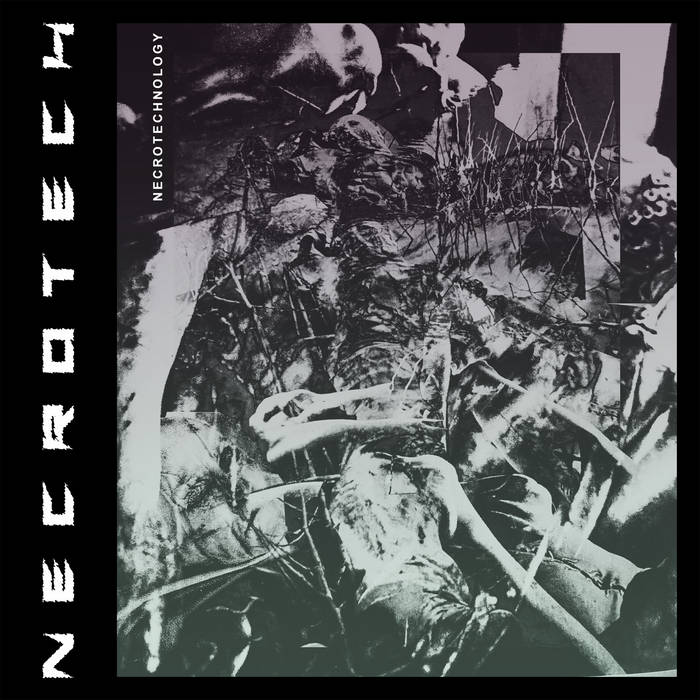
Although some thirty five years on, industrial metal still seems unable to move out of the shadow of Godflesh’s ‘Streetcleaner’, this EP impresses for its ability to recapture what worked about that album that so many fail to mimic. Chiefly the weaponisation of space and tension alongside cacophonous assaults of rhythmically persistent guitar vignettes. Necrotech take a more direct, physical, punk driven route through this style, proudly repetitive, determined, and undeniably heavy. But they leave space for brief pauses, builds in droning distortion where nothing appears to be happening before tugging the music back to a pulsing, percussive constancy. Random flections of guitar material too minimal to be called riffs seem to be carried along by the tide of driving industrialism, punctuated by a low end bark of vocals veering into spoken word histrionics at times. It’s this combination of rampant, cluttered activity, one that looks almost diverse on paper, alongside an underlying minimalism that drives these pieces forwards with oppressive persistence that marks this out from more overwhelming, full bodied but ultimately redundant efforts in the industrial metal oeuvre in recent years.
Relics of Humanity: Absolute Dismal Domain
Out 31st January on Willowtip Records

Essentially a dark ambient album with an exercise in tempo changes attached to it. The riff signatures of brutal death metal are broken down to their most basic components and driven through several iterations at various tempos, often with a laboured, sluggish, march toward decay as the tempo drops out entirely and the guts of a riff are laid bare before the listener. Guttural vocals accentuate this by moving from bursts of pulsing syllables to extended droning notes that draw attention to an intentional monotony, one further foregrounded by the austere (by brutal death metal standards) drums. In one sense this album is refreshing through its explicit desire to place brutal death metal into an atmospheric environment, forcing the musicians into a place of restraint and modesty despite moments of cluttered blasting. But in another sense it falls short through failing to develop its ideas beyond the initial introduction. Various themes are rarely developed past their germinal stage. Whilst uncomfortable repetition is clearly the intent at times, when Relics of Humanity do attempt to introduce developmental material it lacks context or forethought, making this highly conceptualised variant of brutal death metal seem disjointed over and above the usual disruption one expects of this style.
 Hate Meditations
Leave a comment