The riddle of steel
So that was Christmas. The auditing fury of December gives way to new projects launched, ideals dusted off, promised resolutions, and a renewed drive to make life better, cleaner, more focused, efficient, slicker, or otherwise optimised. If you’re a hustler psychopath that is. For normal folk it just means a fucking hangover.
There are many things I have considered doing with Hate Meditations in 2025. Stepping back from writing to focus on YouTube. Moving over to Substack. Writing fewer but more detailed essays. Moving away from reviews entirely in order to beseech some larger publications to grant me column inches for a think piece or two.
Some or none of these things might actually happen. If you have an opinion and are even minimally invested in this site, let me know your thoughts. For now, I will be forcing myself to take a mellow start to the year. No big announcements, rebrands, projects, or petitions for funding. Just some pressure free quality time with some music we’ve not visited for a while.
In keeping with the season, and the subzero chill gripping England as the long and (for many) teetotal slog of January beds in, my attention remains fixed on the cold and the dark. And that means yet more black metal. I’d go as far as saying that death metal is my summer music given how rarely I turn to it in winter outside of material I’m reviewing. But such is the extent and duration of January’s hangover that a deeper dive into black metal as an abstraction feels warranted.
And what better place to start than one of Mayhem’s many incarnations. I’ve always characterised this outfit as the Death of black metal. Marred by tragedy, repeated lineup changes, difficult characters, the centre of activity within their respective scenes, their musical significance over and above the reems of bands they inspired and the scenes they administered still hotly debated.
Even in the Euronymous era, Mayhem were hardly a coherent entity, held together by will, reputation, and the determination of one man and his ability to source the best talent from within the scene. In this sense they were and are a banner under which a rolling cast of characters have come and gone, all of whom made their mark with varying degrees of success.
Given the pressure the returning members and Blasphemer in particular were under following their unexpected reformation, it is remarkable that they took as many risks as they did on ‘Grand Declaration of War’ following the ship steadying fury of ‘Wolf’s Lair Abyss’.
But to some extent this was in keeping with the state of black metal at large as it greeted the new century. Its various molecules placed under a microscope, its assets stripped and sold for parts, fragments of the genre winding up in industrial, post rock, big budget symphonic metal, alt rock, and other equally unlikely places.
Pure black metal receded to the previously obscure outcrops of the US, Canada, and Eastern Europe. All delivering their own unique stamp on what was otherwise a style of black metal derived from the Nordic scene. The new generation of USBM artists brought a depressive urbanism to the fore in their distinctively ambient interpretation of the genre, aided and abetted by a renewed avant-gardist push from French bands like Blut Aus Nord and Deathspell Omega.
Post reformation Mayhem therefore, walked a tightrope. On the one hand forced to live up to the reputation of their suffocating reputation. On the other trying to keep pace with this new unprecedented diaspora of influence and genre blending in a genre they helped fashion. The bizarre choices found on the faltering podium metal of ‘Grand Declaration of War’ makes more sense in context, reflecting the tension of a band trying to stay relevant and vital without severing all links with its notorious history. The crowd pleasing ‘Chimera’ was more in keeping with fan expectation, evincing a “one for us, one for them” release schedule.
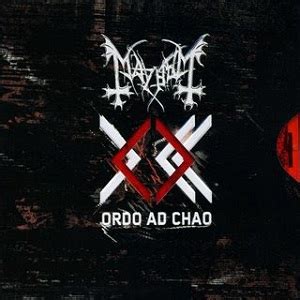
And sure enough, by 2007 the time had come to once again resist the pressure cooker of fan expectation, and decide what these individuals had to say beyond the long shadow of Mayhem’s reputation and the lingering sense that they must live up to the memories of Euronymous and Dead.
The return of Attila reflected a renewed desire to push at the boundaries of black metal. A singular vocalist by any measure, his inclusion was the first sign of Mayhem’s leftfield turn. Allowing Hellhammer, one of the most talented drummers in the genre, to let himself off the leash was another. There’s also a sense in which Blasphemer is pushing himself well outside his comfort zone on ‘Ordo Ad Chao’. Having cut his teeth with the blackened thrash of Aura Noir, his style has never been to my taste but one could hardly deny that he certainly has an identity as a riff writer, one that comes through on both Mayhem albums preceding this.
Here, bolstered by Hellhammer’s non-linear, jazz fusion drumming, he manages to integrate his mix of classic black metal flair and harsh modernist thrash with a droning, dissonant form of noise metal. The music flows in waves of energy, faltering, tugging, moments of true blasting momentum are rare, working in marked contrast to intermittent waves of noise. In this sense, Blasphemer points the way toward a form of non-naturalist black metal written not through riffs but competing energies. Quiet, loud, fast slow, melodic, dissonant, solid or defuse.
Attila’s vocals, so eerily bizarre on ‘De Mysterious Dom Sathanas’, are here elevated to a form of abstract theatre. Matching Hellhammer in his defiance of rhythmic comforts, deviating from standard extreme metal distortion to operatic crooning, following or defying the flow of energy expressed through Blasphemer’s guitar.
In this sense Mayhem remain unique for their ability to not only match but surpass the black metal scene of the time. Updating the old formula into a futurist, dystopian form of noise jazz, one that borrows from the riff language of older metal, but situating this as one tool amongst an armoury of looser, more anarchic compositional techniques. Looking at the sheer volume of bands that owe a debt to this album, I’d stake my reputation on saying that this is Mayhem’s most influential release bar none.
The wave of dissonant black metal that lent into chasmic production with overwhelming walls of distorted guitar, heavy handed reverb, and industrial aesthetics failed to grasp what made it unique however. To be fair, it requires a drummer with some knowledge of jazz and other non-rock forms to carry it through to some extent. But ultimately, it’s the realisation of contrast, tension, and release through non-traditional means – i.e. through fluid waves of intensity and dynamics rather than riffs and tempo changes – that makes this such an important addition to the evolution of black metal beyond its limitations, and something that is sorely lacking in the reams of homogenous copycat albums that followed in its wake.
Having traversed the calorific discography of Germany’s Nagelfar, it seems only appropriate to continue the journey into Alexander von Meilenwald’s follow up project The Ruins of Beverast. I’ve had a hot/cold relationship with this artist over the years. I would characterise its first era up to and including ‘Rain Upon the Impure’ as archetypical of black metal integrating atmosphere at the compositional level, perhaps the only distinct development achieved within black metal throughout the 2000s. But Beverast slowly pivoted toward doom metal by the late 2000s and have settled their ever since. Hardly surprising given the popularity of the dark, cinematic form taken on albums like ‘Foulest Semen of a Sheltered Elite’ and ‘Blood Vaults – The Blazing Gospel of Heinrich Kramer’.

Despite the exceptional naming conventions, these albums epitomise the bloat of huge swathes of modern extreme metal. As the digital realm stretched out before them, offering limitless vistas of storage space, album runtimes extended out into eternity. The particular brand practiced by Beverast straddled black metal, doom, church music, all manner of atmospheric flourishes, and highly realised conceptual material. The extent and detail of this vision remains compelling. 2017’s ‘Exuvia’, at a mere hour and seven minutes, being a particular high point owing to its focused and efficient construction. But Beverast were emblematic of a regrettable trend within 2000s metal toward overly conceptualised albums longer than feature films, opulent and lavish in presentation but devoid of meaningful compositional language.
In this sense, Beverast were easily one of the best of a bad crop. But it is an earlier incarnation that concerns us here, with the rather vanilla title of ‘Rain Upon the Impure’, a mammoth hour and twenty minutes of material. This is the fabled transitional album for this entity. Reaching for a muscular form of doom metal which adds greater weight and temerity to what is otherwise atmospheric black metal. What marks this album apart from its follow ups was precisely that, the long, meandering drone of funereal processions still steeped in a uniquely oppressive, dare we say it, vast atmosphere conveyed on this album.
It is typical of an era fixated on extra musical features – guitar tone, production, choice of keyboard patches, diversity of vocalisations – to bolster or otherwise enhance the raw materials of composition. Of course choices made in the studio have always played a key role in the final product of an album. But by the 2000s, advances in digital technology, affordability, and variety came on leaps and bounds, opening up new territories of creativity for a younger generation of musicians. Predictably many would lament just how limitless the possibilities at the (now digital) mixing desk would become, yearning for a time of limitation and austerity that focused the mind on raw creativity.
But Meilenwald’s mix of classical black metal, early Christian music, and commanding doom metal has always shone above the bespoke production jobs furnishing his discography. Perhaps not quite to the extent he believes given far his albums stretch beyond the shelf life of the actual ideas therein.
But the material on ‘Rain Upon the Impure’ is coated in an ambient veneer, smothering all in this dark, oppressive, imposing cathedral of a mix, the sounds move around the room as if reverberating from a space so vast as to be beyond comprehension. From this angle, it’s almost incidental that some of the riffs anchoring these pieces are fairly rudimentary, simply there to flesh out the sound, create a sense of coherence, a backdrop onto which are thrown additional accents, drops in tempo begetting an aching tension, or sweepingly dramatic moments of Gregorian chanting.
With hindsight, this was a mere stepping stone to the fundamentally more typical metal format found on subsequent albums. The atmosphere remained, but the mix accentuated individual instruments as opposed to presenting a singular wall of sound. Each element became clearer, the riffs the central focus, the individual components easily discernible, the presentation more obviously one of a band with each instrument presenting a distinct element of the track. Whilst this muscular approach certainly helped accentuate the increasing reliance on doom metal, the extended interludes and deviations Meilenwald insisted on inserting felt less like dark ambient mood music and more like filler, completely killing the momentum in a more directly metallic setting.
All is homogenous on an album like ‘Rain Upon the Impure’, inextricably bound together into a single unit, making any extended break into ambient or drone look entirely intentional, intuitively flowing into the music, extending its expressive range. A profound and unique moment of foreshadowing for early 21st Century black metal whose character has never been successfully replicated, including by Meilenwald himself.
The project of integrating atmosphere into the compositional dialect of black metal was perhaps taken to the outer extreme by Paysage d’Hiver. This is undoubtably the most traditional entity in this rundown. It is one logical development of the form of black metal that became hegemonic after Norway’s run at the top of the food chain. The accepted narrative that flattens black metal’s complex and internationalist early evolution into a continuous stream of trebly guitars, tremolo strumming, and washes of ambient noise.

This last feature has been a chief concern for black metal since the turn of the century. Memorable riffs, and more importantly creating a cohesive dialogue through riff construction, are increasingly elusive. Something that has prompted many artists to turn away from them entirely. What made Mayhem’s effort so unique was not that it dispensed with riffs, but that it sought to pull apart and dissect the very idea of a riff in various different ways. The Ruins of Beverast, for all the unique moods conjured on an album like ‘Rain Upon the Impure’, were still beholden to the need for riffs, if for no other reason than their function as a serviceable foundation for reverberating cathedrals of sonic overload.
Paysage d’Hiver are emblematic of perhaps the easiest and therefore most common route out of the “riff problem”, achieved through treating black metal as pure texture and harmony. As long as chord sequences are structured in the right key, with the right cadential shapes, but more importantly with the correct blend of reverb, treble, distortion, and washed out production, there is no need to undergird this with further elaboration. The result, when compared to the efforts of Mayhem or The Ruins of Beverast, is almost an act of violence. It splits apart a music’s essence (atmosphere) from its substance (riffs). Leaving a blank space where information should be.
In one sense this was very necessary by the 2000s, particularly for black metal which – despite numerous attempts to complicate the genre with additional techniques and music theory – remains a regressive, austere, minimalist project. Metal-if-less-was-more. By splitting the core essence of black metal from anything remotely metal – i.e. conveying sonic information through riffs – we can better discern what was unique in black metal as a development on riff technique beyond the headline grabbing anti-production.
Compare something like ‘Das Tor’ with the style developed by the Blazebirth Hall for instance. The latter, despite relying on a similar uninterrupted stream of atmospheric currents, still traded in something that was, at the very least, an ancestor of the riff. A humming, lyrical melodic flow that saw different themes recapitulated and developed as a piece wore on. Minimalist, sure, it stretched only the most rudimentary ideas to breaking point. But still recognisably a descendent of 80s extreme metal at the foundational level.
‘Das Tor’ functions more like a series of ambient clusters. Each passage contains a chord sequence. Some passages even introduce additional material. But this is not development in the strictest metallic sense. It usually involves swirling synth lines, a shift in pitch, additional harmonic layers. Development, when it comes, involves simply transitioning to a new and mostly unrelated idea. Were it not for the fact that each transition is so laboured and sluggish they would look decidedly clumsy.
The result is a compelling piece of ambient noise. The perfect execution of an idea. The logical conclusion to black metal as a textural project, one that stands in defiance of conventional “band” music, where each musician has a unique role, one that can be separated and studied from the rest of the music. No such analysis would be possible on ‘Das Tor’. The work is a singular unit of ambience. The building blocks of black metal are deployed in isolation. Single, static moments onto which are hung a tapestry of ambient garments, mannequins frozen in time, compelling in their unelaborated isolation.
For all the barbs I throw at the state of metal in the 2000s, the many toxic seeds that were sown then, it’s easy to forget the possibilities that were offered by artists old and new. But such possibilities were impotent against the encroaching free-for-all. Either commercially where its expansion into a playground for the deranged and cynical became even more apparent, or the collapse of its closely guarded borders, with outside influence growing in intensity, unscrutinised, not subjected to proper administration. Metal’s response, by the 2010s, was to revert to the safety of shared symbolism, and realise a new sense of “cool” in retro music that – in the 80s and early 90s – was decidedly not cool or popular. This ironclad love of the past that dominated the 2010s made true deviation from the norm all the more challenging. But in that brief pocket of the 2000s, when extreme metal was cast out to the wilderness, some oddities were thrown up in response to the ever present dual threat of stagnation or repetition.
 Hate Meditations
“Stepping back from writing to focus on YouTube. “
Ewww, don’t do that.
“Moving over to Substack. “
Double-edged sword. On one hand, it would probably grow your audience. On the other hand, do we really want one fewer website and one more author beholden to one of the six or seven websites that comprise all of the internet now?
LikeLiked by 1 person
how´s this for a future summer project? could you pick up the baton and finish Old Disgruntled Bastard´s Death Metal Battle Royal?
Please don´t migrate to YT fully. Reading is faster than listening. Speaking of which, you should do transcripts of Necropolis. I don´t have hours to digest stuff that could be read in 20 minutes.
LikeLiked by 2 people
Less, but more developed writing could be interesting… Agreed that a move to youtube may not be the best idea. Also the video format does not lend itself as well to active engagement, and the self-paced nature of writing allows more easily for re-reads (re-watches can be a bit tedious)
LikeLiked by 1 person
While I absolutely agree with not moving to YT fully, the politics of metal video was excellent and can’t be reproduced in writing. I would love to see more similar content. Also moving to Substack makes sense.
LikeLiked by 1 person
I mean this in the kindest way, but your writing is infinitely better than your ability to talk about something on youtube. I see your work as an elevation of discourse and criticism, which the youtube format doesn’t really lend itself to. Its also not that entertaining a topic for youtube or a podcast.
In my humble opinion, you should focus on writing more long form pieces, or maybe even a book. Thats probably your best trait and its the one most unique to the site.
LikeLiked by 1 person
“There are many things I have considered doing with Hate Meditations in 2025.“
As others have said above: please keep it as it is. This blog is one of a kind: well informed, in-depth, witty but not for the sake of getting cheap laughs, and highly eloquent.
Other formats come with the temptation of finding a lower common denominator. There’s plenty of that already.
Greetings from the North,
Jornfin
LikeLiked by 1 person
Hi, man, please don’t focus more on the YouTube channel than your writing here. I also prefer the writing world over some videos to think about music. Regarding to move over to substack, I think it’s ok and I understand the appeal to use that platform. I wouldn’t have a problem to pay the usual fees on substack (I already do that with one rock music critic there) if that means that you can continue to write about metal.
Now, about the kind of writing I would prefer, I really appreciate the kind of engagement you’re trying to do to find the different interesting things are happening in metal music without losing the idea of quality as a guide. In that sense, I prefer what you’re doing here than the current encarnation of deathmetal.org. But it’s also truth that sometimes I feel that there are too many reviews for the time I have to devote to reading about music (so this is a strictly personal matter); in that sense, I would prefer some larger reviews maybe once a week of works that you think are important to talk about (a really good album, a not really good album but with some interesting traits, an album praised on other sites but you think it’s just hype, ect.). I also like your essays where you muse over diffent metal topics (the one about avant garde metal, the retromania series, etc.).
So, in other words, I hope that you continue to devote to write about metal in the way you consider the best.
Belano
LikeLike
Hi, man, please don’t focus more on the YouTube channel than your writing here. I also prefer the writing world over some videos to think about music. Regarding to move over to substack, I think it’s ok and I understand the appeal to use that platform. I wouldn’t have a problem to pay the usual fees on substack (I already do that with one music critic there) if that means that you can continue to write about metal.
Now, about the kind of writing I would prefer, I really appreciate the kind of engagement you’re trying to do to find the different interesting things are happening in metal music without losing the idea of quality as a guide. In that sense, I prefer what you’re doing here than the current encarnation of deathmetal.org. But it’s also truth that sometimes I feel that there are too many reviews for the time I have to devote to reading about music (so this is a strictly personal matter); in that sense, I would prefer some larger reviews maybe once a week of works that you think are important to talk about (a really good album, a not really good album but with some interesting traits, an album praised on other sites but you think it’s just hype, ect.). I also like your essays where you muse over diffent metal topics (the one about avant garde metal, the retromania series, etc.).
So, in other words, I hope that you continue to devote to write about metal in the way you consider the best.
LikeLiked by 1 person
(I took a brief Internet leave and am reading this post today)
Your writing is in an uncomfortable position. It’s good and deserves more readers, not for your sake strictly but the metal world at large. If you had a very wide readership, it could perhaps be influential. But then, however, you’d be exposing a digital “underground” (interpret that as you will) to the light, and all the threats that come with it. YouTube and Substack are corrosive to quality writing. You might turn your work into a source of income, but then you’ll be driven by that income, no matter how much your conscious fights the urge, at which point you’ll serve the same demon every contemporary metal band you hate does, at which point you lose everything. You’d have to maintain your ideological integrity – not just a matter of will – in an environment extremely hostile towards it. If you could, it’d be your greatest gift to the art form. Only if you could, and you probably can’t.
So what do you do? Neither choice is wrong or right. All I can tell you is you have the potential to do it. Do you want to? Do you have to?
LikeLiked by 1 person