Bridges to nowhere
October opens the gateway to winter. Darkness makes inroads into our lives. The vestigial traces of summer ebb away by the end of the tenth month. Declining temperatures herald the arrival of November’s high autumn.
This particular October has also brought with it a glimmer of the Northern Lights to my native Yorkshire. A surreal, liminal experience belying what one might have expected. A silent, formless, eldritch green glow piercing through the night sky even in the most built-up areas.
As life prepares for its temporary cessation, the flurry of organic activity is only enhanced in the knowledge of how important all this decaying matter is for springs regrowth. Fallen leaves in the garden bring comfort, knowing they will be greedily pulled down by worms and fertilise the grass. This uncanny period of transition will soon come to an end, as winter (and a much advertised cold snap due any day in the UK at least) beds in, and the trees embrace their eerie stasis.
Despite being at least peripherally conscious of this rampant preparation – the ceaseless labouring of birds, the last vestiges of insects burrowing into piles of compost, the growing piles of decaying vegetable matter – one remains alive to the fact that this is all driven by a period of death, or at the very least a halting of organic activity.
The cold outside lays waste to life. Suspends the process of decay.
Alone without a friend suffer as night becomes the death of day.
Winter
By contrast, most metal music is defined by an impulsive, frenetic motion. This is true even of the most winter obsessed of black metal. It takes a special kind of mind (an Ildjarn maybe) to communicate the alien stillness one experiences in the presence of nature at the height of a January chill. Consequently, the majority of black metal chooses to instead call on storms, wildlife, battle, or mythology to justify the raw physicality of the music itself.
One could therefore argue that autumn, not winter, represents the true fount of inspiration for metal as the expression of melancholia. All motion and purpose in this brief window is motivated by the death drive. The uncanny realism that floods the senses for this brief span of weeks in late October provokes a craving for Weird black metal. Music loyal to the genre’s naturalism, but toying, manipulating, and mutating the boarders of convention, gouging open wounds just to see what bacteria will grow within the flesh.
Ved Buens Ende are the first entity on the tip of most people’s tongues when the topic of formative avant-garde black metal is raised, and by extension a good portion of post black metal. Their sole full length ‘Written in Waters’ is contemporaneous with other great upheavals within extreme metal.
We must always be aware of treating the past with the “enormous condescension of posterity”. This extends to imposing knowledge of context and location on musicians who may have been utterly oblivious of such things or their place within a wider movement. That being said, many contemporary accounts of the mid-90s lend credence to the idea that metal knew its arc of progression was about to expire. Black metal had expended itself in a brief flurry of activity. Following some unfortunate run-ins with major label attention, death metal had proven itself unsuitable for mass consumption, and was left powerless in the face of rejection from MTV, Roadrunner, and the favour of a wider listening public. Thrash and heavy metal were settling into a comfortable middle age, looking for all the world like throwback music, at a time when pastiche was the exception not the norm, music’s relevance and value still being tied to some form of temporality.
Add to this the exploding popularity of grunge, and more broadly alt rock, which, if it could be defined by anything, was marked by its rejection of the overly polished, self-assured and synth integrated pop rock of the 80s. This prompted Gen-X, as the first generation to view the events of the 60s and 70s as history rather than memory, to look anew at the experimental rock of these decades. Echoes of everything from The Doors, Black Sabbath, The Clash, to King Crimson made sudden inroads into guitar music of the 90s with renewed vigour. A final wake for post war culture.
Into this moment of transition stepped a slightly younger cohort of metal artists very conscious of these changes. But being largely “of” a metal oeuvre, they remained deeply wedded to metal’s isolationism and unique expressive potential when measured against its neighbours.
Where progressive metal had previously defined itself in grand, sweeping gestures of virtuoso theatre (Queensrÿche) or dense displays of excessive musicality (Watchtower), this new avant-garde appeared sensitive, introspective, ironically distant, in keeping with the complex vibe shift that heralded the transition from the 80s to the 90s. A vibe that some artists reconfigured their style to (Enslaved, Death, Voivod), but most strikingly articulated by newcomers placing it at the foundation of their identity (Opeth, Manes, Dødheimsgard).
This latter cohort were (historically) important precisely because they dragged metal into a postmodern context, thus bringing it up to speed with the psychological disposition of rock music at large in the mid-90s. In doing so, they laid the foundation for the ostensibly experimental moves metal made in the 21st Century, setting clear limits on the terms of any development (namely, measuring the degree of one’s radicalism by how far and fast one is willing to run away from metal whilst still claiming to speak for it, something still lionised today, see Blood Incantation).
‘Written in Waters’ is in many ways the archetype of this transition. In one sense a second run at the ‘Into Pandemonium’ experiment, linking the noble but failed avant-gardism of Celtic Frost with the contrived surrealism of mid-90s alt-rock heavily informed by King Crimson’s ‘Red’, all knitted together under a loosely black metal aesthetic umbrella. Whilst it may seem trivial to point to the vocals to illustrate this, the choice of predominantly clean vocals – despite the attempt at tortured, undead crooning – a priori frames the limits and flow of the music.

Each meandering alcove and laboured interplay of dissonance and consonance is deployed to showcase a work of abstract poetry. Black metal appears almost incidentally as a shared influence between the members of Ved Buens Ende but not their end goal. As a piece of dark, prog infused 90s alt rock, one that lifts heavily from black metal but just as liable to lean into math rock and post hardcore, it is a detailed and immersive work. But as far as “avant-garde” black metal, if such a thing exists at all, it would not be this pleasant to listen to. Ildjarn perhaps came closest by almost psychopathically torturing the bare rudiments of black metal as a means of testing their limits, something echoed in Burzum’s ‘Filosofem’. Ved Buens Ende by contrast are great alchemists, fusing the heavy handed musicality of progressive rock with an understated, depressive veneer unique to 90s alt-rock, a wedding officiated by black metal but not determined by it.
Bluntly, the worst thing about ‘Written in Waters’ is just how well it is regarded as a formative document of avant-garde black metal. That it was retrospectively framed in this way explains why, in listening back to it, one can see its fingerprints on everything from Deathspell Omega for its dissonance to Agalloch for its shedding of metal’s proactive rigidity in favour of a passive flow of moods. No doubt holding this album entirely responsible for the implosion of black metal by the end of the 90s is heavy handed. But because the fandom regards this not as a curious piece of avant-gardist rock but as progression on the black metal form itself, this has not only inflated its significance within black metal, but retarded the evolution of the form in the years following 1995.
Turning to another alcove of untrue Norwegian black metal, Forgotten Woods reveal an important bridge between early Burzum and fledging depressive black metal. Toying with the borders of a style located between Burzum’s self-titled debut and a playful, drab black ‘n’ roll swing that – far from appearing trivial – draws attention to the trancelike, meditative sway of this style through a burrowing, absurdist repetition.
As with Ved Buens Ende, we must caution against imposing hindsight onto the past. A set of musicians emerging from the black metal scene exploring their love of rock’s avant-garde wing in the case of Ved Buens Ende, and a group of avid Burzum fans cobbling together a niche within a genre that had all but breathed its last in the case of Forgotten Woods, neither can be blamed for the manner in which their music was mutated and developed by the generation that immediately followed.

The main difference with Forgotten Woods being that theirs was an act of regression. Both the debut ‘As the Wolves Gather’ and even more so 1996’s ‘The Curse of Mankind’ form some of most convincing carbon copies of Burzum one is likely to find (the guitar solo two and half minutes in to ‘My Scars Hold Your Dreams’ almost perfectly mirroring ‘Key to the Gate’ for example). Presented with more immediacy, shaving off any edges of complexity in Varg’s playing for the sake of linear, droning runs of simple punk based chord sequences. These features, achingly sparse on their own, receive no developmental material, and are instead treated as a stage onto which are paraded idiosyncratic melodic suggestions, folky vignettes, and dramatic vocal flexes.
To their credit, and despite the vintage of these works, I always underestimate Forgotten Woods’s ability to surprise. I’ve sat through most people’s fair share of bargain basement black metal, a pastime that has made me very accustomed to this strain and its regrettable tendency to go precisely nowhere. Listening to Forgotten Woods with the benefit of an additional three decades worth of similar material to compare it to makes this Norwegian oddity look positively groundbreaking. A great subverter of expectations. Never short on dramatic melodic flourishes. Always mindful of when repetition pays off or when to stir the pot.
But, as with the other artists explored here, there remains a striking problem of integrating the two contrasting motivations behind this music, which therefore limits what this artist can say about black metal that hasn’t been said before. By revisiting early Burzum and populating it with a more lyrical (human) harmonic language (admittedly in a far more tasteful manner than most have achieved) they leave the underlying architecture of this formula largely untouched. This limits their project to merely adding footnotes to already completed material as opposed to opening a new chapter.
From today’s perspective, Nagelfar are the much touted pre-cursor to The Ruins of Beverast, the project masterminded by their drummer Alexander von Meilenwald. On first encountering the breadth of music spanning both artists’ discographies, one could be forgiven for thinking they have stumbled on an embarrassment of riches. Every album is – for the most part – ardently celebrated by their fanbase. The gradient of peaks and troughs in quality between releases is relatively shallow. Each work is strikingly different from the last, and each is rich in conceptual and musical detail.
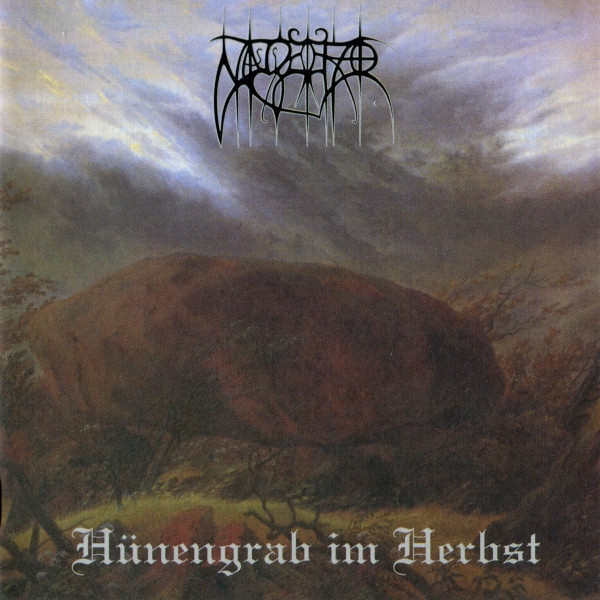
But it’s always important to approach music afresh and with a semblance of scepticism even in the face of such lavish packaging. Engaging with what I actually hear as opposed to what I wish was there, I confess to a hot/cold relationship with Nagelfar. Hot because it does the hard work of building on the format of black metal as it was in the mid-90s. Cold because it fails to deliver on its promises, a problem continuing well into the career of Beverast.
Nagelfar’s debut ‘Hünengrab im Herbst’, clocking in at a weight fifty five minutes, is the shortest of their three albums, but what makes them feel like an imperial stout is not simply their length but their hubris. Somewhere under the opulent presentation is a serviceable continuation of early Satyricon and Dimmu Borgir, one that at times uncannily resembles Primordial’s ‘Imrama’ for its clunky delivery that nevertheless stumbles on novelty too often to be mere coincidence.
The album fights against its own impetus to simply be in its quest to force out a headier, art school take on what at the time was becoming a rather stale form. The quest to integrate experimentation into extreme metal has been far more limited in its success than other genres precisely because extreme metal as a musical form was quickly established and passionately defended at an early stage. A feature that many outsiders mistake for sterility, small mindedness, is simply the higher premium extreme metal places on form and intentionality. Artists that push at the boundaries of how and to what extent the compositional form can be stretched strike me as better examples of experimental extreme metal than those that merely season pre-existing forms, precisely because the former approach is still in direct conversation with the genre itself. Summoning, Averse Sefira, and Immolation come to mind for achieving this in their respective fields well after extreme metal’s heyday.
‘Hünengrab im Herbst’ shines when it forgets to be quirky. Boasting rich, cinematic melodies, epic, plundering turns of phrase, and ambitious, conceptually weighty narratives. It’s an endeavour only intermittently interrupted by incongruous deviations, momentum quelling interludes, and industrial breaks. In this sense, Nagelfar attempt to short circuit their way to looking experimental. They lay the groundwork for what amounts to a serviceable iteration of symphonic-cum-pagan black metal. Once established, they furnish this with eccentric spices and harsh juxtapositions. But one couldn’t call this experimentation simply because there is no clear desired outcome beyond the act itself, no clear intent behind the expression. It’s a plain shepherd’s pie gilded with Chinese five-spice, and just as jarring to consume. Fusion cooking requires a degree of forethought and premeditation to effectively marry distinctive and well established traditions.
This is possibly exemplified – albeit under a very different guise – by the likes of Summoning, who sedated black metal’s hyperactive tendencies in order to fully integrate its harmonic vocabulary into darkwave, neofolk, and ambient. A gradualist yet highly experimental project precisely because it yielded new results for the genre with a greater degree of intentionality and longevity, all using much the same inputs as Nagelfar.
In studying artists that, with the benefit of posterity, bridged the gap between second wave black metal and its offshoots of avant-garde, depressive, and post variations in the 21st Century, the macro picture of how we got here becomes all the clearer. Desperate not to be a “metal died in 1993/96/98/99” reply guy, many latched onto albums like these as evidence of longevity in the form beyond its initial explosion. Whilst there is much to discuss and learn (and enjoy) within their pages, this looks for all the world like wishful thinking. Errors compound on errors, like an AI being fed on data generated by AI, coherence collapses as newer artists not only replicate their limitations, but place them at the very foundation of the genre.
Despite this, these artists, being all more or less pre-digital, still brim with a clunky, vibrant individuality that still makes them infinitely more interesting to listen than 90% of contemporary metal. They were close enough in time and spirit to second wave black metal to at least parrot its greatest strengths. And in the process created works worthy of the occasional revisit. But as far as the project of adding to codex of black metal is concerned, their success was frustratingly limited.
 Hate Meditations
Re: “avant garde black metal” that truly is such, I’d argue one clear example exists — Transilvanian Hunger.
The construction of the riffs on that album is unlike almost anything else in metal at the time. Progressions were created by treating the lower and upper guitar string in the dyad as separate melodic voices and writing counterpoint melodies on them, a technique that only had precedent in metal from Voivod (ironically, this album is closer to jazz guitar than anything Atheist ever did), but then blurring the melodic lines together with the combined use of guitar distortion and picking technique. It featured a surprisingly educated use of modes aside from natural minor/major and diminished scales, remnants of the band’s semi-technical death metal past haunting the black metal present, injecting alien dissonances into the most unexpected places. This was locked into four separate layers of rhythm — drums/bass/left guitar strun, right guitar strun (if listened to on headphones, you can tell that the strum patterns of the right guitar sometimes don’t follow the left guitar and bass, an effect used to stress certain beats), the rhythm of the chord changes as independent from the strum patterns, and the vocal rhythms. However, all of these progressive aspirations were mercilessly crushed under the boot of extreme black metal purity, without even the tiniest olive branch offered to the listener of “respectable” music. Songs like “Over Fjell Og Gjennom Torner”, “Graven Takeheimens Saler” and “As Flittermice As Satan’s Spies” are so outlandish in construction as to make even the most dedicated disso-black bands sound like Venom by comparison, but the Kaufman-like dedication to the bit, with Fenriz being willing to eternally pretend that the work was an act of primitive fundamentalism when he for sure knows damn well that it wasn’t, means it never can be interpreted in the same kind of non-black metal context as such overtly progressive acts.
Darkthrone were *so* great on those first five albums…
LikeLike