I miss stuff. Stuff used to be everywhere. I watched The Lost Boys recently. It occurred to me that stuff clutters every shot of 80s films, trinkets, knickknacks, gumph, it clogs up the screen to the point of distraction when compared to the barren surfaces of modern television. All my life I’ve been told that stuff is the enemy. Excess weight. A morass of barnacles clinging to the underside of our lives that must shaken off in periodical decluttering frenzies. The stuff we accumulate today is tomorrow’s landfill we were told. Austerity is the unsung virtue.
One of the first pieces I wrote for this blog in the 2010s was a – thankfully now lost – commentary on the contradiction that stuff presents for vinylheads and other physical media acolytes. If owning stuff is wrong, bad for the planet, resource heavy and the reason you’re poor, how does one square that with the vast document of humanity balancing precariously on your creaking shelves in the form of records, CDs, cassettes, books, and DVDs?
We’ve since accepted that this question is a misdirect. Ping back a quick “no ethical consumption under capitalism” and it’s off to record store day. And yes, in the context of companies willing to boil the ocean and obliterate mountains in the name of industry, there’s something to the idea that, on an individual level at least, owning excess stuff, whilst hardly commendable, may at least be morally neutral.
But something strange is happening. A sea change in our attitude to stuff. For all the grief stuff got back in the day, a limited intake of stuff was largely accepted as a necessary evil. But now the very idea of stuff itself seems to be under threat, and we’re coming to terms with the dire consequences of this. The death of stuff could mean the death of our own humanity.
Perhaps the canary in the coalmine was an ad from Apple in 2024. It featured a cornucopia of stuff, various musical instruments, a metronome, paint cans, a turntable, mixing desk, arcade machine, books, clapperboard, typewriter, all are arranged on a hydraulic press to be crushed away to nothing. As the press lifts, it reveals an IPad occupying the space where stuff once reigned. You won’t find this ad online anymore, at least not without a voiceover helpfully explaining what it could all mean, because after significant backlash Apple decided to pull the ad and issue a rare apology. People weren’t ready to see an anti stuff message expressed so blatantly, to see stuff treated with such wanton cruelty.
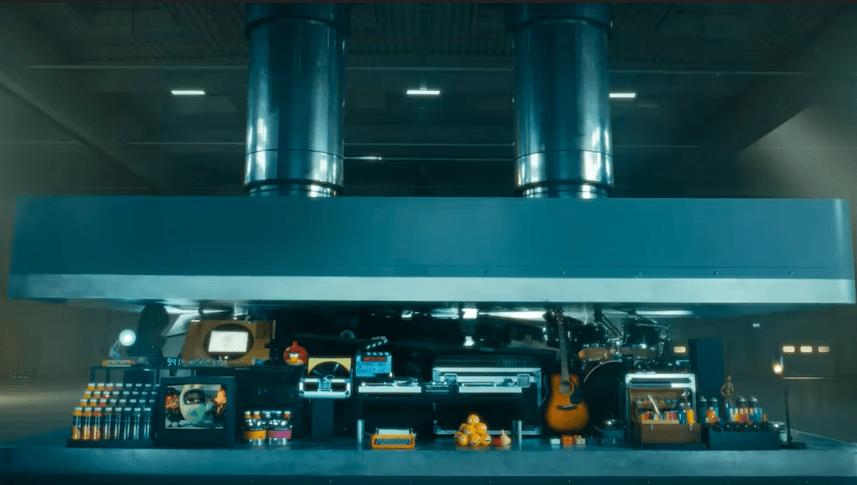
Stuff may have won this battle, but I fear the enemies of stuff are winning the war. Proselytisers for a single, shiny black rectangle, one easily portable vector conveying the entire spectrum of human knowledge and creativity through a series of neatly arranged subscription nodes. In some ways it’s a mutually beneficial arrangement. We, the end user, can finally gain closure from stuff, once and for all ejecting it from our lives. And they, the weightless new breed of cloud overlords selling their tech wears, they receive a reliable revenue stream through the rents they charge for access to their digital fiefdoms (as Yanis Varoufakis poetically refers to them), all through a single touchscreen.
But the bonfire of stuff extends well beyond knowledge and culture. Big protein is coming for your food. Its ambition nothing short of divorcing us from the simple yet endlessly appealing joy of dumping matter down our gullets, a joy we share with all life. Everything from the sad meal deal to the lovingly homecooked dinner to delicate restaurant whimsy, all are slated to be replaced by a homogenous, suspiciously glowing brown goo, served in a utilitarianly branded plastic drinking vessel. We may laugh at Huel converts today. We may scorn the overreach of attempting to eject solids from our diet. We may argue that food is just too fundamental to understanding ourselves as organic entities in an organic ecosystem. This could never be replaced by a set of powders delivered in smugly resealable pouches, under the administration of another faceless subscription service. But we thought the same of Apple in 2024 even as we continued to hand over our books, DVDs, and records whilst outsourcing the need to own and practice musical instruments to generative AI.
I know what you’re thinking. You’re the kind of person who didn’t hand over their books or their records. You still collect things. Physical media is important to you. You even sporadically play a musical instrument when time allows. And that’s just great. I’d also love to wax lyrical about the virtues of throwing on an LP over the sterility of streaming, or the smell of a printed page over the cold minimalism of the Kindle. But once we’ve finished wanking the impotence of it all returns like a bad hangover. Things have moved on. We, the stuff faithful, are a vanishingly small minority. A subset of hobbyists. Consigned to a specialist community within a self-sustaining economy. Outside our microcosm, macro events are conspiring to eject stuff from the universe once and for all, and a handful of audiophiles drenched in their own ejaculate will not trouble their plans.
No, for that you need a more belligerent demographic. Gamers for example. Now, these people may be little more than vermin. Malformed adult sized babies unable to comprehend their own existence without manipulating imagery and data on a screen with pointlessly repetitive hand motions. Culture’s sickening underbelly desperately bleating that the toys they drool over have the same value as art or literature. But for all the visceral loathing they inspire, gamers are also the pensioners of culture. And as any politician knows (save our soon to be jettisoned Labour leadership), don’t fuck with pensioners. They will come at you with everything they have. A devastatingly powerful demographic not afraid to wield that power even if it means burning society to the ground.
This makes PlayStation’s decision to remove hundreds of films and games from its library, content people had purchased outright (albeit in digital form), look like a suicidally tone deaf move. That some were speculating that Sony did this to make room for AI’s abyssal appetite for computing power is of course the icing on the protein shake. But in doing so, Sony may have just resuscitated the corpse of stuff.
In the war for stuff, my enemy’s enemy is my, well, not friend, but it’s useful to at least point gamers in the right direction on the battlefield. And as they emerged from whatever putrid swamp they inhabit to the news that the content they owned yesterday had just been wiped from the face of the universe by PlayStation, they took to the airwaves on war footing, tantrumming their way through TikToks and forum posts with gusto. One hopes this will be followed by gamers wielding their enormous spending power and penchant for smear campaigns. A devastatingly powerful consumer base has suddenly realised that, unless you hold an object in your hand, ownership is only ever at the behest of someone else, in this instance a tech company that would literally boil your eyeballs in their sockets if it meant increasing their margin.
But primarily, this episode has highlighted just how vitally important stuff is. If this can happen to products people thought they had bought outright, what could it mean for our reliance on streaming platforms? All it would take is for three, maybe four companies to fold or suddenly decide to withdraw all content from their platforms to remove 90% of music, film, TV, and literature from your life in a heartbeat. And all you’d be left with is an empty room, a pouch of conceitedly branded protein powder, and memories of the shot composition in The Lost Boys.
At the time of writing PlayStation hasn’t buckled to pressure. But with gamers joining our ranks the stuff militia will once again be on the march. Buy the CD. Take that guitar off eBay and hang it back on your wall. I myself have been maniacally putting up shelves in anticipation of what’s to come. And to our digital overlords, you may hold all the power, all the subscriptions, but you’ve extended yourselves too far this time. Stuff is coming for you. Offline stuff. Physical stuff. Undeletable, messy, substantive, rapturous matter.


Damn straight. I will never give up my stuff esprcially my CDs and vinyl. And I play them every day.
LikeLike
Don’t fetishize objects. The book isn’t the paper, and the music isn’t the plastic. I have all the media I need as files on my PC, backed up on several flash drives. Any book and disc I donate or gift to someone. If it was worthwhile, I wouldn’t forget it so easily that I need a daily reminder gathering dust.
LikeLike
Metalheads for example. Now, these people may be little more than vermin. Malformed adult sized teenagers unable to comprehend their own existence without listening to someone screaming about teenage angst they refuse to grow out of over pointlessly repetitive noise. Culture’s sickening underbelly desperately bleating that the music they drool over has the same value as classical.
LikeLike
Thank you for this article. Theese are in deed dark times we´re living in.
I´m very aware of the Sony Situation. I myself used to be a gamer and I´m still sporadically playing games from the 90s to early 2000s. But I´m not actively gaming anymore. Similar to how I´m almost not actively listening to metal anymore. I´m sad about the fact, that obviously all physical things tend to get discarded for subscriptions and other online sources.
About 6 or 7 years ago I found an old video store by accident, long after I had given up on those stores. I became a member and am renting about a dozen movies a month now. Before this I had lost all interest in movies. When I began renting the dvds I asked myself what had changed. I think the difference is, that there is no effing algorithm “curating” what I will watch. Because the stuff that was reccomended was almost always terrible with little to no story to speak of. Also a movie on a physical disc I got myself is something that I really want to watch. I can´t just swipe it away. And then there are the people in the store, there is a small community. All those things are absent in the digital space. At least to me.
But I´m also aware of the fact, that I´m in the minority. Almost all other people around me use streaming exclusively for all their media. And I hate it. It´s so sad to see how influences society.
LikeLike