The noise diaries XVII
There’s maybe just one more heat wave standing between us and a seasonal reset. Brown leaves are already littering the ground in the North of England. Autumn is in the bones. I think I’ve finally reasoned my way through why I take such umbrage with summer, and it’s nothing to do with the weather (sort of). As a creature who values stability (some would say stasis), I feel most at peace when the weather – and hence the world around me – is most in flux, it offers a clear and physical contrast with my own state of rest. But in summer these positions are inverted. The nature of my job means that I am at my busiest in the summer months, I am at my most transient just as everyone else stops, goes on holiday, or lolls around in beer gardens.
Welcoming the coming transience of autumn is the theme then. A time when all the pieces are once again thrown into the air. Schubert’s final sonata in B flat Major has always been one of my favourite pieces of music, despite its bloat and repetition it conveys a sense of flux through incessant modulation. From there, death/doom oddballs Supuration have also resurfaced in the listening rotation, their 1993 classic ‘The Cube’ every bit as hard to grasp as it was when I first encountered it. And finally we feather the nest with a more recent pick from Plague Bearer, the black metal oriented side project of Drawn and Quartered alumni.
Franz Schubert. Troubled, gifted, unlucky in love, died young, pretty much the archetype of a tragic romantic. Much like his contemporary Beethoven, his work straddles the transition between the classical and Romantic era. Forming the vanguard of classical music’s shift toward fragility and idiosyncrasy in a post Mozart universe. A more individual, emotive, erratic creature carried forward perhaps most convincingly by Chopin but finding expression in Schumann, Bruckner, and Mendelssohn in contrast to the confident swagger of Liszt or Wagner’s Romanticism.

Many of his most lauded works came after the death of Beethoven, including the Wintereisse series, Fantasy in C major for Violin, and of course the last three piano sonatas, the very last of which, D. 960 in B flat Major concerns us here. Despite being amongst the last pieces he wrote for solo piano, and the lasting impact of Beethoven’s death on Schubert notwithstanding, it would be wrong to construe them as his most Romantic works. The final piano sonata, despite its extreme length and acutely distinct melodic signatures, is still very much in keeping with the Beethoven tradition.
Glenn Gould didn’t like Schubert. He found him plodding, repetitive, trite. That is, until he heard Sviatoslav Richter give an achingly slow recital of the B flat Major sonata, inflating its already considerable length whilst illuminating the subtle motion at work behind this piece.
My understanding of Schubert has always been somewhat simplistic. The main themes, much like Beethoven, take on an obvious, almost clumsy gait, but through their laborious unfurling they somehow become “inevitable” (in the words of Leonard Bernstein). But where Beethoven largely sticks to the rigour of the sonata form, any variation in the main theme following the development section being somewhat conditional or forced, Schubert introduces an array of modulating, ornamental material that gives the music a sense of life and emotion over and above its architecture. But further, such is the significance of Schubert’s use of key changes and elaborate decoration that they become part of the piece’s foundation, they transition from matter to form. In the words of Gould, through Richter’s sluggish interpretation he was able to see what he initially mistook as decorative flourishes as “organic elements”.
It is true that, unlike Beethoven, Schubert sometimes throws clusters of interchanging arpeggios, modulations, trills, and lyrical melodies at the listener, whose sole purpose, if one weren’t looking too closely, is to cover the extent of repetition on display. But through Richter’s slower interpretation one is afforded the chance to peer through the cracks and understand how each theme finds its echo within the supplementary material, the latter working to contest and evolve the former. It’s a less profound but perhaps more delicate balance Schubert is attempting here, between a cerebral exercise in thematic unity and a flamboyant, emotive energy that weaves its way between what are at times rather dry statements of intent.
Such is the breadth of moods and tones explored by Schubert across this sonata that one is afforded the chance to witness this subtle tension play out in an array of contexts. The determined narrative of the opening movement. The aching, funereal desperation of the second, the playful, dark to bright transformations taking place across the third and fourth. Such a wealth of material and wide ranging scope in a single piece is bound to invite competing and at times contradictory interpretations. A piece that seems to evolve and transform with the listener as their tastes and intellect evolves over time.
Some artists form part of your immediate circle. You remain intimate with them and catch up frequently. Some are old acquaintances, stoic and distant, but always welcome. And then there’s old flames. Artists you had a fling with many years ago and then forgot about. Supuration are one such example of this for me. Following an intense six month affair back in the early 2010s as they began putting out new material, culminating in catching them at Hellfest, I largely forgot about them. I don’t know what made me pick up ‘The Cube’ again after all these years. But my instincts proved correct, this album is exemplary of what I’ve come to call “high death metal”. After the initial wave of founding documents were issued between roughly 1988 to 1992, death metal entered a period of flux, pushed toward a disastrous commercialism at one end, yet displaying a remarkable determination to forge into uncharted experimental waters at the other.

Although we can chart this onward thrust in artists from its former heartlands, Incantation, Gorguts, Pestilence, Atheist, Demilich, and Morbid Angel all carving out niches throughout the 90s, the spread of death metal outside of these borders led to many accidents of nature, chiefly throughout Eastern Europe, South America, and of course France. A nation whose anomalous metal output over the years is every bit as eccentric as its wider artistic reputation. Supuration are no exception here. ‘The Cube’, released in 1993 at the beginning of the high death metal period, is an amalgamation of Peaceville melodic doom (specifically early Paradise Lost), classic progressive metal, industrial stomp, and a heavily conceptualised narrative flow. All packaged in a downbeat iteration of classic metal swagger.
The album oozes idiosyncratic melody, yet manages to remain drab, depressive, borderline monotonous. Something only hammered home by the clean, robotic vocal work supplementing the measured distorted growls. The rhythm section poses as a linear, backbeat driven foundation, only to hack itself to pieces at consistent intervals, thus challenging the melodic flow to wrap itself around these irregularities. This in turn elevates segments defined by their driving momentum, most obviously on the lead refrain of the title track, which sees Supuration reach a state of uncharacteristic euphoria.
The muscle of the rhythm section frees the guitars up to engage in a more complete package of lead work than is typical of death metal, hence the comparisons to Paradise Lost and earlier iterations of heavy metal. To get around the rhythmic challenges presented by the drums, a lot of melodies are delivered staccato, a pulsing, disorientating unfurling of developmental material reminiscent of electronic over any obvious rockist tradition, in some ways anticipating the signature industrial contouring of Desecresy.
Marshalled into this brew are elements of heady thrash in the likes of DBC, Voivod, and Coroner, filtered through a death/doom lens, losing any sense of 80s optimism or bounce in the process. A deadpan, oppressive, and unsettling exercise made all the more remarkable given that that these traits are so rarely achieved within the medium of death metal.
Revisiting top picks from the recent past, “feathering the nest”, is an instructive exercise. Anyone that spends their days trawling through the dearth of quality new material is liable to pounce on anything halfway decent and hold it up as exemplary in desperation if nothing else. Plague Bearer are one such example. Despite forming in 1992 the project never got off the ground whilst its primary members were focused on Drawn and Quartered. 2023 saw the release of their debut album which, to broadly sum up, feels like listening to Immolation play black metal.
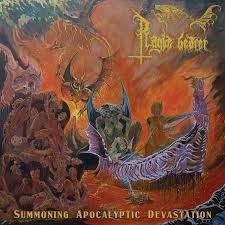
On balance the material holds up incredibly well. Elements of Gorgoroth sit happily alongside Incantation riffs without feeling incongruous. The album oozes power and confidence. The production is raw yet immersive, creating a visceral, physical experience, achieving a sense of mysticism regardless. And of course, the efficient guitar leads scattered throughout scale the vertical summits of Rob Vigna at his best. It shines amongst the output of 2023 not least because its members have a clear understanding of the genre norms they are working within, how to motivate, integrate, and communicate through them. There is a clear signature at work, dictating the contouring and flow of each piece, fleshing out an identity that so many younger artists lack.
And yet ‘Summoning Apocalyptic Devastation’ was not greeted with the same enthusiasm amongst some of my peers. The reason is simple, and common to most quality material in the last decade or more. Limitation. Each track either pivots on a single good idea onto which lesser material is hung to flesh out the experience, or builds to a single glorious moment of high drama that, whilst suitably prepared for in the preceding material, fails to link up with anything equally substantive, and so lacks balance, a showstopper without a show. If we compare – somewhat unfairly – this album to Immolation’s ‘Unholy Cult’, each track on the latter forges inherent links between moments of revelation and chaos, passages unfurl like new chapters in a book, connected but distinct from its prerequisites. Plague Bearer easily clear the first hurdle, but fail to carry their best ideas beyond their context, thus condemning them to an active but limited life within their confined moment. The clearest illustration of this is the simple fact that the tracks, although short, are all highly repetitive.
That Plague Bearer are even capable of failing at this higher level is cause for celebration however. And there’s a reason I return to this album more than most released in the last five years or so. ‘Summoning Apocalyptic Devastation’ unlocks a potential for more within modern metal. To make direct comparisons with an album of Unholy Cult’s calibre would be pointless in 99% of instances, but here it serves a useful purpose in highlighting where this album shines and where it may fall short.
 Hate Meditations
Leave a comment