Time to hear different
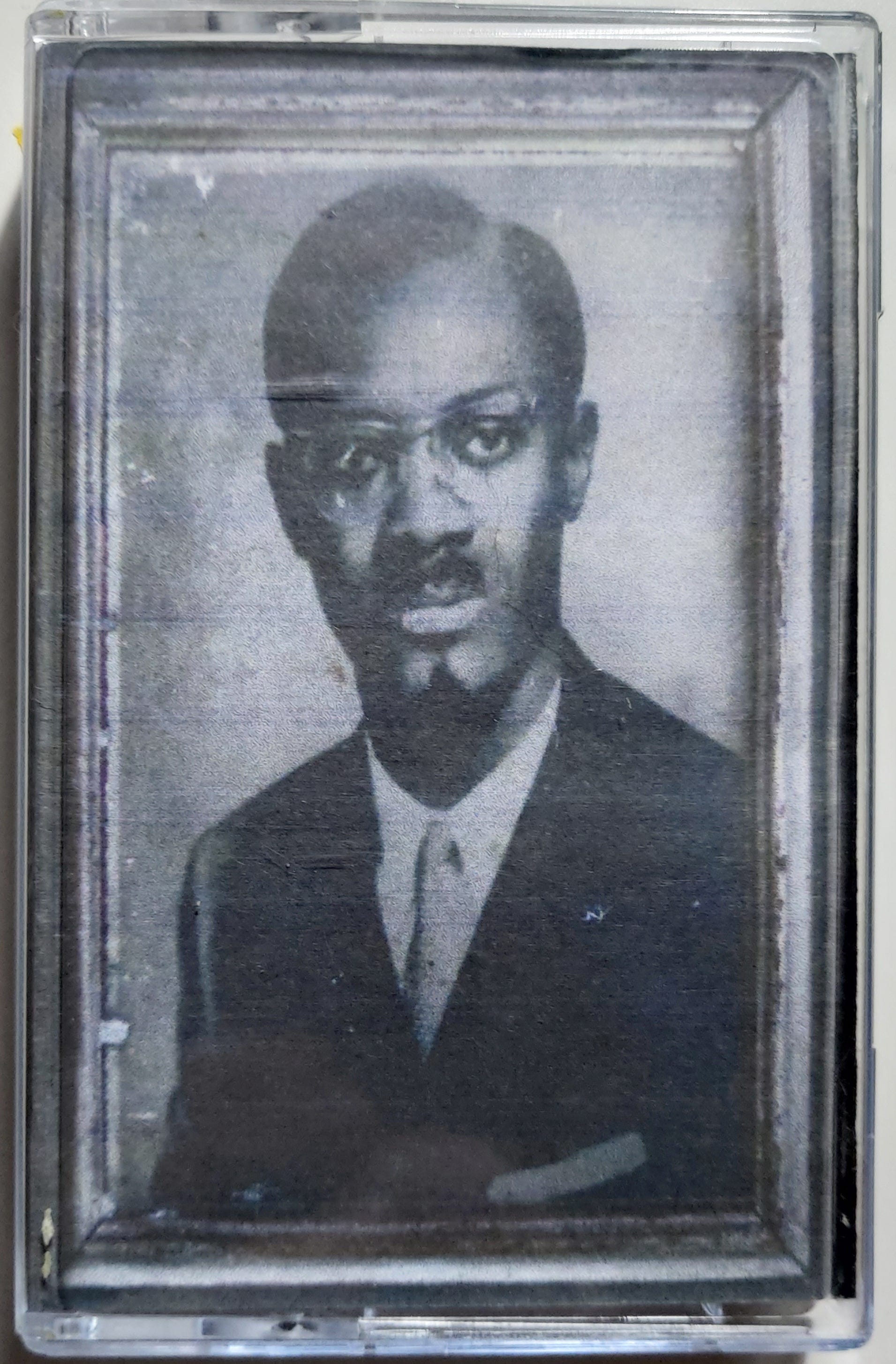
Strange things happen in your thirties. You become irrelevant. But instead of accepting this with grace, you desperately cling on, gestating within you a borderline intolerable personality. One that continues to hog the zeitgeist, unwilling to relinquish its toys to an upcoming generation desperately trying to push you aside. You nurture an arrogant entitlement toward culture only made worse by the fact that you actually have been around the block a few times by this point, you have seen some of the world, metabolised a portion of life’s rich tapestry. You are, in many ways, wiser than a twenty year old. But you’re not yet old enough to realise that you no longer matter. You are not the main character anymore. It’s supporting roles till death from hereon in. Accept your fate with grace.
How does one cope with this debilitating condition? I myself cultivate a mile deep inch wide approach to taste curation. Embrace ossification. Claim mastery over a tightly limited space to save yourself the indignity of intruding where you’re not wanted. Spend time putting down deep and lasting roots. By time, I mean the aching years of focus and meditation required to truly know an artform, to get under its skin and analyse its every orifice. To fully commit to this process is to relinquish any chance of hearing other music, let alone understanding it. Their content washing over me, gestures I have no business trying to decode, any complexity and nuance lost on my calcified ears.
This goes against the instinct of the serious music fan. They are forever attempting to embrace the world’s rich bounty. Regularly auditing their taste for variety and breadth. Many of my friends play this role of cultural safarist. Happily extending their tendrils into the cornucopia of music on offer to the modern fan. The asymmetry between us is, at its best, quality pub fodder. Generating lively and spirited debate despite our diverging tastes. At its worst, it results in me receiving a mixtape. How did it come to this?
On one such marathon pub opera, I was cornered into performing another clumsy rearguard action to defend my position. Why, my friends wondered, did I still refuse to engage with jazz? Have you no curiosity? It had been a long day. I was on the outside of many beers. I was not on form. Given space and sobriety I might have said something like “there’s a lot of music out there, I don’t have the time to familiarise myself with all of it in a way that I would find satisfactory, so I’m happy staying where I am for the foreseeable”.
But even this qualified retreat is a provocative statement for someone knee deep in the eclectic impulse of aging music fans. But its a common gambit when my friends and I are arguing. Grab the attention with a headline, and retrospectively defend it in meticulous detail, regardless of whether you actually believe what you’re saying. I might have started by framing it not as an intellectual claim, but one based on the pure experience of music. That I struggle to emotionally engage with music too divorced from what I already know about my taste. It’s not a hierarchical claim. It’s actually a kind of inverse cultural appropriation. In that I am so averse to cultural appropriation that I’m simply incapable of being moved by unfamiliar music. Maybe I would have reiterated that it was merely intended as a provocation. A corrective to dilettante overreach, at eclecticism for its own sake. It’s more about the virtues of intense intimacy with a limited cultural zone. It’s not actually a reflection of my own listening habits. Maybe I would’ve got carried away, and framed it in the context of a wider racial discourse. Highlighting that “white” culture plays the role of invisible default, its most profound achievements in pop culture since the 1950s the result of appropriation from non-white cultures, and that genres like metal and neofolk are examples not only of modern white culture, but demonstrate that white culture – far from being invisible – is actually fucking outlandish if left to its own devices. And that I enjoy spending time with this idea, trying it on for size now and then.
Instead I said I don’t listen to music made by black people…the awkward pause. Choose your next words carefully. They will make or break you. Shall I mention the Suffocation albums sitting on my shelf at home? We’re very close to a classic racist finger trap. The harder you struggle against what you just said, the worse it’ll get. So I didn’t struggle. I got up and left. I had a train to catch.
The crime: accidental racism. The verdict: guilty. The sentence: a mixtape. The moral: never provoke a newly recruited jazzhead. The rewards in seeing their face redden as you stubbornly rebut their advances are lavish, but the punishments in the form of a hefty mixtape are equally…lavish.
The setlist:
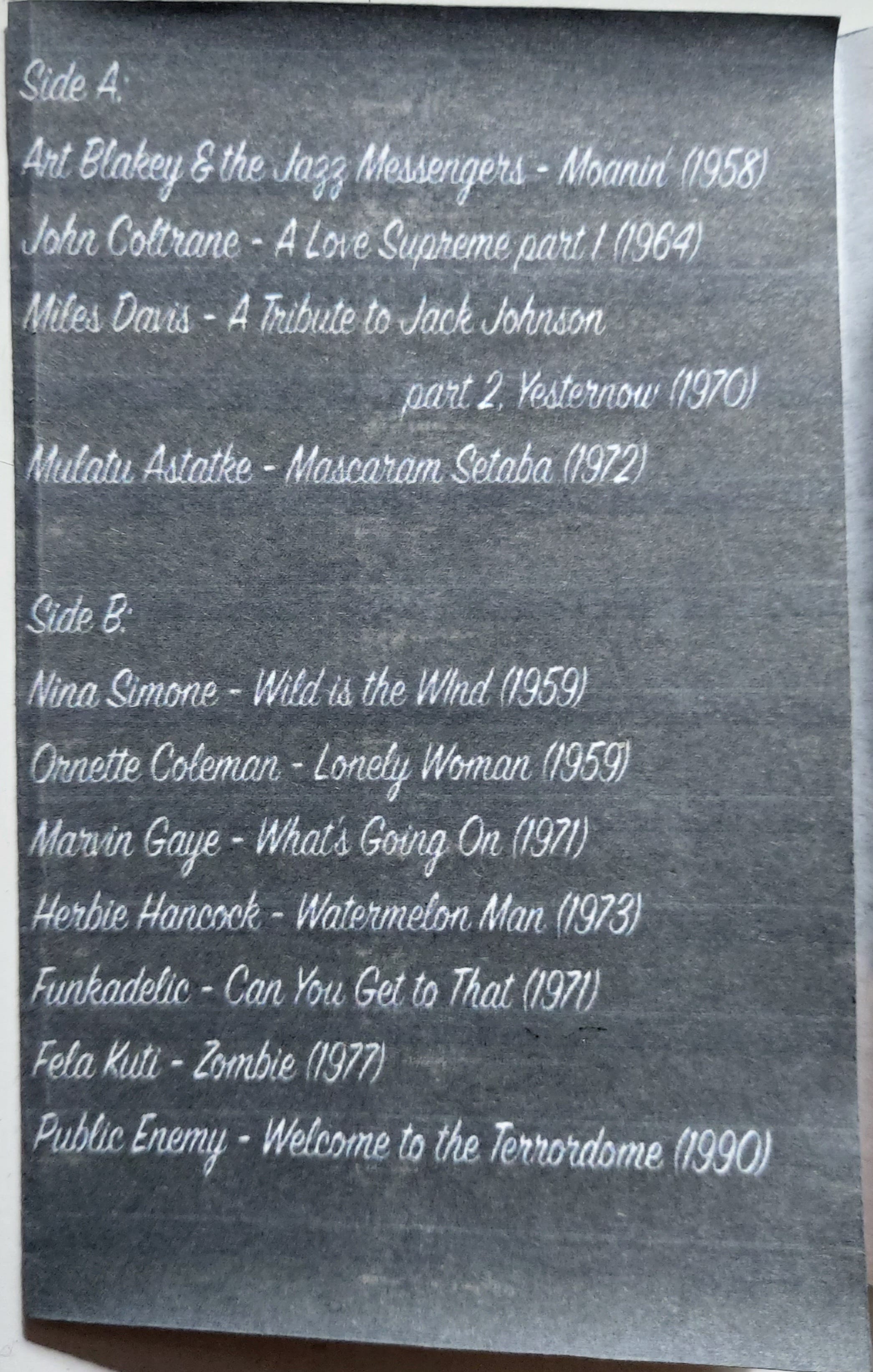
Given the dominance of household names, I must have emphasised my narrow horizons more than I thought. This might shock you, but out of choice or not, I’ve listened to some of these artists before. That being said, we certainly aren’t in Kansas anymore. So I resorted to Google for some on the fly curation to save me from devolving into inane babble.
Since receiving this tape, I’ve been interrogating why this sort of jazz does nothing for me. Is it association? For example, late Romantic music’s association with Looney Tunes style cartoons in the modern Western mind is so close that hearing the music afresh, divorced from absurdist imagery, is an act of sheer will many are incapable of. It just sounds like a chaotic mishmash if not regarded with the proper attention. Similarly, Art Blakey, John Coltrane, the loose, swinging exchange between brass and piano are so closely connected in my mind with images of smoky bars, grainy black and white footage, American mid-20th Century urban sprawls, decoupling it from this and accepting it on its own terms takes some mental gymnastics. Even the Debussy-esque flowing piano lines of Nina Simone fail to transport me.
Maybe it’s education? Admittedly my formal music training ended nearly twenty years ago. But the association of jazz, and for that matter samba and salsa, with dry academia – list the time signatures, name the cadence, improvise for eight bars in the key of G – has stripped it of all joy. The tedious jazz and blues exercises my first piano teacher Keith foisted on me have left lasting scars. Why then, you ask, were you able to cultivate a love of classical music? Surely no other form has been sapped of joy by dry academic study than classical? It’s the bane of any young student’s life.
I think this is because when I was sixteen my parents switched me to a new piano teacher. A wizened old woman called Eleanor. Her passion for classical was intoxicating. Her arthritic fingers danced over the keyboard with an athleticism that put my fresh young hands to utter shame. I’m pretty sure the last non-classical album she encountered was Revolver. Other forms of music just didn’t exist in her world. It was all she ever needed out of life. She taught me that Bach sounds good at any tempo, so always prioritise him in your practice and play it slooow. She taught me that Beethoven’s mastery of chords is still unmatched. She encouraged me to take joy in his first piano sonata despite it being beyond my abilities. She taught me to enjoy spending time in every bar, there’s a wealth of artistry contained in each moment. She taught me about modern dissonance, the physicality of Chopin’s leaping octaves. She imbued within me with a passion for classical that the rather procedural Keith was unable to do for blues and jazz.
Eleanor’s hyper fixation probably influenced my attitude to other genres more than I realised. The idea that you can spend your entire life with one – admittedly broad – form of music and understand it with a degree of familiarity bordering on the pathological. Her influence on me is something I’ve not thought about for some time. Unpacking it all these years later is illuminating.
Or maybe it’s because I’m a screaming racist. A lot of the jazz on this tape flows with the informality of a conversation, totally distinct from the preconceived narrative forms I tend to favour. It requires a different ear. I think I’m starting to hate conversations. Conversation is what got me here. Remind to avoid them in the future.
Miles Davis’s ‘A Tribute to Jack Johnson’ fairs better in the ensuing carnage between me and jazz. The tension of the stop/start rhythm, the intentionality of the trumpet lines allows me to decouple the instrument from its inherent whimsy in my mind. The Fripp-esque world building in the tentative guitar chords, degrading the building blocks of riff into a looser cement, a more flexible module of composition.
Mulatu Astatke takes us forward a bit, he is “an Ethiopian musician and arranger considered as the father of “Ethio-jazz”” according to Wikipedia. A more organised, consistent presentation, the playful polyrhythms holding my attention for a time. This in turn is followed by Ornette Coleman. More brass, more loose rhythms. I enjoy the idea of exploring more jazz. An urge that quickly dissipates when I sit down and listen to it. Marvin Gaye’s ‘What’s Going On’ brings a necessary change of pace and genre. But whatever is actually going on confirmed my suspicions on my relationship to Marvin Gaye, a cold, indifferent, and very distant one.
I guess my friend pictured me putting this tape on late at night, with a glass of whisky, maybe some light reading. I would press play, and let the music flow over me as I discover a new world I had never fully regarded with the attention it deserves. Whilst this expectation wasn’t entirely unrealistic, it underestimates the amount of damage of I’ve done to my brain since Keith’s repetitive blues drills. Not the good kind of damage. Metal, classical, ambient, neofolk, what these genres have in common is their need to over explain themselves. They make pretty damn clear to the listener what they’re about, telling you in no uncertain terms where to look at any given moment. There’s always a main character, a clear thematic or aesthetic intent flowing through each passage. An insistent flow that’s pretty hard to miss. That’s why I favour them. I don’t listen to music to furnish my day-to-day activities with a soundtrack, I listen to music to listen to music. I therefore need music that spells itself out for me.
If we set aside that ingrained cultural programming immediately delivering a series of images into my brain whenever jazz or funk is playing, it’s actually pretty ambiguous music. The material I’ve been tasked with here is multi-dimensional, simultaneously flying off in several directions, leaving sentences unfinished, transferring to a fresh segment only tangentially related to the last. I cannot, to borrow a phrase, get my ear into it.
The tape finishes with Public Enemy. I’ve heard of these guys. It’s not a particularly original thought, but I don’t think middle class white guys, especially the English variant, should be listening to this sort of thing for pleasure. It’s not for people who grew up in Southwest Surrey. It feels voyeuristic. I’m witnessing something I shouldn’t. I shut the tape off before someone catches me.


“I don’t listen to music made by black people”
It’s nice to know that all metalheads have a Varg inside of them, screaming to come out, no matter how proper and civilized the opinions they hold at an intellectual level.
LikeLike
Most humans have an intrinsic bias. It’s a natural protection mechanism from times when we competed for food to survive.
Harvard even has a test for determining intrinsic bias – the Implicit Association Test.
LikeLike
I don’t think it’s racist. Music has or should have a cultural aspect to it. That is part of what gives it uniqueness and its value. Mozart to Michael Jackson to Sex Pistols to Public Enemy to Cannibal Corpse are all products of cultural factors relevant to that historical period.
Now some of these cultural factors can be long standing (eg classical music as exemplar of European high culture) to very short time span (eg Spice Girls).
And if you don’t understand those cultural aspects it can be very difficult to enjoy or truly understand an art form.
I like classical and go to see it live. But I do feel somewhat disconnected from it compared to seeing a metal band live. The cultural aspects of metal are also my cultural aspects. It resonates with meaning. Classical music harkens to a different more aristocratic world that no longer exists.
Similarly K-Pop or Rap music have no cultural bearing on me so I don’t enjoy them whilst a Korean person or African-American will find great intrinsic satisfaction in it.
From a pure metal perspective, I think it’s also why metal resonates in some countries more than others. Eg France is one of the largest countries in Europe but a minor player in heavy metal, in fact a proverbial midget! Heavy metal didn’t resonate in France like it did in Britain (in the past), Germany, Greece, Sweden or Finland. So not many French metal bands came out and they never developed a massive thriving scene like other European states.
LikeLike
“Eg France is one of the largest countries in Europe but a minor player in heavy metal, in fact a proverbial midget!”
I simply cannot agree with this statement. Massacra, Mutiilation, Antaeus, S.V.E.S.T., Suhnopfer, Aosoth, Inkisitor, Malhekebre, VI, Ritualization, Ancestral Fog, Annthennath, etc. And also far from a minor player in terms of influence, since probably the two most influential labels of the 21st century, Norma Evangelium Diaboli and End All Life are both based in France.
LikeLike
You prove my point by mentioning a few very obscure bands and a couple of small labels.
Compare that to US, UK, Germany, Sweden, Finland, Norway and even Greece and Denmark.
The only major players to ever come out of France are Trust and Gojira as well as some off kilter black metal (Alcest, Deathspell Omega and Blut Aus Nord).
France has never had a large or prolific metal scene. Metal has never really attained the sane level of market penetration as it has in so many other western countries.
I suspect it is cultural. Metal doesn’t resonate with French youth in the same way that it does in Germany or Finland or in the past, the UK.
LikeLike
It seems difficult to call the above bands “obscure” on this blog when Massacra was cited by basically every early ’90s death metal band and their debut was listed as the greatest death metal album of all time by a certain notorious website that Shelly has written about in the past, and when Shelly took his username on Metal Archives after the slogan of another one of them (Antaeus). Likewise, it seems strange to call N.E.D and E.A.L tiny labels when a band you admit is a major player (Deathspell Omega) is signed to N.E.D., has a singer that owns E.A.L., and who took on their current musical direction entirely to follow the zeitgeist of what E.A.L. and N.E.D. were releasing in 2000-2003.
Black metal as a genre has basically been run by the French for about 25 years now. Even with non-French bands, all roads for underground black metal bands that formed in the 21st century or first achieved notoriety in the 21st century lead back to the French scene. The collapse of Shadow Records in the late ’90s leading to their upcoming releases all getting picked up by French labels (most notably E.A.L. and N.E.D., but there were others involved such as Battlesk’rs) combined with the importance of the warlust.net forums in the early 2000s (it was the forum that pretty much every musician that played black metal, from any country, posted on) combined with MKM relentlessly bringing bands from other countries to play in France in the early 2000s made it *the* player in black metal.
LikeLike
The amount of work that Terrance Hobbs and Mike Smith are doing these days to make white people feel not racist threatens to overshadow their actual contributions to the genre.
Jazz was not intended to be background music any more than metal was intended to be played during timeouts in hockey. These are just incidental to the genre, like late romantic musics association with Looney Tunes (also a barrier for me to enjoy it).
You’d probably have been better off saying you’re not into it and leave it at that.
LikeLike
I’ve despised the rootless music nerd and “eclecticism for its own sake” for a long time. It’s better to know little than to half-know many things.
Also, I don’t know what personal consumption habits have to do with racism. I used to listen to a lot of black rappers. For the most part, I’ve lost my taste for rap music, and I don’t know how any black person could be better or worse off as a result, in terms of actually existing material reality. I’ve listened to some Art Blakey, Pharoah Sanders and Don Cherry. Although I don’t understand jazz on a deep or even superficial level, it’s easy to tell that a great deal of musical talent and craftsmanship goes into it, and I appreciate that. But my own music explorations have always been motivated solely by personal curiosity, not because I’ve ever felt as if I owe it to any culture or ethnic group to “enrich” or “diversify” my own personal consumption habits. Again, I don’t know how any ethnic group could be better or worse off, depending on whether a white person spends an equitable chunk of his or her private leisure time listening to music by black artists.
LikeLike
I don’t think jazz, funk, soul, etc. are nearly as ambiguous as you think they are (and it’s certainly not background music!)–it’s just that they have an entirely different internal logic from the theme-based development of classical music and metal. These forms of music are based around the rhythmic groove (entirely different from “groove metal” in the Pantera idiom, which despite its name is completely lacking in groove, which is why it’s so tedious)–if you can’t get and stay with the groove, the music will just wash over you and you’ll miss all its subtleties and intricacies. The groove in turn is rooted in the bass, which is usually a pretty marginal instrument in metal but is the alpha and omega of much of black American music. If you are lost, follow the bass. As an American, I never really had any choice whether to understand this sort of music or not–it is the music of my country more than any other sort of music. It is the musical air Americans breathe. But yes, it is “conversational” compared especially to classical music, which is quite aggressively didactic. The musicians are all interacting and playing off one another’s ideas in real time, and the musical culture of black America has generally been a lot more communal and collective than that of European countries (though that is changing with the internet, mega-celebrities, and stan culture turning what was once communal into almost fascistic cults of personality dedicated to the individual superstar).
Granted, I have my own musical blind spots and thinks I don’t get–notably death metal, for one. I love classic heavy and thrash metal, Norwegian black metal up until around 1996, and above all the ’80s US power metal scene (it’s not just “sword and sorcery” damnit!) but death metal has always reminded me of the mortuary and not in a fun, gory way–emotionless, antiseptic, atonal, and sterile, a harmonic desert of empty power chords and random, meaningless tempo changes (and no, “melodeath” isn’t the answer, that shit’s even worse, like it doesn’t know whether it wants to be power metal or death metal and fails at being either).
Also I’m glad to have had classical record dealers for parents as my associations with late Romantic music involve old records with the smell of foreign houses and liner notes written in lofty (some might say pretentious) language I was not quite old enough to fully understand. Of course I watched Looney Tunes, but Living Stereo and Deutsche Grammophon overrode “Kill the Wabbit” as my primary association. Now, baroque and especially 18th century music (Haydn, Mozart, et al), that makes me think of drawing rooms, knee breeches, powdered wigs, servants, and people with four middle names who think it is scandalous to say the word “legs”. If Haydn’s audience heard Scheherazade or “Siegfried’s Funeral March” they’d have to retire to their fainting couches.
P.S. if you think Public Enemy is something white Englishmen have no business listening to, I remember when my dad blasted The Last Poets’ debut, which makes gangsta rap seem downright prim in its brutal confrontation, especially since they (a group of Nation of Islam-adjacent communist black Muslims) said “n—er” with the hard R, and said it all the time. “N—ers are Scared of Revolution” has to be one of the most racially inflammatory songs ever put to tape, complete with the background being two of the guys chanting “N—ers, n—ers, n—ers” over and over and over while the third chastises, in a voice that is halfway between rapping and a hectoring, ranting stump speech, early ’70s black people and black culture for their lack of revolutionary consciousness, martial discipline, and willingness to kill and die, while himself saying the N-word just about every line. We’re talking music that openly, brazenly advocates for race war and hatred of white people, being listened to at ear-shattering volume by an old white guy. I wanted to shrivel up into myself and die.
P.P.S. Now that I think of it, chamber music might be a good introduction to understanding the “conversational” nature of improvised black music, since it is quite “conversational” itself. Goethe described string quartet music as “four rational people conversing”, and a lot of white jazz music (perhaps ECM Records’ oeuvre most of all) tends to have elements of chamber music in it.
LikeLiked by 1 person
“As an American, I never really had any choice whether to understand this sort of music or not–it is the music of my country more than any other sort of music. It is the musical air Americans breathe.”
As a fellow American (by technicality — I’m Texan, so not *really* American, but close enough for this conversation), I can assure you that you most definitely have the choice of ignoring Jazz, Blues, and Rap. I’ve been doing it for almost 40 years now.
“but death metal has always reminded me of the mortuary and not in a fun, gory way–emotionless, antiseptic, atonal, and sterile, a harmonic desert of empty power chords and random, meaningless tempo changes”
Check out the last Drawn and Quartered album, “Congregation Pestilence”. It’s death metal that’s heavy on harmony, both explicitly in chord choice and implied via melodic choices.
LikeLike