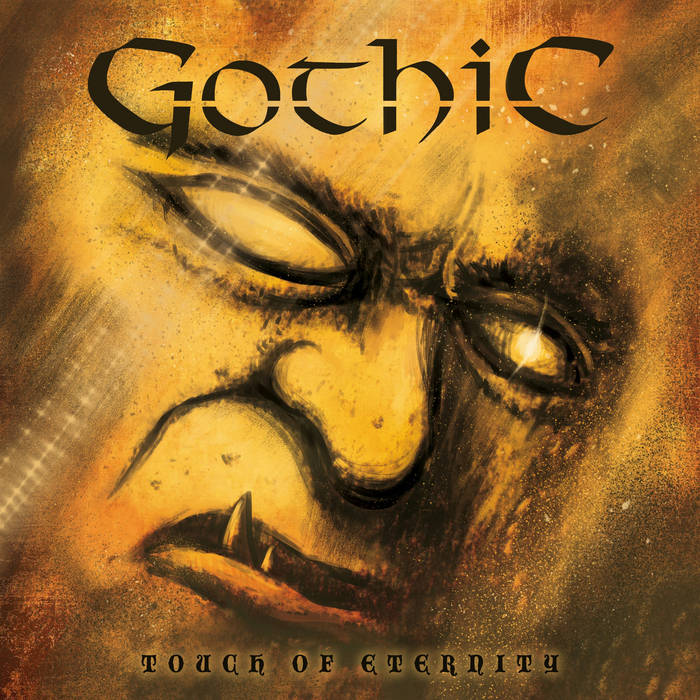
A Touch of Eternity
Out 16th December on Loud Rage Music (originally released in 1997)
Given the reserved, no thrills demeanour of my native North of England, it’s always puzzled me that a variant of overtly emotive, randy, flamboyant death metal bubbled up here in the early 1990s. The drab poise of the Peaceville bands certainly made for a neat counterweight to their Earache peers, even as they shared stages, scenes, and fanbases. But their fantastical interpretation of death metal, one that quickly evolved away from the genre entirely as its crossover with the still active goth scene solidified, feels incongruous next to the austere, grey, mundane reality of life in the urban climbs of Yorkshire and Lancashire.
Bands like Paradise Lost were charismatic enough to be propelled well beyond the borders of metal, becoming a household name in alternative circles at large. Despite their fingerprints being all over metal, many regarded them by the mid-90s as having long since detached from their roots, making their relevance to the genre an anomalous early outcrop and nothing more. An open antagonism led Paradise Lost and Anathema to turn even more dramatically away from a metal scene they began to regard with barely concealed revulsion. The fanbase that made their name being – at the time – unwilling to follow them all the way to the Depeche Mode love letters of ‘Host’.
As always, the story was not as simple as this well trodden narrative however. Death metal was not a coherent entity one could stand in opposition to by the mid-90s. Yet, despite tearing itself apart in the quest to evolve at one end and the open hostility to anything that reeked of compromise at the other, it had become a global phenomenon. It’s artefacts, techniques, and methodology all being picked up by a newer generation well outside the hubs it had emerged from.
Loud Rage Music continue their efforts to bring examples of this period to the light of day. Romania is not a country synonymous with death metal, but following the re-issue of Ultimatum’s ‘Among Potential States’, Deimos’s ‘Insane’, and now Gothic’s ‘A Touch of Eternity’, it’s time we reappraise this nation’s legacy from the mid to late 90s.
Its evolution is distinct from earlier vanguard scenes in Northern Europe and the US, whose adolescence was intimately knitted into the development of death metal itself. These Romanian artists are an early example of a commonplace in metal today, in that they approached death metal as a readymade genre, one with many variations, modules, and expansion packs available for appropriation, allowing artists to cobble together their own hybrid from its divers styles.
The dissemination of ideas is a strange and unpredictable process. In essence, Gothic’s debut album ‘A Touch of Eternity’ sits somewhere between Paradise Lost’s album of the same name and the follow up in ‘Shades of God’. Where PL gradually evolved away from death metal toward explicitly gothic influenced metal via the catchy hooks of Metallica of the same period, Gothic themselves resurrect the linear, melodic, mid-paced death metal articulated by earlier iterations of Paradise Lost, aiming for a purer expression, one adjacent to death metal, but equally informed by older heavy metal and doom, alongside some bizarre aesthetic choices – both vocally and texturally – that could only have arisen from the experimental freedom rampant in mid-90s metal.
‘A Touch of Eternity’ feels like a highlights reel of these musicians’ favourite moments in death metal to date, because that’s essentially what it is. And whilst it’s derivative enough of early Paradise Lost to warrant discussing them at length in this review, there is still a sense of freedom, unpredictability, and vulnerability to be found on this album, a daring, far reaching, ambitious presentation that engages even through its more questionable decisions.
Driving, basic rhythms underpinning highly melodic death metal makes up the backbone of this release, borrowing language from the fledging melodeath movement even if the tempo is slowed somewhat. But this template is peppered with imaginative lead guitar working in unison with the half sung/half barked vocals, foregrounding a clear lyrical centre to this music underpinned by vestiges of ideas that grew out of death metal, now a few steps removed.
This would be enjoyable in itself, but Gothic insist on reaching further than their grasp by attempting to lean into stadium rock anthems at times, awful clean vocals and all, alongside odd post punk interludes and link passages with little in the way of context to explain the juxtaposition, indulgent heavy metal jams, leaning into – and at times achieving – Candlemass grandiosity alongside emotive ejaculations that are more comedic than powerful. But these are compensated by such an engaging melodic flair that one can hardly help but submit to the experience.
It’s this combination of overreach and a genuine talent for composition and arrangement that gives albums like this such a distinct identity. There is nothing curated, controlled, or self-conscious about it. A moment of creative freedom, but one borne out of the wealth of material and influence that was available to musicians by 1997. In this sense it avoids the double edged sword of modern releases which are often both derivative and sterile in execution. Too aware of the immediate negative feedback facilitated by social media, too able to control and edit every facet of the recording process through the home studio, and too fixated on theory and form instead of substance and identity.
For all the rough edges to an album like ‘A Touch of Eternity’, the sense of careless freedom one gets from studying its composition leaves one yearning for a time when metal artists articulated clear visions that guided their work above and beyond a study in raw technique.
 Hate Meditations
Leave a comment