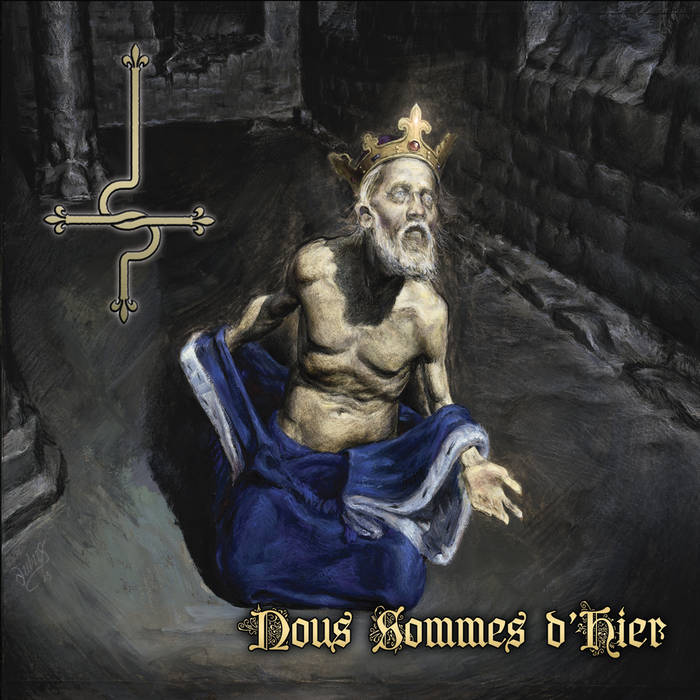
Nous sommes d’Hier
Out 6th October on Debemur Morti Productions
The more metal succumbs to anti-traditionalism, the more a rigid compositional discipline begins to look like an act of defiance. Many times metal has attempted to extract itself from the burden of melodic construction (I here mean melodic in the broadest possible sense, covering atonal and chromatic forms). Whether this be via shaky alliances with industrial, noise, jazz or the entire spectrum of music that sees itself as left-field, or embedding so deeply in dissonance that it becomes a genre prefix, or the extraction of substance itself via “post” metal austerity and minimalism with no overarching artistic goal beyond an affectation.
Far from being a quest for genuine novelty or innovation, the chief motivation behind these movements is simply to renege on the most difficult aspect of metal composition: writing a series of riffs that form a cohesive whole, knitted together by some underlying artistic identity. This could be expressed via traditional melody (‘The Red in the Sky is Ours’) or undulating chromaticism (‘Here in After’) or meditative repetitions (‘Transylvanian Hunger’). What these examples have in common is their ability to confront the uncomfortable question head on, how does one add to the vocabulary of metal without entirely de-anchoring the music? Or rather, how does one do this whilst retaining the right to speak on the evolution of the form?
Mainstream metal discourse utterly fails to grasp this nettle. As a result, works are foregrounded for their eclecticism, novelty, aesthetic, or production. Means are treated as ends. And the central fact of any revolutionary artwork is forgotten: to shed the burden of history, one must first engage with it. Current wisdom fails to do this. It therefore mistakes a lack of context or meaning for something revolutionary. The amnesia of metal is now endemic. To the point that metal bands celebrate the extent to which they don’t play metal. It is seen as something to be surpassed, transcended, rejected, diluted, a regressive shackle.
At times like this, we must turn to ‘Far Away From the Sun’. As with any great work, it offers new insight with each reappraisal. For all black metal’s primitivism, it was at heart a project driven by the reassertion of melody, but melody recast in an obscurantist dialog via aggressive philosophical flourishes. Sacramentum were keen champions of melodic dominance in metal. But they were ahead of the curve as far as black metal was concerned in that they had no interest in limiting themselves both compositionally and aesthetically. The presentation was ambitious and cinematic, creating space for a rich melodic language to unfurl in endless waves of undulating complexity, moving with an elegance and grace rarely seen in contemporary music.
It offered continuity with Iron Maiden, but connected this older language with a post Bathory extremity, giving rise to novelty that connected with a linear historical processes. It stands apart even amongst comparable watershed moments within mid-90s extreme metal for its ability to achieve such a giant evolutionary step within the confines of classical harmony. No post-modern sleight of hand, no atonal link phrases, no regressive dissonance.
The landscape of metal has changed in the decades since, to the extent that what was once an act of quietly confident defiance looks nothing short of revolutionary today. But Sühnopfer continue to attempt just that on their fourth outing ‘Nous Sommes d’Hier’. This album sees them expand the vocabulary of pure melodic expression whilst retaining fealty to a pre-classical contrapuntal interplay, weaving in a distinctive religiosity that marks them out from the paganist set.
Sühnopfer stand at the heart of a move toward melodic advocacy rarely acknowledged as such. Individual artists may be marked out for praise but are seen as outriders. But it’s worth connecting the intent of an Ungfell with the rampant violence of an Ultra Silvam, or the intriguing derivations of Indonesia’s Tombstone, or the sugar-coated theatrics of Brazil’s The Kryptik.
The scattered geography and divergent quality amongst this small crop of artists might explain the lack of discourse surrounding them. But there’s no denying that Sühnopfer are one the clearest and most established threads in this quiet revolutionary turn.
A bracing, neoclassical edge expressed through lightning fast tempos, dense link threads offering an embarrassment of riches as far as pure information is concerned, all are at risk of falling into homogeneity at times through lack of diversity. But this is studied music, one requiring our full engagement in order to fully trace the dramatic stakes and narrative import. We are force fed nothing. The substance remains behind a veil of thick, gloopy composition. Indeed, beneath the bounty of metallic discharge on display is a provocation. In terms of presentation, pacing, or the populist requirement for hooks and grooves, ‘Nous Sommes d’Hier’ does little to ingratiate itself to the listener, and so will be dismissed as homogenous and monotonous by knowing critics who only see value in metal as an aesthetic template.
But praise and admiration are due those able to converse in such traditional language and still find a distinctive voice. Let’s not forget that it’s not just the evolutionary threads of metal that Sühnopfer are engaging with here, but also a marked influence from baroque and medieval religious music. And with the channels to history increased, so too are the risks of sounding derivative or stale. But this nutritionally dense barrage of sonic information is so unmistakably Sühnopfer, requiring considerable effort on the part of the listener to even digest, let alone situate.
In doing so, Sühnopfer tread where the latter day saints of metal turn away. This is metal reconnecting not only with the value of melody, but the challenge it presents to any composer as a means of communication. The opportunities to create a statement distinct from that which preceded it comes only with labour, time, and creative will. To fully engage with this process and master its nuance is an act far more revolutionary than even the most seeded avant-gardist statement that would seek to purify metal of the very thing that makes it unique: context.
 Hate Meditations
I think you have one of the most unique and distinct voices in metal commentary. Your writing requires study and patience, and I’ll welcome the challenge every time.
(I also love this album)
LikeLiked by 1 person
You go too far, but I thank for the kind words and for reading.
LikeLike
What did you think of Passéisme’s 2023 effort? It was my album of the year. They’re my favorite in the new wave of melodic black metal we’re experiencing. I saw you covered Eminence back in 2021, and I think Alternance is a step above it.
LikeLike
That one honestly passed by. Listening now. Feels like step down to me, has too much of a post Obscura mathcore flavour that distracts from the flow. Second half of the album is definitely more focused.
LikeLike