With most histories tracing the line from Black Sabbath through to the extreme metal of the late 1980s and early 1990s, it’s easy to forget those artists that held on to one of the original credos of old school heavy metal, the slow droning powerchords and apocalyptic lyrics that led to what would be known as doom metal. These are the most direct ancestors of the 1970s in the next generation of metal’s story, Saint Vitus the offspring of Black Sabbath, and Candlemass that of Judas Priest. In an age when Slayer ruled the world, to play slowly in 1986 was deemed by many to be a daring move, one not well received by all. But there must be something else going on behind doom metal beyond playing the same music as everyone else only slower.
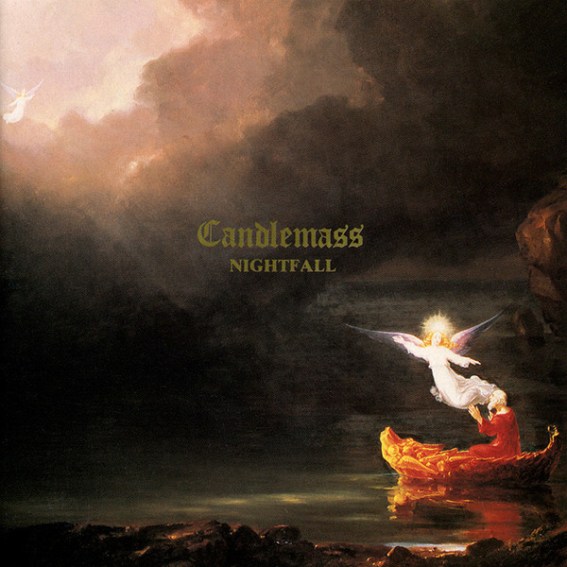
In the case of Candlemass this may not be the case. Their seminal 1986 offering ‘Nightfall’ is pretty much on the nose classic heavy metal played at a snail’s pace. Everything is there, the epic riffs, the operatic vocals (the power of which simply cannot be understated), the screaming solos, and all the classic stories being retold once again; theological anxiety, the contemplation of death, the occult, magic. To say that there is nothing special about this album is to do it a great disservice however. Yes, it is just a slow heavy metal album, but what heavy metal it is. By allowing us more time to experience each riff, each chord, each note, we feel like the journey took much longer and accomplished more than a noise that races past. Like the virtue of the epic poem or the extended fantasy novel we are with these songs for much long, and so well-crafted and played are they, with such sincerity, that it is not an understatement to say that the music of Candlemass easily stands up to the best of Iron Maiden or Judas Priest.
Unfortunately this take on doom metal never really took hold into the 1990s, with artists preferring to go the way of Sleep, endlessly trying to recreate the loose blues of Black Sabbath with varying degrees of success. Recently however, this style has undergone something of a resurgence through the works on Atlantean Codex and Pallbearer. Arguably more interesting than the ever popular Electric Wizard as it relies less on bludgeoning the listener with fuzzy guitars and endless droning, and more on actual composition and powerful clean vocals. One must be a good musician to play this music, and a good composer to play it in such a way that holds the listener’s attention.
Saint Vitus’ legacy on the other hand requires little introduction. Widely regarded as the torch bearers for doom metal throughout the 1980s, they kept it alive in the age of speed so that a new generation could take inspiration from them. Of course it’s impossible to talk about Saint Vitus without mentioning Dave Chandler’s guitar tone, and on 1986’s ‘Born Too Late’ it really came into its own. The production on previous works did not quite capture the power of what is essentially a lead bass guitar in all but name. But with this offering it finally makes sense. This is incredibly simple music; three chord riffs played really slow, solos made up of screeching….just higher up the fretboard, rather than an intentional string of notes that makes sense when played in order. But beneath this simplicity the essence of doom metal comes alive.

The atmosphere is oppressive, mainly thanks to the all-encompassing guitar tone, and this would come across as boring noise were it not for the simple but well-crafted drum fills that hold it all together, an essential building block for all decent doom metal. Wino’s voice may not be as powerful as his predecessor Scott Reagers (I always felt Reagers would be more at home in a power metal band rather than stoner doom), but there is a sincerity he brings to these songs of addiction, loneliness and drinking that invokes an almost mournful hopelessness to this music.
In terms of musicianship this is a real David and Goliath comparison. Saint Vitus were essentially a hardcore punk band playing really slowly, really basically, but they hit on something which resonated with many misfits of the next generation which turned this album into a legend. Candlemass’ ‘Nightfall’ needs no such explanations for its appeal. The power of every aspect of this music makes itself immediately apparent and does not relent until the album is over, no matter how far you turn the volume down. And you know almost immediately if you’re going to enjoy it or not.
For my money, Candlemass were an incredibly competent and creative heavy metal band that happened to be chucked into the doom metal spectrum by pundits simply because they played slowly. You may say that that is pretty much the definition of this music, to which I would say such a demarcation is lazy. There must be more to doom metal than various forms and styles of metal slowed down. Because doom is much harder to pin down than other subgenres it tends to simply be defined as a certain way of playing other styles, rather than its own separate thing. If you described a band as death metal one could get an approximation of what they were going to sound like. Not so with doom metal. Saint Vitus however, speak to the contrary. This is not only heavy metal played slow, it focuses its energy on actually sounding like doom…by that I mean the word. Songs that explore our collective doom, or the personal dooms of drug and alcohol addiction are punctuated by music so frustratingly simple but attention grabbing that if caught at the right moment it can almost hypnotise. And the one essential and under-discussed factor to all this, is creative drumming. Not the overly showy drumming of the jazz schools of metal, but creative fills and rhythms that work away beneath the drone that hold your attention without you even noticing their presence. It’s things like this that are the true legacy of artists like Saint Vitus, far more than just a slower take on heavy metal.


I know this isa old blog,but like candlemass are doom metal simply because they coined the term and influnced a generation of bands (alongside viking era bathory) that continued to play their style of epic metal fused with traditional doom(who are not epic doom but are clearly influenced by them), bands such as count raven, while heaven wept, solstice ,scald,sorcerer, and solitude aeturnus.
I think framing doom metal around the offshoots from unrelated cultures such as stoner doom or death doom leads to a very incomplete conception of the genre, doom metal can only be understood through the tracking of the style of true traditional doom metal.
LikeLike
Doom Metal doesn’t have a tonal language in the same way death/black/thrash/heavy metal do. The only thing that connects doom metal bands is depressed tempos. That’s not to it’s not a useful framework of analysis, or that doom bands are inferior, but it lacks an identity distinct from the metal genres it borrows from, making it a stylistic module, not a distinct genre.
LikeLike
I dont think I agree, this perspective heavily centers an extreme metal centric notion of metal history. Bands like candlemass ,pentagram or Saint vitus did develop traditional doom metal into a more coherent language that took place in the 90s through bands that pushed their language further such as iron man,solstice, scald, count raven,and revelation who all play rather diverse tempos but are united by the language of traditional doom metal.
doom metal as you refer became a stylistic model when its language was applied to other genres outside of its own language and mythology, such as death doom which really has nothing to do with doom metal its just slow death metal (its stylistic orgins more related to celtic frost than vitus) or stoner doom which plugged traditional doom metal into the language of psychadelic revivalism and happy sludge rock
LikeLike
To back up the “doom metal is a real genre” point; I don’t even agree with the framing that death/doom is just slowed down death metal: Paradise Lost/My Dying Bride/Anathema were clearly writing guitar lines inspired by Trouble and Candlemass
LikeLike
I haven’t actually read the original article since it was published, so maybe I would’ve worded it differently, but I’m happy to be enlightened.
I don’t see anything in those bands beyond reconstituted black sabbath riffs combined with the harmonic language of heavy metal. Again, not to say they’re inferior, Solstice are a personal favourite of mine, and Pentagram, Candlemass, and Saint Vitus deserve particular credit for going against the grain when the rest of metal was in a speed arms race, keeping metal’s genepool of influences healthy, but the doom you’re referring to falls under the heavy metal umbrella, a useful but limited distinction.
Tempo alone is not a genre.
I’d say the same about grindcore for similar reasons, which doesn’t amount to anything beyond its punk and metal forerunners.
LikeLike
well ig I can’t really say much after that because so much of what is traditional doom metal is literally seeing how far the language of black sabbath can be pushed which as far as im concerned has made for a very strong sense of language, being that this sound has been pushed to the extreme slowness of Reverend bizarre and the midtempos of Iron man, both united by the language of sabbath which is typically a bass centric approach where the bass guides the drums and guitar where to go and the drums play around the ryhthm of the riff to heighten its impact, as opposed to something like sludge metal which often seeks to use things like feedback to disrupt this resolution of riff for an extreme example see burning witch ,boris’s amplifier worship,or select moments in eyehategod.
Traditional doom metal is for all purposes “reinstated sabbath riffs” but I do believe that language has been pushed far beyond sabbath bands like pagan alter introduced a sense of mystic melodicism of something like pagan alter or the glacialiness of Reverend bizarre that keeps itself as slow possible while never leaving the language of black sabbath.
I hope im making sense i am dreadfully bad at organizing my thoughts
LikeLike
what i meant to say here is that traditional doom metal guitar tends to glue itself to the bass to get itself of rhythmic identity
LikeLike
as in like the bass guides the song and the drums are often subservient to the guitar as opposed to sludge metal which uses feedback to disrupt this tight sense of ryhthm and gives drums abit more of a say as an antagonistic force in the language of the music, sorry random addendum
LikeLike
Stoner doom often being a middle ground of these two styles being that it treats feedback as a character in the composition (as it is a sludge metal derived genre ) and sees the language of traditional doom metal as meer phychadelic fodder at the behest of its amplifier worship. Sorry for another addendum ^_^
LikeLike