the pleasure machine is here: a few thoughts
Big questions tend to throw us in multiple directions at once. What does it mean to live a good life? There are simply too many factors to consider. No reasonable person can be expected to provide a succinct, satisfactory answer. That’s why philosophers use thought experiments. The philosopher might, for instance, ask us to imagine that you could plug your brain into a machine designed to stimulate your various pleasure receptors. Suppose it could satisfy your every intellectual, emotional, and physical need. Suppose the simulation of reality it offered was tailored to your every desire. And suppose that once you were plugged in, you were unable to distinguish this simulation from reality. Is this a good life? Would you willingly choose this existence?
Philosophers aren’t neutral parties when they propose these scenarios. They clearly want you to answer a certain way. They clearly believe that any rational, honest person would refuse to plug themselves in. A good life involves some strife for it to be, in some sense, good. The pleasure machine scenario is designed to make us consider the most tempting alternative to real life imaginable, and explain why, even in this case, real life is somehow preferable despite its imperfections.
But something strange is happening. This particular thought experiment has escaped the lab and is playing out live as a social experiment. And much to the chagrin of philosophers and assorted concerned citizens, a significant minority are plunging in with abandon.
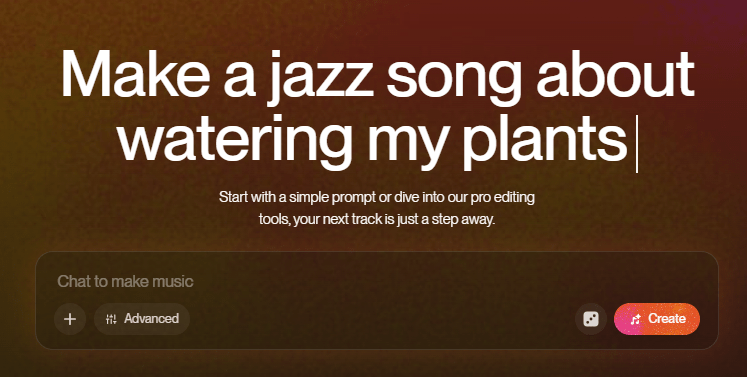
A generative AI company like Suno claims to offer its users the ability to “turn any moment into customized music instantly”. A scan of Suno’s homepage reveals its ambitions are nothing short of the instant conversion of thought into sound. Not only that, but for a nominal monthly fee (naturally), users can own the rights to the music they produce on the platform. We are faced with the prospect of big tech finally chewing through that pesky barrier between creator and consumer, between desire and its realisation. Whilst Suno might fall short of the total immersion experience imagined by philosophers, some amalgamation of various AI, streaming, and social media platforms brings us a little too close for comfort. The vision of humanity conjured by tech gurus, an individual safely ensconced at home, fed by a raft of AI content and streaming subscriptions, typing out prompts and scanning recommendation algorithms, a closed circuit of input and output. Music, film, literature, nothing more than a flow of information to be streamed directly into the brain. Even if this isn’t quite the pleasure machine of philosophers’ nightmares, we’d be well advised to treat it as such.
The emergence of a demographic only too happy to plug themselves into the pleasure machine will be deeply troubling to philosophers. It’s not enough that most of us recoil at the prospect. The philosopher is greedy. They work in ironclad, universal principles. Now that the pleasure machine is all but here, how is it even possible that our intuitions on the matter diverge so wildly? And more importantly, how do we, the righteous few, convince AI’s lemmings of their folly?
It helps that actually existing AI is the result of irredeemably evil forces, sure. But that’s not enough for the philosopher. They aren’t interested in contingencies. They want ironclad principles capable of enduring the shifting sands of circumstance and any possible future scenarios we can imagine. The philosopher wants to know that we would still reject the pleasure machine even if it came in a completely benign form. What if a new version of AI were set loose tomorrow that involved no exploitation of labour, was carbon neutral, and of no use to military contractors? Would we still abstain from creating and consuming this “art”? And if so, why?
Answering these questions requires us to define art, which is, to the philosopher, the real affront of AI. Suddenly they are being asked to recite some pretty fundamental concepts. A thoroughly undignified process. Philosophers, art scholars, creators, and concerned citizens, all are rooting through the back of the cupboard and dusting off some pretty basic assumptions about the human condition and the creative impulse. Arguments that should have been settled centuries ago are suddenly re-entering by the back door.
So, rather than laying out a clear definition of art and placing whatever is produced by AI firmly outside it, maybe we should take a closer look at how AI’s acolytes define art, and then just do the exact opposite.
In a recent video essay on this very topic, popular Youtuber and jazz bassist Adam Neely conducted an informal survey of Suno users. He asked them three simple questions. What does Suno offer that you cannot get from traditional digital audio workstations? Do you feel like you can express yourself through Suno? And which AI musicians have influenced your own work?
Answers to the first question were revealing enough. Suno, they overwhelming responded, allows users create at speed, save time, and often functions as a co-creator. In other words, it removes the inconvenience of learning to play an instrument, it encourages you to think primarily in terms of how fast you can go from an idea to a finished product, and it removes the need to deal with other people who might get in the way of converting “any moment into customized music instantly” with annoying obstacles like suggestions and constructive criticism. In short, Suno’s users view art in ruthlessly utilitarian terms. In the mould of Suno’s CEO Mikey Shulman, making music should be like playing Fortnite. Human creativity is only understandable through the lens of “meaningful consumption experiences”.
To the second question, can Suno users express themselves, the vast majority answered in the negative. The reasons for this should be obvious. Suno is generative AI, meaning it feeds on a vast pool of training data, i.e., all of recorded music to date, in order to produce content. That your specific voice, armed with nothing but prompts and a dream, can’t cut through this cacophony is hardly surprising. It’s also not a mystery why Suno acolytes don’t seem all that bothered by this. Expression is meaningless when the only things that matter are speed to market, consumption, and stimulation.
Lastly, answers to the third question overwhelmingly revealed that Suno users have no AI influences. No one is listening to anyone else’s music in the AI ecosystem. Why should they? They are given a limitless bank of data to work with and software that will produce new music from this data tailored to their specific whims, not anyone else’s. This is the future. A population of self-sustaining human centipedes, mouths confidently stitched to their own arseholes, feeding themselves a steady diet of their own desires.
This is what happens when we outsource our relationship with music to the Mikey Shulmans of the world. And it makes me feel that we’re well past the point of appealing to some abstract principle cooked up in a philosopher’s thought experiment. Even if Suno’s output is an approximation of art, the language they use to describe it implies that they don’t view it as such. At least, not in the same way we, the unplugged few, understand art. Art to them is a mode of consumption. To be experienced from the comfort of home because going outside to experience art is anathema, another barrier between you and the thing you want. Further, the conditions once thought necessary for art, such as communities and culture, are viewed as inefficiencies. Ditto the line between creator and spectator. You, the individual, have transcended such distinctions. You are a higher form of consumer able to curate your own bespoke artistic experiences based entirely around personal preference. Personal taste becomes the totem of this new world order. A space made sacrosanct by AI, cleansed of old obstacles like surprise, chance, and the input of other people.
And for consumers, gone are the days of having to deal with artists and all their scandals, misdemeanours, opinions, and messy personalities. No more endless debates over art/artist separation. And if no one is listening to the same music anymore, gone too are the days of having to engage with someone else’s opinion on your favourite album. Why bother when you can just prompt a bespoke album into existence that no one else will hear.
It’s notable how willingly and bluntly Neely’s respondents volunteered this information. Don’t these people realise that the attitudes they reveal go against everything that is good and true in the world? Well no, obviously.
So why is simply learning an instrument infinitely preferable to whatever it is that Suno users are doing? Sure, the space required to hone artistic abilities (in the traditional sense) has been slowly degraded by the collapse of the social contract, but AI certainly isn’t the solution to this. I have, at different stages of my life, played music, both in bands and in solitude. I’ve formed relationships through music. It exercises parts of my brain thoroughly unloved by the day job. It requires patience, discipline, effort, things that make the output all the more rewarding even as my abilities set clear limits on what I can express. To get Aristotelean, it’s about habit formation. These are concepts every child can grasp by the age of ten. To go back to the pleasure machine, the philosopher is trying to demonstrate that the good life is valuable precisely because it is imperfect, because joy is only possible when caveated by pain, hardship, struggle, and finitude. Basic life lessons being merrily unlearned at the behest of tech psychopaths bent on infantilising humanity back to their most basic impulses until nothing but id remains.
What can we do against such reckless optimisation? It’s probably too late to save anyone already balls deep in platforms like Suno. But we can at least salvage what’s left. Maybe we could start by calling AI art what it is, namely, stimulation masquerading as art. Masturbation may help you through a dry spell, but it’s no replacement for the real thing. Suno offers its users masturbation. It allows you to curate a fantasy experience in a risk free environment. It hardly needs stating but, actual sex, between consenting adults, is more valuable because it takes more effort and involves a genuine connection with another human. It also requires you to relinquish some control. It only takes a word to kill the mood, a single gesture to rekindle it. It’s a rich tapestry of risk and reward we are hardwired to seek out. Much like sex (and unlike masturbation), an essential ingredient in the artistic process is accident. Hitting a wrong note and realising it works better. Tabbing out a riff you love and stumbling onto a neat idea of your own. Endlessly twiddling the nobs on your effects board only to find the perfect tone on the house amp at your local. The perfect lick that came from idly noodling around. And of course the entire spectrum of just being influenced by the music around you.
Art is as much about the imperfect as it is truth and beauty. Which is just another way of saying that context is essential to how we define art, whether you’re producing it or encountering it. It’s the difference between art and stimulation. A difference we were in danger of forgetting long before AI tentacled its way into the mainframe. The shift from youth culture to aesthetic regimes of consumption culminating in the hipster, to the geek culture that replaced them which allowed the entertainment industry to cosplay as artistry, from algorithms gorging on your every decision and churning out recommendations accordingly, from the gutting of the music industry, the horizontalism of fandom facilitated by the internet, digital audio workstations, Bandcamp only releases, to streaming platforms elevating your taste to the main character of culture, to the slaying of fabricated gatekeepers, to individual expression reframed as the only valid artistic currency, to personal preference becoming a protected characteristic that must be shielded from the opinion of others, to the reduction of fandom to a series of aesthetic signifiers paraded across Instagram, the individual being granted full, uninhibited control over what they consume and when they consume it. AI is simply plugging the final gap in this equation, between creator and consumer. Little wonder that there was already a population more than willing to plug themselves into the pleasure machine when the possibility arose.
To resist this tide, we, the righteous few, could start by putting clear blue water between the creator and consumer again. Insisting that art and only art comes with a whole spectrum of inconvenience and imperfection inherent to human endeavour. This is the difference between art and the fluid stream of stimulation pumped out by platforms like Suno.


Amen.
LikeLike
RE: AI and “tech psychopaths bent on infantilising humanity back to their most basic impulses”
Well, everyone SHOULD of course get what AI is REALLY all about but most people CHOOSE not to want to understand it…
“Ignorance is the root cause of all Evil. Since only Knowledge eradicates ignorance, it is our duty and moral obligation to educate ourselves, as well as the masses around us.” — Anonymous
Like with every criminal inhumane self-concerned agenda of theirs the psychopaths-in-control sell and propagandize AI to the “awake” public with total lies such as AI being the benign means to connect, unit, transform, benefit, and save humanity.
The 2 major OFFICIAL deceptive fake FEAR-MONGERING narratives or phony pretexts (ie, lies, propaganda) nearly everyone, including “alternative news” sources, have been spreading is (1) that the TRULY big threat is that AI just creates utter chaos in society and that it might achieve control over humans (therefore it must be regulated, ie monopolized by the typical criminal governments); and (2) that we, the US, have to invest heavily in AI technological development so as to stay ahead of other nations, such as China (https://archive.is/pBzAt).
The TRUE narrative (ie empirical reality) virtually no one talks about or spreads is that the TRULY big threat with AI is that AI allows the governing psychopaths-in-power to materialize their ultimate wet dream to control and enslave everyone and everything on the whole planet, a process that’s long been ongoing in front of everyone’s “awake” nose …. https://www.rolf-hefti.com/covid-19-coronavirus.html
The proof is in the pudding… ask yourself, “how is the hacking of the planet going so far? Has it increased or crushed personal freedom?”
“AI responds according to the “rules” created by the programmers who are in turn owned by the people who pay their salaries. This is precisely why Globalists want an AI controlled society- rules for serfs, exceptions for the aristocracy.” —Unknown
“Almost all AI systems today learn when and what their human designers or users want.” —Ali Minai, Ph.D., American Professor of Computer Science, 2023
“Who masters those technologies [=artificial intelligence (AI), chatbots, and digital identities] —in some way— will be the master of the world.” — Klaus Schwab, at the World Government Summit in Dubai, 2023
“[…] what we are being sold through all this AI hype is that everything should be reducible to categories and hierarchies, put in the form of measures and statistics for prediction. However, if you understand that counting, measuring and predicting are always situated, and therefore subjective and political, you might not be as excited about such AI-determined futures. […]. The bigger AI project asks that you abandon meaning and feeling, to believe in a neutral, objective, all-knowing source built from massively large datasets hosted in hyperscale data centres. AI asks that you buy into the idea that more data means being closer to The Truth. It means that you should want to offload your limited cognition to the super machine. And perhaps most dangerously — that you understand all of this as a scientific endeavour.” — Mél Hogan, Associate Professor in Film & Media, 2026
“COVID is critical because this is what convinces people to accept, to legitimize, total biometric surveillance.” — Yuval Noah Harari, member of the dictatorial ruling mafia of psychopaths, World Economic Forum [https://archive.md/vrZGf]
“The whole idea that humans have this soul, or spirit, or free will … that’s over.” — Yuval Noah Harari, member of the dictatorial ruling mafia of psychopaths, World Economic Forum [hhttps://archive.md/vrZGf
“It looks to me like AI has been tasked with creating literally millions of fake videos tailored for every possible interest, to snare you in an endless loop, waste as much of your time as possible, stir your brain, create fear and unease, and make it impossible for you to tell reality from fiction. Why? TO KEEP YOU FROM STARTING THE REVOLUTION.” — Miles Mathis, American author, 2026
LikeLike
sorry to give it away for everyone else, but: i’m going to give you the credit of attempting to write like a silly little chatbot, instead of straightaway serving us its dribble
LikeLiked by 1 person