Words by Jason Kiss
Only Death is Real
“Only Death is Real” is one of the most endearing slogans of the extreme metal
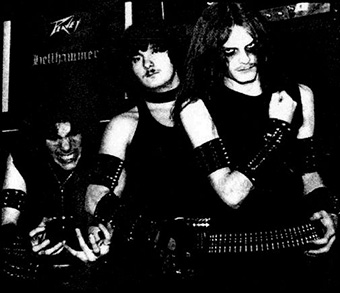
underground. The phrase was first brought into metal lexicon by Hellhammer, later reformed as Celtic Frost, in the track “Messiah” on their 1983 demo Satanic Rites. Since then, it has become a sacred maxim for many. In fact, the extreme metal underground is quick to blaspheme against Christianity and other mainstream ideals, but never death. There is a kind of reverence for the horror embedded in the acknowledgement of our own finitude; a not-so-silent acceptance that everyone will die, and their illusions will vanish with them. Hellhammer may not have been philosophers in the academic sense, yet their unambiguous worship of death carries philosophical weight. And taken further into the realm of philosophy, the meaning of “only death is real” explodes into different directions depending on the philosopher. For Emil Cioran, the phrase resounds as a nihilistic resignation from life, while for Martin Heidegger it serves as an existential catalyst that thrusts one toward authenticity.
Cioran’s Death-Obsession Ultimately Led to an Idealism of Suicide
Nihilism, particularly the form expressed by Emil Cioran, neither sees nor creates any meaning. Everything is static and remains for nothing. Death stands as the only certainty, and all is for naught. From this recognition of death arises a deep awareness of mortality, also known as mortality salience, and it is the very ground upon which Cioran built his death-obsessed temple.
In utter death-obsession, Emil Cioran once wrote, “I long to be free–desperately free. Free as the stillborn are free” (Cioran, 2012b, p. 9). Moreover, his fixation with his own release from existence did not remain inward; he pushed his mortality salience outward: “If I used to ask myself, over a coffin, ‘What good did it do the occupant to be born?’ I now put the same question about anyone alive” (Cioran, 2012b, p. 18). Such words try to force an outlook that all is futile. Mortality salience, when turned upon the frivolous culture in which we reside, can make mundane life appear like a dull charade. Cioran was adamant in his rejection of such illusions, as he remarked, “The West: a sweet-smelling rottenness, a perfumed corpse” (Cioran, 2012b, p. 129). Perfume here denotes that we artificially obscure what is real, death.
Cioran uncompromisingly paints an irredeemable picture for the world we are trapped in. As such, who, then, were his personal heroes and heroines who reached his level of death obsessed nihilism? They were initially great intellectuals who ended their own lives: Kleist, a writer who shot himself in a suicide pact; Karoline von Günderode, a poet who stabbed herself to death; Nerval, a writer who hanged himself; and Otto Weininger, a philosopher who shot himself in the same house where Beethoven died. As Cioran grew older, his admiration extended to ordinary people, such as concierges, who chose the same fate. He respected those who took their own lives far more than any living poet with supposed insights into life. For Cioran, the very fact that a person continued living, no matter how brilliant they are, was evidence of their stupidity in the grand scheme of things. As he put it, “Thus, as living men, we are all retarded. . .” (Cioran, 2012a, p. 167).
Suicide, for Cioran, is not a choice as it is for Sartre but an ideal. It is an ideal he himself failed to realize, which was ostensibly something that deeply troubled him. Perhaps his most widely cited quote reflects this inability to live up to his own standard: “It’s not worth the bother of killing yourself, since you always kill yourself too late” (Cioran, 2012b, p. 32). He is not condemning suicide here. Rather, he is observing how suffering reaches such an intensity that suicide appears to be the only escape. By the time one takes that final step to alleviate their distress, it is already too late because one has already endured the heights of their suffering; their suffering can’t possibly worsen.
Another viewpoint is that Cioran did not end his own life because he wanted to tormenthimself by living, a kind of anti-life elitism which refrains from dying in order to prolong suicidal reflections. Regardless of the reasons why Cioran never killed himself, suicide advocation is still something that he regularly reaffirmed above all else as a refutation of the human condition: “Kill yourself because you are what you are, yes, but not because all humanity would spit in your face” (Cioran, 2012b, p. 95). To be clear, not only did suicide remain the highest ideal for Cioran, it was an ideal that transcends the social norms that most people are conditioned by.
Heidegger’s Death-Obsession is Ultimately Life-Affirmation
The central difference between existentialism and nihilism lies in the question of meaning. Both schools of thought recognize that the world is devoid of inherent meaning, yet existentialism insists on the necessity of creating meaning. Cioran’s elevation of suicide as an ideal offers nothing that can be lived out in practice, since it clashes with the basic orientation of life, that is, in a Schopenhauerian and Darwinian sense, to survive. For this reason, it is more fruitful to approach death through the existentialist lens of Martin Heidegger, where mortality salience can reveal new possibilities for living.
In his magnum opus Being and Time, the existentialist Martin Heidegger describes death as something profoundly intimate, something each of us must own for ourselves. As Michael Gelvin, a prominent Heidegger scholar, explained: “Every man dies his own death. It cannot be shared or be taken over by someone else. All the protections and devices of mind that one uses to avoid confronting the question of dying fade away when death actually comes.” (Gelvin, 1970, p. 142). Cioran may have admired those who ended their own lives, but their deaths are nonrelational (Heidegger, 2008, p. 354) and were never his to claim or to celebrate. In championing the deaths of others, he outstripped (Heidegger, 2008, p. 355) the authenticity of their experience of dying and turned it into a means of reinforcing his own anti-life philosophy.
This is not unlike the way people speak about the deaths of celebrities, especially when they post about them on social media. In doing so, they turn the deaths of others into a form of social performance and thus embed themselves further into an inauthentic mode of living, per Heidegger, which is a “levelling down” in mundanity or everydayness (Heidegger, 2008, p. 165). The deaths of celebrities, in this context, become their final act of entertainment for the public to consume, something Heidegger would later describe as enframing.
Death is anything but mundane. As some Heideggerians put it, “it is the possibility of our own impossibility.” Death itself can’t be abstracted into philosophical speculation nor subsumed into everyday mundane life, yet in anticipation of our demise we gain a sense of the totality of our existence. As Michael Gelvin explains, “My awareness that I am going to die is sufficient to give me perspective of totality; I do not have to actually die in order to see my ‘end’” (Gelvin, 1970, p. 147). As such, death becomes a mode of disclosure: it reveals that we live in the present and sustain our past, however our existence is fundamentally oriented toward the future where we will ultimately die. This is the basis of Heidegger’s concept being-towards-death. This orientation to the future is what makes authentic being-towards-death possible, and it is incompatible with the suicide idealism of Cioran, who refuses to see that death is the prospect that gives existence its meaning.
Gelvin further clarifies Heidegger’s understanding of being-toward-death by noting that it is not at all like Cioran’s pessimistic perspective: “the authentic view of death is far from being morbid or fatalistic, and is rather an exciting and courageous awareness of one’s finitude” (Gelvin, 1970, p. 157). It is precisely this awareness of finitude that opens the way to meaning through possibility. Life gains weight from the fact that it is finite, and the possibilities before us gain significance in the freedom to choose which paths to take. Gelvin explains: “By showing that death, as an existential awareness of possible not-being, is meaningful authentically only as a possibility, Heidegger has laid the foundation for treating freedom and authenticity as ontologically significant terms” (Gelvin, 1970, p. 157).
It can’t be overstated that, for Heidegger, the future in which death resides is more
significant than both the past and the present. It is the future that grants meaning through the manifold of possibilities and the weight that death carries, and it is the future alone that “bears the locus of existence” (Gelvin, 1970, p. 185). The past and present exist for what lies ahead, and it is within this future that we will die. Suicide, if understood as the immediate ending of one’s life and a refusal to embrace the possibilities that the future grants, does not embody the Heideggerian ideal of “courageous awareness of one’s finitude.” It is the opposite of courage, which is cowardice. As such, it is a sign of weakness.
Conclusion
The phrase “only death is real,” when taken under Cioran’s influence, collapses into sheer weakness. This approach offers nothing to the living other than a veneration of futility. Death, in Cioran’s view, does not open any possibilities and only embraces anti-life regression and suicidal ideation, which is cowardice incarnate in the face of life. It is no wonder that the bulk of Depressive Suicidal Black Metal bands are comprised of crybabies who are unable to write powerful music. They lack the courage to confront death in life! Hellhammer would unquestionably disapprove of their weakness! To wield Hellhammer’s “only death is real” slogan requires strength!
For Heidegger, in comparison, “only death is real” is true not because it voids out
existence but because it discloses its weight. To face death with courage is not to be tempted by the immediacy of suicide, but to recognize finitude as the ground of the possibility of meaning. Thus the slogan of “only death is real” which began as a provocation in the extreme metal underground finds its deepest resonance not in nihilistic resignation but in existential life affirmation through the unavoidability of our annihilation!
Only Death is Real: Existential Death-Obsession Prevails Over Nihilistic Death-Obsession – References
Cioran, E. M. (2012a). A Short History of Decay (p. 167). Arcade Publishing.
Cioran, E. M. (2012b). The Trouble with Being Born (pp. 9, 18, 32, 95, 129). Arcade Publishing.
Gelvin, M. (1970). A Commentary on Heiddeger’s “Being and Time” (pp. 142, 147, 157, 185).
Harper Torchbooks.
Heidegger, M. (2008). Being and Time (pp. 165, 354-355). Harper & Row.
 Hate Meditations
Heidegger then commits that most common human folly of trying to give meaning to life. It’s no different to religionists. In reality, life has no meaning or purpose and even “courage in face of death” is a futile concept.
That’s not to say suicide should be glorified, though I have no problems with people committing it and I do view it as a brave act given our survival instincts are designed to pursue staying alive.
But like life, dying and thus suicide serves no ultimate purpose and has no meaning save that given to it by humans.
Maybe then to go back to Heidegger, we give our life purpose and meaning both from individual and collective meanings. But it’s all ultimately pointless except to make our own brief lives more tolerable and fire up the more pleasurable neural receptors more often than the ones associated with discomfort.
And yes I’m not a philosopher. Economics, history and culture are more my jams.
LikeLike
Good article up until the last bit where it devolves into childish posturing and equating suicide to weakness
LikeLike
I agree, it was a startling turn after what I read as a tempered essay, albeit under-informed and therefore of little utility. I would not deem this worthy of publishing.
LikeLike
I agree. I find this to be true of most of what has been written by Mr. Kiss. He should stick to writing about what he knows, which is music composition.
LikeLike
You guys are being shemales. Excellent ending! It’s time to put some tabasco on your testicles!
LikeLike
Prompt for posts like this?
LikeLike