The unlikely story of dungeon synth
By Jordan Whiteman
I’m a longtime fan of black metal. In that capacity I was familiar with the music we now call dungeon synth long before its so called revival in the 2010s. I’ve maintained a mild curiosity about it ever since. Given all that, I would have thought I’d make for the ideal reader of a book claiming to tell “the unlikely story of dungeon synth”.
But ‘Dark Dungeon Music’ insisted on being an incoherent mess. It is, to put it bluntly, the most poorly written book on music I’ve ever encountered (and I’ve read Black Metal Rainbows).
Author Jordan Whiteman’s dedication to research, along with his knowledge and passion for the music, can’t be faulted. But for the love of god, get this guy an editor, a ghost writer, something, because it’s not clear what Dayal Patterson, Cult Never Dies main man and the credited editor, was up to here.
Needless tangents, sentences that dissolve into garbled streams of consciousness, excessive misuses of the word “musicological” (for the love of christ just say musical), excessively verbose phrasing [sic], I’m actually having difficulty summarising what went wrong here.
But I think the key issue is this: ‘Dark Dungeon Music’ is essentially a Reddit post in hardback book form. It has a lot of very specific scores to settle with alleged enemies, scene politics that go unexplained throughout, the flow of writing is constantly interrupted by anticipating pushback from the reader in some imagined “comments section”.
The result is achingly pedantic prose that looks frankly undignified on the printed page. Look, Cult Never Dies books are often little more than glorified magazines. But they’re still books. Their gorgeous presentation indicates that they are at least intended to rise above disposable online partisanship.
The physicality of books is part of their USP. Even the most well constructed, researched, and beautifully told video essay is inextricably stained by the instantaneous graffiti of its comments section. Not so for books. Sure, any herbert can write a damning review on Goodreads, but the book itself, as held in the reader’s hands, exists over and above the online noise, untarnished by any immediate negative feedback.
So guess what Whiteman, you made it! You’re in print, don’t squander this opportunity settling scores, spewing endless encyclopaedic lists, or second guessing your reader’s reaction with snooty footnotes and weirdly combative bracketed phrases.
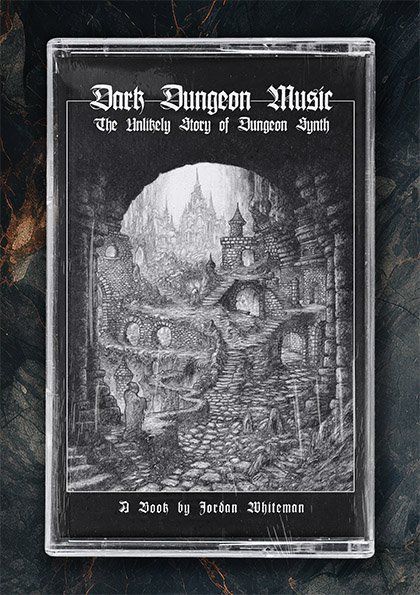
I’d love to spend this review discussing the subject matter itself. The book is not entirely without value. Meticulously researched, replete with trivia, recommendations, and some fascinating source material in the form of letters, flyers, interviews, and memorabilia. All are wonderfully presented. But taking the book’s subtitle to heart, “the unlikely story of dungeon synth”, this is something you have to painstakingly pry from its cold dead hands.
Briefly, what I garnered of the book’s arc is that dungeon synth emerged in the early 1990s as a form of melodic ambient music with occult, fantasy, or medieval themes. Most of its earliest practitioners emerged from the black metal scene, remaining closely connected in aesthetic and ethos as a result. It was largely composed using consumer grade synthesisers, distributed on cassette, transacted via letter writing and underground zines. But despite this, the scene was more coherent and self-aware than people give it credit for throughout the 90s. By the 2000s it all but collapsed, only to be resurrected by a blog post by Andrew Werdna (amongst others) in 2011, who catalogued this earlier material and coined the term “dungeon synth”. This led to a revival conducted largely online through Bandcamp. Today the scene remains underground but is more popular than ever, being subject to pastiche and parody (something Whiteman is very upset about).
Most of this I – and I imagine most readers – already knew. But the book’s structure is so baffling that even putting this simple synopsis together was an act of sheer will on my part, with Whiteman actively working against me at every step. For example, the first seven chapters cover definition, sound, look, the devil, ethos, cassettes, and definition again…in that order. In other words, Whiteman opens the book by agonising over whether dungeon synth should be defined, gets distracted by listing bands that made reference to satanism and singing the praises of the cassette format, only to circle back and define dungeon synth in the most specific and sternest terms possible (with “requisite” and “adjunct” criteria no less). So we are essentially furnished with speculation on dungeon synth’s links to satanism and the importance of the cassette medium before we are even told what the music is. God help any readers less familiar with the genre than myself.
Whiteman – despite his obvious passion and knowledge – appears completely baffled by his subject matter. Obscurantist language and laboured tangents lead him into argumentative cul-de-sacs, before devolving into dispassionately listing examples of specific themes (references to Tolkien, rare cassettes, equipment). The “story” of dungeon synth is lost behind an anally retentive need to make the book at once an encyclopaedia and a polemic against perceived antagonists, whose identity and motivation go largely unexplained throughout. To quote one of Whiteman’s many cryptic footnotes, “If you know, you know”. Having spent £40 on your book, maybe we could also know Whiteman…
Having finally furnished us with a definition by chapter 7, in chapter 8 it’s time to discuss the early artists. So of course chapter 9 goes further back with “The Musical Antecedents of Dungeon Synth”, which looks at early ambient and industrial music. Naturally, this is followed up with two chapters on “Synthesizers, Keyboards and Gear in Early Dungeon Synth”, which is literally just Whiteman listing different albums and the gear that was most likely used to record them. A niche but useful reference manual certainly, but could we not disperse this material across our “unlikely story” instead of mainlining two successive chapters of dry gear chat into the readers eyeballs mid-narrative?
Subsequent chapters on physical media, Tolkien, the influence of film, “Rare and Lost Relics” (spanning four chapters), and the dungeon synth revival, all follow in much the same vein. Exhaustive, banal lists of things that happened with little to no attempt at captivating the reader, at cultural analysis, at telling a coherent (or “unlikely”) story. Essentially, the rump of this book was brutally dismembered to make way for reams of material that should have been consigned to appendixes.
I’d love to talk about the dungeon synth revival here. How it relates to pre-internet dungeon synth, how it developed from it, and what distinguishes it, and the online culture that has grown around this revival that has recently burst into physical spaces with festivals, meetups and the like. But I can’t, at least not based on this book, because there is no attempt to contextualise this phenomenon within the history of the 2010s, the changing musical landscape, generational shifts, anything. I’m not exaggerating here, for long stretches of this book Whiteman really is just listing things (bands, labels, albums, keyboards, rare cassettes), as if leaving out the tiniest detail would be a betrayal of a genre he clearly holds dear.
These structural defects only compound on the considerable shortcomings in Whiteman’s laboured, mind numbingly tangential prose.
That Casket of Dreams’s album ‘Dragons of Autumn Twilight’ was originally intended to be a black metal album gets explained twice at different points in the book. In chapter 1 Whiteman asserts that Mortiis was the first dungeon synth artist, a claim accompanied by a footnote stating that “Those of you shouting ‘Kirkwood! Kirkwood!’ right now can save your breath”. Being only loosely aware of Jim Kirkwood, I had to wait until chapter 8 and a section called “the problem with Kirkwood” for this remark to become clear. Apparently Kirkwood isn’t relevant to dungeon synth because Whiteman says so. Incidentally this is followed by an amusing section on Danzig’s ‘Black Aria’ released in 1992, and why this was also not the first dungeon synth album because, despite checking many of the boxes spelled out by Whiteman in his “requisite” and “adjunct” criteria, “it’s difficult to characterise an album by a millionaire rock iconoclast as dungeon synth”. I have no horse in this race, but watching Whiteman contort around this bone of contention was amusing regardless.
Chapter 9 on “musical antecedents” confusingly follows the chapter on the origins of dungeon synth. Meaning Whiteman’s discussion of earlier ambient and industrial music gets bogged down in reiterating to the reader that Klaus Schulze shouldn’t be considered dungeon synth despite influencing the genre (are you following at the back). He eventually just gives up and starts listing ambient and industrial albums that were released between 1970 and 1991 that could perhaps maybe have been an influence on Mortiis but definitely shouldn’t be considered dungeon synth because of this.
To illustrate just how baffled Whiteman is by cultural osmosis, see these painstaking closing remarks from the chapter on film:
“For decades, movies and music have underlined culture as the lifeblood of creative expression and entertainment. There are films about everything, movies about making movies, movies about rock bands, movies about artists, and every other conceivable facet of human creativity. It strikes me as nearly impossible that any new mode of art – whether a genre of music, a genre of film, a style of painting or anything else – could come into existence totally bereft of some influence from movies.”
Whiteman ends with a final hate letter to adversaries who are apparently rife in the contemporary scene. An unhinged Reddit post tediously lamenting the fact that his favourite music is a meme now. History authors are entitled to pick a side. But they also have a duty to maybe explain what’s going on before doing so. What’s the controversy that’s got Whiteman all riled up? That dungeon synth is vulnerable to irony and pastiche. Again, I’m already aware of this trend despite the book’s best efforts to not explain, contextualise, or introduce the debate to us. How did it arise? What’s the history? Who are the different players? He’ll never tell.
Whiteman’s contention is hardly unique to dungeon synth. The genre has been appropriated by bad actors who insist on redefining it, ignoring its past, turning into an ironic pastiche, and crying gatekeeper at the slightest sign of protest. This leads Whiteman into a lengthy discussion of the concept of genre itself. He argues that a genre’s definition should be fixed.
This is not something I entirely disagree with (I’ve discussed this at length in regard to the same process in black metal after all), but the chapter is so poorly written, bitter, and hyperbolic, that I came away wanting to disagree with Whiteman out of spite:
“Never in my own life have I seen such fervent and wanton disregard for the accepted boundaries of a genre than in the modern appropriation of dungeon synth” (wait until this dude hears about the Ballroom scene)
How are genres negotiated? Can they evolve? Are definitions contestable? He’s dealing in big themes now. There’s a whole body of academia dedicated to this. But despite his earlier claim to be writing a “quasi-academic” book, Whiteman disregards this and treats the topic with all the grace of a Twitter rant, recklessly steamrolling through nuance because he’s angry with dungeon synth albums “about pizza or a frog choir”.
Genres are normally defined after the fact, by a range of things, and are notoriously contestable. Whiteman appears to be aware of this given the agonising lengths he goes to in chapter 1 (and 7) to define 90s dungeon synth after the fact.
Further, in chapter 5 (*sigh*) on ethos, Whiteman asserts that mood, atmosphere, and the invocation of imagery and wistful longing are key to dungeon synth over and above the music itself, leading him to claim that an artist’s intentions cannot be disregarded:
“In a lot of music, there’s this notion that once a song is published, it no longer ‘belongs’ to the artist, but now belongs ‘to the world’ – the public. In dungeon synth, it’s quite the opposite…listening to dungeon synth…encourages the listener to contemplate the artist’s emotions or intentions – or total lack thereof – when they created a given piece of music”
An interesting contention, one that I’m inclined to agree with as far as dungeon synth is concerned. The music’s lack of substance means it benefits from some additional curation by the artist. I often listen to it on YouTube casted to the telly. Having the album artwork and title in full view enhances the experience.
But at the end of the book, in his fury at the existence of things like dino synth, Whiteman contradicts his own analysis by asserting that:
“Once an artist publishes their music and makes it available to the public, they no longer reserve the right or privilege to categorise the music. That decision is now exclusively made by the public. I can think of nothing less totalitarian than pure democracy.”
So are genres defined by rigid, painstaking empirical analysis as you initially claim Whiteman, or are they defined by a show of hands within the scene? You clearly have no truck with placing “genre” in some middle ground between formal codification and organic negotiation within a scene, so is the artist’s intention key to understanding the music or should we throw out said intentions the moment their music sniffs fresh air?
You continue:
“Fief has remained associated with the modern genre despite sharing nothing in common – even sonically – with [dungeon synth]. The initial reaction to this…was hostility towards the idea that Fief could not be classified as dungeon synth. Ultimately, it was the genre which was forced to cede ground”.
And yet you earlier claimed that rejecting genre is to “reject the very foundations of the conscious experience”. So how exactly did these foundations cede ground in the case of Fief?
No, I’ll answer, it’s ok. I would suggest that naturally this is because “genre” is not as you assert solely an empirical concept, but contains a social element that is contestable and open to change over time. We refer to genres as entities with a collective conscience all the time, as we would football teams or political movements. Surely the dual function of genre – as empirical categories and social dynamics – warrants some unpacking here?
Listen…Whiteman, in chapter 7, your second chapter on definition mind, you claim:
“I am about to do the one thing I did not want to do with this book: lay bare some enumerated index for a framework that defines dungeon synth”
and you assured us that:
“this is agony for me – dungeon synth as a genre deserves better”
Yet…that one agonising thing you definitely didn’t want to do is certainly doing some very heavy lifting by the end of your book. You go so far as to use your rigid, empirical definition of a genre to beat perceived adversaries and tricksters within the scene over the head with this definition (tricksters and adversaries you have made no effort to explain or contextualise to your long suffering reader mind). If genres are strict, rigid definitions that grow more specific over time, who exactly is codifying all these genres? Is it you?…and your…“book”? Or do genres refer to a process? A meeting point between formal definition and organic, scene driven activity? Look what you’ve made me do Whiteman, pedant to pedant, you’ve made me go out to bat for whoever was behind Frog Concert and Garden Gnome. Your book has forced me onto the wrong side of history Whiteman! I demand satisfaction!
Ok, things are getting desperate, so let’s return to first principles, and ask why and for whom this book was written? The story of dungeon synth is notoriously decentralised and hard to piece together, a book claiming to document, canonise, and organise its history into a coherent narrative, one stamped with the authority of the printed page, this could have been a welcome intervention. To the extent that a vague narrative can be extracted from its pages, a list of significant artists from each era, and a wealth of curiosities and obscure points of trivia, ‘Dark Dungeon Music’ just about cobbles together some value over and above a blogpost.
But the combative tone, structural incoherence, constant and unexplained references to obscure points of scenic contention, and many chapters simply dissolving into archival lists of releases and artists, all made the reading experience utterly torturous.
Whiteman is an awful writer. Too distracted by scene politics to offer any coherence. Incapable of judging what information to include in the narrative, and what should be banished to an appendix. Patterson’s handwaving of this travesty is equally damning. The resulting tome is a revolting assemblage of churlish forum rants, dry encyclopaedic lists, obscure arguments addressed to phantasms, and baffling editorial choices. As an avowed but curious sceptic of the genre, even I will admit that in this case, dungeon synth deserved better.
 Hate Meditations
Writing this book feels like a lot of effort to create references for a wikipedia article to push a narrative nobody really cares about, and to punish people who you don’t like.
I can’t imagine being this petty.
Thank you for the review, it needed to be said.
LikeLike
Hi, Shane.
LikeLike
this book was fucking awful, torture to read it. you could get a better overview of the history and development of dungeon synth by flogging yourself with a wet newspaper while reading back issues of dungeon synth zine and it would be better edited.
LikeLike
You can hate me for whatever reason, but you don’t get to spread lies. I have never knowingly published music by anyone associated with NSBM or NS crap. I’m positive you’re referring to the Lord Einsamkeit tape I published 7 years ago, the one I published long before he decided to do something stupid and publish a tape (himself) with an NS symbol in it. That had nothing to do with me and we did not work together again after that happened. I am absolutely certain whoever you are that you were not around for that because you’re regurgitating something that has been touted as true and proven false many times over the years.
I’m positive you haven’t read this book because if you had, you would know that many, many modern names are discussed in there. Several of them interviewed, even. I’m also certain you haven’t read it since you’re trying to paint me as some sketchy baddie when there are multiple occasions in that book where I lament the presence of NSBM/NS ideology throughout the history of the genre. Sounds like you’re a modern artist feeling scorned because you didn’t get included in this book, which is fine, but that doesn’t give you license to spread outright lies about me.
LikeLike
Musicological.
LikeLike
Musicological.
LikeLike
Musicological
LikeLike
The book and everyone in here are gay.
LikeLike
im gay
LikeLike
Hard evidence that this guy is just a whiny gatekeeper who got his feelings hurt enough times to write a whole book about it. Musicological? This level of elitism should have died in high school. It’s wild really.
LikeLike
Hard evidence in the comments in the comments section alone that this guy is just a whiny gatekeeper that got his feelings hurt so much he had to write a book about it. This level of elitism should have died in high school.
LikeLike