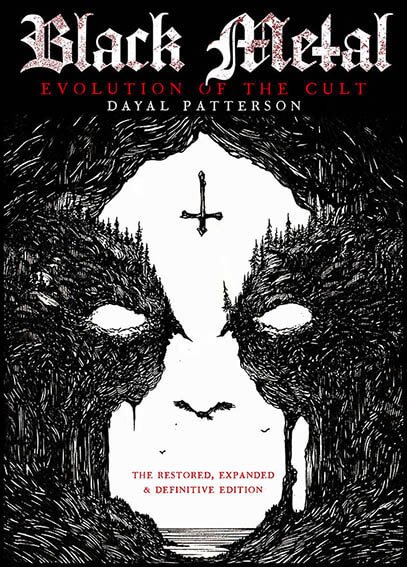
The restored, expanded, and definitive edition
The study of history serves the needs of the present. New agendas lead to new interpretations of old facts. New theoretical frameworks reappropriate the meaning behind key events and source materials. Despite being a pre-digital phenomenon, the history of black metal has largely been written in the internet age, subject to all the rumour, scrutiny, revisions, misconception, and projection this entails. The needs of its present have long been for some kind of official history. There have been many such attempts from writers and film makers to step above the partisan mire and institutionalise its notoriously opaque origins into a set of agreed facts. But such efforts are afforded only the briefest honeymoon period before a severe backlash and yet more partisanship is revealed; Lords of Chaos (the book) and the Until the Light Takes Us film both notable examples of this.
It’s therefore important to understand Dayal Patterson’s expanded and revised edition of ‘Evolution of the Cult’ in this context. Despite being clear at the outset that the goal is empiricism over “fanciful theories and wishful thinking”, leaning heavily on source material, his extensive archive of interviews, and a fat book of contacts amassed over many years as a metal journalist, this is simply the latest of many attempts to stand above the online racket, dispassionately treat the often infantile image black metal projects into the world, and distance the scene’s zeitgeist from its immature or otherwise problematic past.
Based on the limited feedback I had received online as to the quality of this book, I went in expecting to be somewhat bored, annoyed, or otherwise disappointed by the experience. It’s with some surprise that I come away keen to bat for Patterson and what he has achieved with this new edition.
Yes, it’s a social and scenic history first and foremost. Any treatment of the music itself is broadly superficial, although largely uncontroversial. Equally, although ample space is given over to the thornier aspects of black metal, the author is light on opinions of his own, preferring to frame the issues and foreground the statements of musicians themselves.
And there’s no escaping the fact that this book, in trying to be a definitive last word, tries to do too much, ending in a place a mile wide and an inch deep. Further, as with many Cult Never Dies publications, it’s difficult not to view this as a beautifully packaged gossip magazine. Each chapter (for the most part) focuses on one band, tracking their career in black metal, featuring interviews conducted for the book or lifted from older magazine articles (most of which were conducted by Patterson himself), with supplementary chapters framing key topics and providing context.
Despite Patterson being explicit in calling forth his inner Louis Theroux, this often comes across as genuine confusion on the subject matter. The framing of Marduk and Watain as uniquely extreme yet broadly popular and a further chapter on underground ethics in general fails to unpack the correlation (or lack thereof) between extremity and popularity, leaving the words themselves only loosely defined (are Watain all that extreme, or only superficially so? How has the ability to parse extreme music evolved within a broader music loving audience?). Daniel Lake’s recent book on USBM also published (in Europe at least) on Cult Never Dies adopts a similar episodic structure. But comparing Lake’s brief but delightful commentary on the music itself, it’s clear that Patterson’s abilities (and perhaps interests) as a music journalist lie more in networking and interviewing than they do in hardcore musical analysis (the words “unholy”, “infernal”, and “possessed” do not describe anything in the music, stop using them without qualification, although sentences like “possessed, almost bird-like screeching” to describe Hat’s vocals on ‘Pentagram’ raised a chuckle).
We also can’t escape referencing the presentation of the book itself. The back cover is cluttered with testimonials from familiar names and a list of the bands featured, each chapter opening with further testimonials from notable figures in the scene, as if the book is constantly trying to market itself to the reader well after the initial purchase. The fact that each chapter follows the same biographical structure makes for a clunky, at times tiresome read. Having to trawl through how each artist got into black metal through Venom, Bathory, Hellhammer, Motorhead and so on becomes repetitive.
The cynic in me wants to chalk this up to the slick marketing behind Cult Never Dies. The distro with above average customer service (shout out to Christine, thanks for helping me out with my order so promptly) has cornered a certain market in metal writing, but scratch beneath the surface of these chunky, beautifully presented books and one finds a whole lot of repurposed magazine clippings and recycled content. Why not rearrange all this valuable source material into a tighter narrative? The story of black metal is confusing and non-linear sure, but it’s hardly the British Empire or the Reformation (to pick two recent examples of perfectly concise narrative history I have read recently).
The book moves through the key bands and events largely free of controversial omissions or inclusions. Although I suspect the list of bands included was largely dictated by who Patterson had access to. With a book this size there are bound to be points of contention. So let’s get this bit out of the way so we can move on.
- The Burzum chapter is well written and gets across the artist’s universal appeal that transcends Vikernes the man, despite the fact that it flows as if the author can’t wait to be done with it (Burzum are afforded the same space as forgettable also rans Gehenna and Winterfylleth, nearly half that of Darkthrone and Emperor).
- Fenriz explaining that Darkthrone were not converted to black metal by Euronymous was important to emphasise, ditto the likes of Sigh who arrived at a similar sound in parallel.
- Mayhem would inevitably be a centrepiece of the book, but they are not musically interesting enough to warrant three times as many chapters as any other artist, on top of the three chapters already dedicated to the non-musical story of Norwegian black metal tracking the evolution of Euronymous et al.
- There is an over emphasis on Norway all round, with chapters given over to all the major players, and subsequent sections on folk and experimental black metal featuring yet more Norwegian acts such as Dødheimsgard, Ulver, In the Woods…, Arcturus and so on.
- Of course some of these artists warrant inclusion, but not at the expense of Varathron, Root, Krieg, the Blazebirth Hall group or any Ukrainian bands (to suggest a few). It’s not a question of politics either. Patterson doesn’t shy away from the Nazi hot potato, with a whole chapter given over to the Polish far right, Graveland and Veles etc.
- A Gorgoroth chapter followed by one on Trelldom gets very Ghaal heavy, again revealing the guy to be an arrogant, slick media operator who knows how to use more talented people to make a name for himself, and play the Vice crowd for clout within the black metal-curious indie crowd.
- Whenever the question of religion or spiritual philosophy arises, the musicians often tail off with comments about how complicated, abstract, or otherwise esoteric their beliefs are without further elaboration, I kept being reminded of the Nietzsche quote on the matter “Mystical explanations are considered deep; the truth is, they are not even shallow”.
I could go on, but ultimately, given the enormity of the task, covering all the major players in black metal and contextualising such a huge archive of source material, Patterson does an excellent job of marshalling everything into a semblance of coherence.
But one shouldn’t judge a book by its cover, nor the first four hundred pages apparently. Having rounded off a section on UKBM with Winterfylleth and Fen, the book segues neatly into a concluding chapter on post black metal and blackgaze. It’s at this point that Patterson pulls no punches with an argument I could not have written better myself. The main contention is best summed up by this quote:
“the presentation of post-black metal/blackgaze/blackcore as the forefront of artistic vitality within black metal is as embarrassing as it is inaccurate, and when fans of black metal-influenced bands attempt to speak definitively on a genre they know very little about, it doesn’t do much to endear such bands to the black metal community”.
He points to the fact that many post black metal musicians themselves have often stated that they are only inspired by black metal, but are not themselves in any way related to black metal. He calls out the spate of articles appearing in the likes of Vice, Metal Sucks, and Terrorizer throughout the 2010s framing bands like Mykur, Alcest, or Deafheaven as the cutting edge of the genre, and lambasting black metal fans as elitist gatekeepers for not accepting them, a view we were constantly browbeaten with at the time (I remember being sent the Vice article by a number of non-metal friends in what remains a particularly sour episode in inter-genre relations, and one of the formative events that led me to blogging in the first place).
Patterson defends black metal fans as uniquely open minded individuals, the musicians as fiercely experimental, both of which should be self-evident given the breadth and variety in the genre even by 1994. He likens placing post black metal at the forefront of the genre to placing The Clash at the forefront of reggae and accusing anyone who disagrees of gatekeeping.
The chapter is so well argued and precise that it made me go back and revise my impressions of the book as whole. Sure enough, the book is littered with corrective barbs. We tend to misunderstand the contemporary experience of early black metal acts. Isolated, innovative, with little in the way of community or inspiration from within the genre to draw upon, but more importantly, unaware of what they were starting, and often stumbling into new ideas by accident. Or the fact that the Norwegian black circle were for the most part teenagers partying hard (albeit spiced with a quintessentially Scandinavian stoicism), or the emphasis placed on the contrast between the fun loving 80s version of Mayhem to the darker, early 90s iteration. All are neatly framed in this book.
For all my criticisms, the inevitable differences in personal taste, methodology, and emphasis, it’s clear by the end that Patterson is coming from a very similar place. He is respectful of the artists as individuals even at their most posturing and infantile. He is respectful of the fanbase despite its many problems. But most importantly, despite the insistence on structuring the book as a series of loosely collected magazine vignettes, Patterson has his eye trained on history. The roots of black metal in early heavy, speed, and thrash metal are thoroughly covered off, ditto punk and death metal. The importance of emphasising that the second wave was in its first iteration a largely nostalgic genre, pushing against death and thrash metal’s progressive turn, and only later expanding into lavish orchestration, antiquarianism, and experimentation. The non-Scandinavian perspective in bringing to the fore South America, the Czech Republic, Poland, Greece, the US, and latterly the UK is all present and correct (Canada, Russia, Ukraine, and Austria are sadly missing).
All this context and detail ultimately strengthens the impact of the arguments laid out in the final chapter. They are placed at the end of a lengthy narrative on black metal’s many tangents prior to the 2010s, foregrounding how important innovations came from within the scene itself. You may not like all of the examples he uses, I for one despise Deathspell Omega, Shining, and can only appreciate the first two Dødheimsgard albums, but there’s no denying the changes they have wrought on the music, and their continuity within black metal despite their overt experimentation. Something that cannot be said of Liturgy, Deafheaven, or Alcest, all of whom have openly distanced themselves from black metal, distinguishing themselves (accurately) as black metal influenced. Something their fans should be mindful of next time they wish to write off the broad and novelty-hungry fanbase of black metal as naught but purist gatekeepers.
Ultimately, this is the first piece of (relatively) popular writing on black metal that does not seek to mark black metal’s homework, accuse the scene of rampant traditionalism, or claim that the music must be somehow “saved” or “fixed” by individuals largely unaware of or indifferent to historical context and the complexity of its evolution. Any differences I may have with Patterson are so much minutia in the face of how important this intervention is in terms of allowing black metal to write its own story.
A definitive history of this genre, one making similar use of the cornucopia of source material now available, but told with a more linear narrative, with major themes perhaps articulated more cogently, is yet to be written. But ‘Evolution of the Cult’ is an important stepping stone toward this.
As an afterthought, it occurred to me in reading yet another account of the events in Norway in the early 90s that the police and court records are only ever accessed third hand via interviews with the individuals involved in the scene. The official history, including accounts from the Norwegian state, would make for an interesting direction by which to re-approach this particular episode of the story.
 Hate Meditations
Leave a comment