Something that’s often misunderstood about the underground ethos is its desire to stay underground. Success itself is not a source of resentment, but popularity dilutes nuance. This is not simply a case of selling out. Complex works can become immensely popular (the enduring popularity of Morbid Angel and Burzum testify to this). But in this process, the ongoing narrative behind the art must be levelled off and simplified for transmission to a wider audience. Commentators in larger publications and media outlets wilfully misinterpret, simplify, or revise history, and in the process bar the underground from whence these works came from writing its own story.
The underground does not wish to stay underground out of spite, but out of a desire for message discipline, to retain an integrity that will inevitably dissolve upon contact with excessive exposure. Why else would the underground engage in a rigorous project of propaganda and promotion – from small label PR campaigns, to blogs, zines, online spaces, and vocal bands with clear ideas on their place and purpose within metal – if it wished to remain within a limiting cocoon?
For a brief time the early internet allowed for segregation between a true underground and the casualised mainstream fandom. But the rise of social media led to a blurring of these lines. An insatiable appetite for content flattens the contours of once nuanced debates, a pithy quip gains more traction than tight longform writing, and individuals able to project the aesthetic, feel, and demeanour of metal’s increasingly nebulous iconography garner more attention than bands engaging with the artform on its own terms as an evolving document of riff based composition.
A subset of the underground has for a long time been influenced by a certain website I have written extensively about before (it’s one of my earliest essays so forgive the sloppy writing). Occasionally people formatively influenced by this website make themselves known to me and – problematic politics of the site aside – wax lyrical about how the reviews shaped their understanding of metal. The uniqueness of the site’s writing lay in its ability to place metal within the context of late 20th Century Western delusion. A last gasp of Post War counterculture attempting to grapple with the insanity of an accelerating world, conjuring works of profound order and sublime logic from a chaotic reality without sense and by all accounts is openly hostile to human flourishing. Reading the at times recklessly opaque reviews mirrored the experience of listening to the music itself, as abstract themes develop from apparent randomness, meta structures emerge and dictate the flow and direction of individual currents, and vast spaces are called forth from the most primitive, rudimentary recordings.
This website remains well known far beyond the community that formed around it, particularly for metalheads of a certain age and persuasion. Its influence still casts a shadow over subsections of metal’s non-casualised population who retain a certain approach to the business of listening to metal, even if any interaction with the site is long in the past. But I’d argue its impact was wider even than that. To take but one example, Demilich’s ‘Nespithe’ was long an obscure outlier of Finnish death metal, largely ignored for many years after its release 1993. But the site’s continuous promotion of the album as an artefact worthy of scholarly study began to bleed into the wider online community by about 2010, popularising the record and ultimately leading to not only the reformation of Demilich as a working live act but to their unique approach to death metal informing younger bands and arguably becoming its own subset of the vastly popular wave of OSDM by 2019.
Of course, this process is an example par excellence of how popularity dilutes nuance. An attempt, forged in the underground, to situate ‘Nespithe’ as a unique marker of late 20th Centur anti-logic by melding the avant-garde with rigorous structuralism: “Each song shifts and deconstructs in a twisted way only to reveal its gradual plan for self-reformation, with each cycle of thematic peak resulting in a new apex of motif. One might call it “virus study music,” as what it traces is evolution of a song from basic principles unique to that song, in an information age version of progressive music” becomes endless simile and individualist journeys of cultural acquisition such as “where Cynic was like a psychedelic water painting mixed with the poetry of Rumi, and Atheist was like a hippie turning into a werewolf, and Gorguts was like the cerebralism of Borges calibrated for death metal, Demilich felt sheerly and purely impossible, like a primal glimpse at the Lovecraftian vastnesses depicted by artists like Zdzislaw Beksinski.”
ANUS.com has long ceded its right to speak on the underground. The hand has been overplayed, and the woefully ill-formed hierarchical political obsessions of its original voice and subsequent champions have swallowed nuanced musical analysis. But there remains an appetite for metal that echoes the sophistication of the halcyon days between roughly 1985 and 1993. Metal discourse by 2019, whether underground or mainstream, was increasingly veering toward treating metal as a fun aesthetic, a vehicle for merchandising, or crumbling under the deification of its increasingly distant past.
In 2020 the world shutdown, and I was left with very little to do other than write and research metal, listen to music, and forge new contacts online. It was at this time that I was introduced to a band called Mefitis, who had released an album the preceding year called ‘Emberdawn’. Upon first listen it seemed to represent everything that contemporary metal had been missing. Aggressively articulating its own identity, monomaniacally focused on architecture instead of aesthetic gesturing or empty genre alchemy, and it further advanced the language of riffcraft by injecting contrapuntal elements to most of the riffs, allowing the listener to break them apart and piece them together with each relisten, building upon techniques found in ‘The Red in the Sky is Ours’. But whilst it was aware of the past, it was not beholden to it. Like many of the revered works of death metal it retained a marked idiosyncrasy whilst engaging in an open dialog with metal history and development. It was “of” metal as it simultaneously demanded more of it.
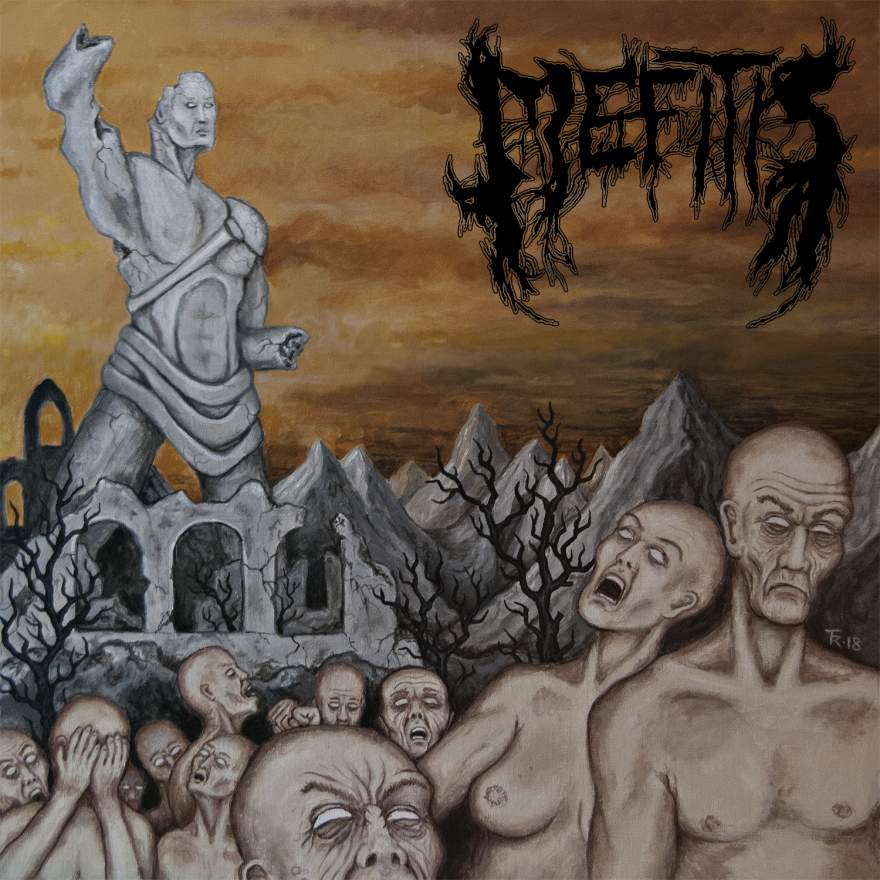
The musicians behind this work are a few years my junior, looking every bit the personification of their home state of California. By osmosis or intention they had clearly absorbed the ideas of the early digital underground. But surfer demeanour aside, this was the first time in decades that musicians with the will and talent were able to step up and realise a vision that the underground had been craving. A number of micro publications including this one leapt at this album, and in the process folded a number of other artists of a similar stock into what felt like a renewed wave of energy and vibrancy. Although largely focused on the Hessian Firm roster in Polemicist and Into Oblivion, and also the later signing of Mefitis themselves, I extend this narrative to a rag tag and diffuse collection in the likes of Cóndor from Columbia, Dutch stalwarts Sammath who were passionately reinstated into the zeitgeist following 2014’s ‘Godless Arrogance’, Finland’s Serpent Ascending and Desecresy, Temple of Abraxas and Condemner from the US, and the UK’s own Cruciamentum, amongst others.
But traction is an increasingly rare commodity. For context, it’s difficult to get across just how quiet the digital airwaves were back in the early 2000s and how easy it was to push narratives into the empty spaces of the underground, under the radar of the still dominant print media, who only after the fact would latch onto fruits grown in the underground as they had done with Demilich. For Mefitis et al., by the late 2010s, it wasn’t that we could not control the narrative behind this music, it’s that it was largely ignored by a casualised fandom. The music consumed by the wider, more populist end of the community was now so far removed from how we understood metal that most considered the efforts of these artists to be irrelevant at best, derivative at worst. Their approach to listening, what they enjoyed in metal, was now utterly divorced from the underground, to the point that ideas from the underground could no longer graduate into the wider discourse at all.
Further, dissenting voices came from within the underground itself. Mefitis were too on the nose in their song construction for some. Too well crafted, too clever, too clinical in their execution, they lacked the underlying feral energy that informed the cavernous gothic architecture of ‘Onward to Golgotha’ say. It stimulated the intellect, but failed to hit at the level of raw, primordial experience. Listening back to the album now there’s no denying a certain lack of flair. Each track is near perfect in its construction, but there is no overwhelming moment of pure transcendent force that defines the best moments in death metal from the merely good. There is no loss of control. The plot develops in meticulous and engaging detail, but trails off without philosophical significance. The follow up, 2021’s ‘Offscourings’, is both better and worse in this sense. Somehow more musically esoteric, almost obnoxiously clever in its manipulation of rhythm and key ambiguity, but also more experimental, eccentric, and relaxed in its delivery.
I’m not so delusional as to believe that myself and the small network of micro bloggers, labels, and artists that championed this brief early 2020s wave of creativity could shift the increasingly cumbersome dial of metal’s narrative in any particular direction. But there’s no denying a sense of betrayal and outright impatience with the reasoning behind Mefitis’s detractors from within the underground itself. Ultimately, our goal remains to educate, inform, and inspire others to approach metal as a sui generis form of guitar music, one with its own distinct language, compositional methods, and complex of rhythmic and atmospheric interplay, one built on, but extending far beyond, the raw materials of distorted guitar and vocals. This project is all the more essential given how far social media has come in manipulating the transmission of culture, how it is understood, and consumed, turning metal from a uniquely troubling object of the postmodern era into a fashion accessory for boring uncles.
And in this sense, Mefitis and others like them did everything right. They stepped into a crowded arena, immediately set themselves apart with a clear project, and a voice to articulate it that went far beyond anything metal had seen for many years. But they were met with a limp pedantry from some critics who should know better. Good, but not good enough, because ‘Altars of Madness’ exists. Dismissed in language that suggested that many in the so called underground still saw artists as owing them something. Passive consumers, thumbing through the latest metal releases and listing the minutia of why they fall short of their own, illogically specific standards.
This is not the underground ethos as I understood it. One that saw listeners as every bit as responsible for the advancement of artistry as the musicians themselves. Bound by a joint endeavour. One that treats criticism as an act of creation, and not a vehicle for dismissing new music cos it’s not as good as your favourite. The kind of metal we champion and celebrate was not conjured from nothing. And disengaging from the project – either out of self defence or sheer laziness – disqualifies one from being able to speak on the music’s broader purpose. If a release as good as ‘Emberdawn’, and a moment as pregnant with possibility as the early 2020s, ultimately runs out of momentum because so called champions of the underground could not muster more than a disinterested shrug, then it’s hardly surprising that metal’s narrative is now completely determined by a mainstream willing to casually revise history, transform it into a fairground of memes, compulsory good vibes, and incoherent critical analysis with little relation to the music they claim knowledge of.
 Hate Meditations
As an occasional reader of Death Metal Underground as well as the owner of several Mastodon albums, I think this article is both very poignant but also misses the point in some ways. First there is no more underground in the same way as was understood in the past. The internet and especially streaming and downloading killed the concept of underground music. Everything is accessible. Unlike the 1980s-early 1990s there is no pretence to true anti-commercialism or anti-mainstream mentality that was pervasive in the 1980s-90s but that in the end was discarded at the first whiff of major label interest. These days Decibel magazine or more mainstream blogs like Invisible Oranges and Metal Injection will cover no name artists. Second, the high point of metal (1980-93) was for the most part never driven by deliberate philosophical and musical sophistication. It was driven by a juvenile arms race to be the fastest, most obnoxious and eventually most primitive band in the world. Hence we go from Iron Maiden and Venom through Metallica and Slayer to Morbid Angel and Napalm Death to Darkthrone and Burzum. In that way, I agree with Death Metal Underground, 1993-94 marks the end of the original metal story. After that it was tinkering around the edges whilst ramping up marketable elements such as melody. 1980-93 was essentially juvenile aggression and primitivism, not sophistication. There is no evidence of a serious philosophical bent to metal until Euronymous opened his record store. If you read the interviews with not just early Mayhem but a lot of 1980s extreme metal pioneers, their opinions are primitive and poorly formed. In fact many aren’t much different to what you hear from the average Slipknot or Pantera fan at Knotfest. Sophistication in metal is actually a watering down of the 1980s spirit. Even when it’s well done such as Atheist’s and Pestilence’s early 1990s albums, there is a massive dilution of that raw energy that in my opinion defined early metal. But then we ever saw this in the 1980s for example Metallica or Iron Maiden’s initial offerings are usually much more revered in metaldom than their more musically sophisticated late 1980s outputs. As “sophistication” grew in the 1990s and 2000s you end up with such tedious metal such as Gorguts’ modern works or the mindless technicality of technical death metal or the mindless meandering of Agalloch. At the same time, the old genres of youthful aggression such as thrash and death metal were often updated to be more marketable whilst still retaining the core early1990s problem of being essentially artistically bankrupt. As always thank you for a thought provoking and well written article. And yes I am checking out Mefitis right now. Regards from Tasmania!
LikeLike
whilst that’s certainly true of the very early 80s, it’s apparent that the likes of Bathory, Slayer (South of Heaven), and Celtic Frost were drawing on a wider pool of influences by the late 80s, including some classical, and were not solely motivated by extremity. A similar case could be made for death metal by 92, and black metal by 94. If you read about Euronymous’s approach to record De Mysterris and the wide pool of influences he drew upon it’s apparent that there was more to him than the infantile public persona.
I would also clarify (and apologies this wasn’t clear in the article) that the underground I am often referring to in the article is the sophisticated discourse that emerged by the late 90s, around the time that the underground actually ran out of momentum as a musical force a whole host of ideas were developed on and offline, deathmetal.org being the first but far from only example of this.
I’m sure there’s more to say here, but thanks for reading and for the thoughtful input.
LikeLike
I actually think “sophistication” has been evident in metal since the origins of the genre, given that Black Sabbath’s eponymous song is an homage to Holst, Blackmore was taking inspiration from Bach in Deep Purple and Led Zeppelin were inspired by Crowley and Arthurian mythology. Even Venom weren’t as neanderthal as people assume, given that they were Rush fans writing 20 minute long songs by their 3rd album.
LikeLike
As a former DM.org man myself, there is a part of me that appreciates the fact that you situate your own personal and historical understanding in a context that takes that website into great consideration. I also – again, as a former DM.org acolyte – feel a certain affinity with your views. Mefitis would be a perfect example of a band that you’re championing that I am completely sold on. Even where I have strayed completely from the wider vision you’re making here for metal, I still know that because you have that vision you will always appreciate metal that I know will be good. It is a noble thing, in its own way.
With that said, I think its worth saying that the preoccupation with a DM.org; whether that be a part of the project that Prozak started, or a vision that overlaps somehow with the old ANUS archives, or even just a stylistic approach to writing about metal music, is a circular logic of defeat. When it started, it made sense within the context of some general feeling metal fans have, but by the late 2000’s it had already become the very thing that it had professed to stand against: touchy, nitpicky, prematurely old in its outlook, with an ever narrowing sphere of acceptable albums, songs, or bands. People who love something so much that they hate it. That is why all of the writers slowly descended into actual fascism, religious orthodoxy, ulster unionsism, or whatever other reactionary niche they could find. Metal is like a healing poison. Too much of it in the wrong way is dangerous to your health. But just enough and it innoculates you.
To me, the path that DM.org acquainted me with was one of power. It was about metal as power. I think we should all exercise our power in forgetting – what Nietzsche called the “goddess of victory” – about DM.org. You will be happier to be free of it than to constantly exist in relation to it!
LikeLike
Thanks for reading, great comment, plenty to think about here
LikeLike