Final Wrath – The Early Hymns of Lobotomy
Out 13th June on vicrecords
In archaeology they use a technique called field walking. It involves systematically walking up and down a field, collecting any fragment that may be of significance, which is later inspected by a finds expert, who will verify if any shards of pottery could be evidence of a lost Saxon or Medieval settlement. If a field has been subjected to regular farming activity, it’s often worth walking it repeatedly in case more finds are churned up by the plough.
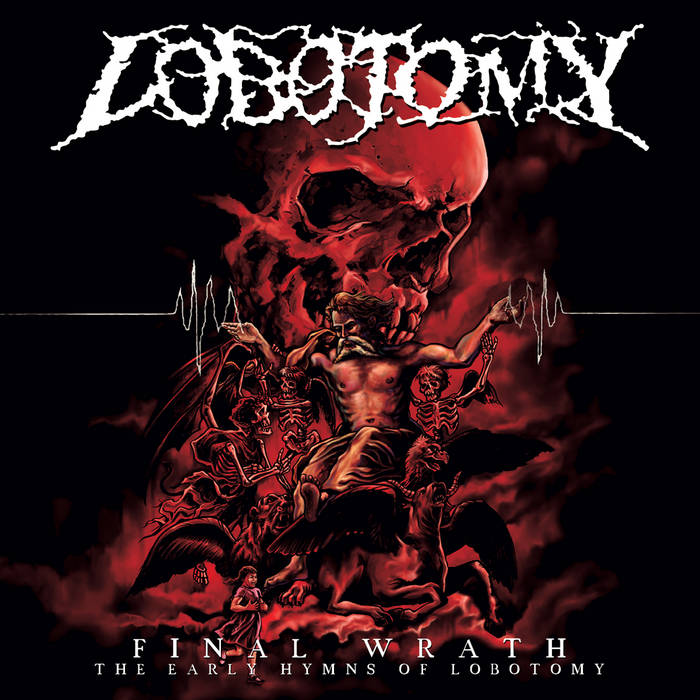
It’s not clear how many times the fields of Swedish death metal have been walked, how many more finds are left to inspect, and what deserves a place in the museum display cases. Surely the lost treasures of this scene have by now all been collected and verified for their authenticity. Following the collections from Unleashed and Desultory put out by Darkness Shall Rise Productions earlier this year, we are now presented with this Lobotomy collection from vicrecrods, a half forgotten after echo of Swedish death metal. By the time this artist entered the full length game with 1995’s self titled effort they had well and truly veered into death ‘n’ roll territory, foregrounding an almost hysterical aggressive urgency underpinned by rudimentary riffs and structures that regressed the music back to the safety of a standard rock architecture.
But this collection, which brings together Lobotomy’s demos and single EP released prior to 1995, reveals a serviceable if unremarkable curiosity of basic Swedish death metal. The compilation runs chronologically through these releases, allowing us to track Lobotomy’s evolution and by extension the parallel developments of their contemporaries.
The first demo, ‘When Death Draws Near’, is a cornucopia of delights. As one might expect of early demos, it’s a chimerical prospect, notable for its mix of styles and aesthetics given the vintage of this material (1990). Odd choices in arrangement and placement of elements are more apparent than any wealth of new ideas. The overriding impression is charming more than anything. A rock swagger collides against dark speed metal passages mirroring the overt gloom of a Grotesque. At other times Lobotomy anticipate the epic doom laden swagger of Amorphis, transcending the primal dirge of the link phrases and in the process surpassing the likes of Grave who, at the time, were pivoting on a similar contrast of tight rhythmic consistency and loose, unfocused guitar drone leaning on the currency of the guitar tone over dynamic composition.
Guitar solos hearken to a more classicalist influence that was common for Swedish death metal, perhaps only paralleled by the likes of Dismember, but here lacking the same venomous dark romanticism. This, alongside some blatantly bright punk riffs, lends the music an almost humorous undertone via loose blues phrasing and highly lyrical lead guitar material. Given the ill formed personality informing the riffcraft, these additional flourishes inject the music with some much needed character, one that nevertheless integrates itself into the primitive power and energy that made Swedish death metal special at this time. A primitivism that nevertheless reached beyond the monstrous and into considered existential ruminations.
Swedish death metal was bigger than the specific style perfected by the likes of Entombed, Carnage, and Dismember. There’s the epic heavy metal/grind intersections of early Therion, the autogenic melodicism of At the Gates, the melodramatic rhythmic contouring of Utumno, or the fanfare nihilism of Gorement.
Watching Lobotomy touch on these diverse prospects across these demos, working themselves round to an identity, all provides us with a microcosm of the precipice death metal stood on as the early 90s rolled on. Although most obviously aligned with the orthodox Sweddeath style, the many deviations and detours this artist took is a reminder of just how free and uninhibited these musicians must have felt compared to today’s generation of musicians smothered by the weight and pressure of cumulative history. Both the individuals and the genre itself were still young, faced with multiple paths before them. It’s a shame that by 1995 Lobotomy had opted for the low hanging fruit of death ‘n’ roll (that’s not entirely fair, serviceable riffs abound across their first two albums), because another artist was ready to emerge from these early templates, making this one among countless “what ifs?” along the long road of metal’s evolution.
 Hate Meditations
Hello again,
Since you are obviously a reader (I recommended Robert Walser’s Running with the Devil last time I got in touch) I was wondering if you were aware of this publication.
I keep enjoying your posts!
Have a good summer,
Jörn Severidt Rovaniemi, Finland
LikeLike