Jo Quail is an interesting case study in what happens when the metal crowd get their teeth into a free floating, genre agnostic artist. This solo cellist taps into a recent trend of artists who use the instrument to bridge the gap between modern chamber music, drone, ambient, and *shudders* world music. Live, the use of loop pedals, creative percussion, layering of ambience via engaging harmonies, and slow-build dynamics makes for an interesting watch. The recorded material unfortunately fails to stack up in the same way. Offering a pleasing but somewhat flaccid simulation.

The music is too loose and informal to satisfy the refined sensibilities of full blooded classicalists. Too light and musical to fall in with the noise and drone crowd. Too organic and humanist to be taken under ambient’s wing. But the underlying darkness, sparsity, and favouring of raw musicianship made Quail’s approach particularly appealing to metalheads.
And so we come to 2022’s ‘The Cartographer’. Following a series of successful festival appearances that put her in front of a metal audience, along with a collaboration with Wardruna, arguably the biggest not-metal band on the circuit, all this attention from the metal crowd has clearly rubbed off on Quail. Gone are the loose, fragile drones that spoke of journeys both personal and literal through mysteries of the earth and mentality, in is a wealth of lavish orchestration, trombones, heavy percussion, and guest vocals curtesy of Grave Lines’ Jake Harding, offering his trademark commanding barks of despair.
‘The Cartographer’ leans heavily into modern classical tropes, utilising dissonance, percussive jolts, slow, building crescendos, with the entire album apparently pivoting on a series of builds in tension with very little in the way of release. The word “soundtrack” looms in the background as a peripheral accusation denoting lack of substance.
But there is momentum here, and structure to boot. By movement 3 proceedings come to a head, as percussive activity gains urgency, refrains are awarded with increased repetition and variation, and the call and response between instruments gives way to coordinated motion.
The cynic in me wants to point to the clear metallic dog whistles Quail is leaning into in response to her newfound, populace, and dedicated audience of metalheads. The clear attempt to contrive heaviness through swelling orchestration and the overt darkness blanketing the entire album, all clearly mark this apart from previous efforts which seem positively bright by comparison. But the problem with this take is the evidence before us. ‘The Cartographer’ is just too good and interesting to dismiss as a mere crowd pleaser. It’s littered with curious refrains, creative use of ambience within organic instrumentation, it grants space for individual voices alongside interesting moments of genuine chamber music, all communicated from the perspective of a strikingly mid-20th Century modernism that nevertheless reaches back to romantic ideals.
Anna von Hausswolff’s blend of Swans dark Americana, organ drone, and Lana del Ray’s nostalgic ballading pathos may be an unlikely fit for a metal audience, but there is an underlying heaviness kindred to doom metal offshoots in particular that prima facie seems obvious, one whose contrast to her soaring, angelic Kate Bushisms gracefully stitches together a vast, unfolding sonic landscape before the listener.
But in analysing why certain non-metal music appeals to metalheads we must caution against superficial symmetries. Ambient, noise, electronica, industrial, neofolk, all are common outlets for dedicated metal fans and all are strikingly sparse in one way or another. It is this very sparsity that appeals to metal fans precisely because it juxtaposes neatly with their regular diet of music stuffed with surplus activity, information, bombast.
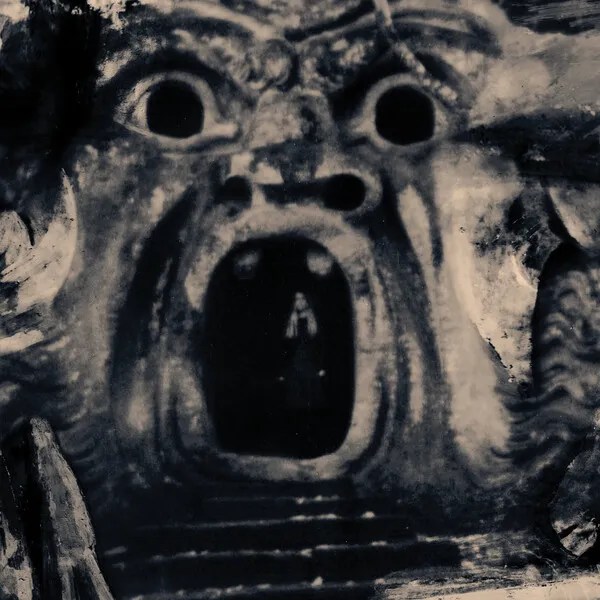
For this reason Hausswolff’s latest album ‘All Thoughts Fly’ released in 2020 caught the attention of some metalheads more than previous efforts. Essentially an ambient work that places the organ within a strikingly modernist setting, it dispenses with her voice entirely, along with the muscular guitar drone that rightly draws comparisons to Swans. With arguably the strongest weapons in her armoury duly jettisoned, we are left with an exposed, fragile, and unapologetically minimalist project that takes time to fully unpack.
Whilst the album is littered with novel harmonic material, conjuring a deep sense of yearning through lightly ascending patterns enriched by clever use of delay, there are also extended passages of atonal drone, and static, repeated arpeggios calling to mind the minimalism of Steve Reich, Philip Glass, or Terry Riley. Comparisons to the haunting theological renovations of Arvo Pärt would also not be out of order.
The problem with projects that foreground a particular instrument and its unique qualities is that they come prepackaged with all manner of cultural associations. An audience can’t help but process the music through this filter, which predigests the music before they come to pass any conscious judgement on its meaning and quality. This is more true than ever as knowledge of the world around us is becomes increasingly siphoned through media. TV and film deploy these tactics all the time: classical music means wealth and sophistication, saxophone means kitsch romance, harmonic minors mean we’re in the Middle East. The church organ is no different, evoking idyllic pastoral Anglicanism or gothic horror.
Hausswolff leans into these sensibilities at her pleasure. Introducing the instrument in a way that meets these expectations, before driving it through subtle and gradualist evolutions to reach a destination well beyond our understanding of what the organ could or should be used for. Of course composers have been doing this for centuries. But Hausswolff manages to humanise this process somewhat. At times revealing the hidden guts of a pop song, with lyrical lead melodies delivered in slow motion. At others rich neoclassical harmonies. And at yet others pure ambience undergirding the electronic roots of the genre with a sense of organic spontaneity and play.
Helen Money’s music exists at the intersection of the organic and synthetic. The two intertwined to the point of adopting each other’s sensibilities, morphing into a distinction without a difference. On her 2016 effort ‘Become Zero’, the cello is co-opted as a distorted guitar, a purveyor of synth drone, heavy percussion, and more traditional textural duties. It’s an album that leans heavily into the manipulation of volume as a well of creativity. Individual harmonies are dirt simple, but through a process of slow drip feeding they swell into attention grabbing moments of high drama. This relative fluidity is contrasted with tight staccato lines that mirror the layered, sequenced arpeggios of late 70s Tangerine Dream, but again, Money delivers these with an urgency that only can come from the human touch.
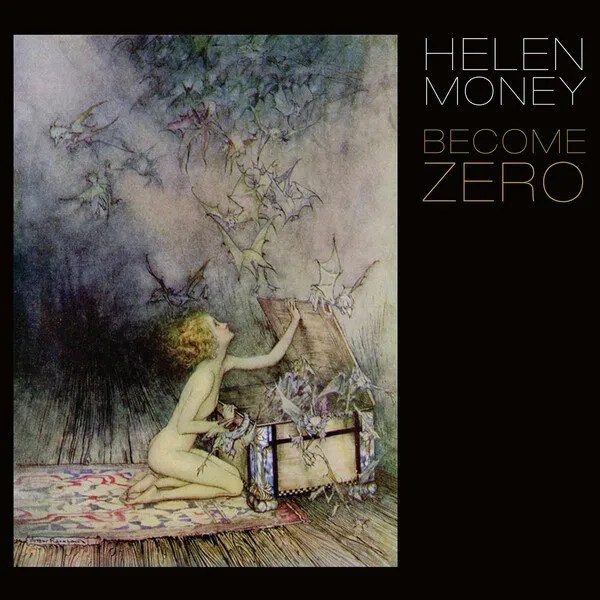
The cello is transposed into unexpected contexts, functioning as a distorted guitar at times, fleshing out the sparsity with surplus texture. At other times this distortion takes on a deep throbbing bass tone, engaged in conversation with abrasive high end meandering. Each piece is left open ended and light on structure, boasting two or at the most three identifiable ideas, each worked around to a point of development, but each clouded in surplus noise accumulating as the music develops.
Percussion in the form of programmed(?) drums is sometimes deployed as a reference point, allowing the music to diverge even further away, relying on the fixed anchor of the energetic rhythms to provide context. But such moments are scant, stitched together by lengthy ambient drones lurching from dark to light with reckless ambiguity. Cumulative noise purports to build to a place of resolution, only to melt away into the distance. Whilst one is tempted to level the accusation that this squanders any hard earned momentum, an odd tension arises from the gradual de-escalation of energy into silence that strikes as hauntingly uncanny.
Despite some jagged edges, the overarching impression one gets from ‘Become Zero’ is not darkness, but a slow, protracted working through of pain to a place of healing. The album is littered with minimalist threnodies, striking in their fragility when set against the at times aggressively percussive approach to ambience. But this emotive, abstract sense of resolution through sonic contouring as opposed to any obvious cadential resolution bleeds through every pore of the album like venom sucked from a wound. Tense, fraught, at times uncomfortable, but ultimately enriching with hindsight.
 Hate Meditations
Leave a comment