Urku Llanthu: Tarpuk Amsa
Out 31st March on Takiri Productions

Ecuadorian neofolk/ambient project Urku Llanthu return for album number four, this time for a lengthy concept piece on Jichi, a water deity native to the lowlands of the Andes. The light touch melodic flourishes exercised through phasing synths, haunting percussion, and a host of acoustic instrumentation is therefore buried in a plethora of water samples, from heavy downpours of rain to gently trickling streams. The juxtaposition of natural sound effects, what sounds like real instrumentation, and the artificial kitsch of dungeon synth is a jarring one. The entire mix is dominated by water samples, weaponised into a form of ambience in itself akin to meditation aids. The actual musical qualities are therefore aggressively minimalist. Synth patches are chosen for their timbral qualities first and foremost. Percussive features enhance the ambience of a rainstorm. Heavier synth samples with less attack and ample sustain flesh out the emptiness around a sample of intermittent dripping. Things become more abstract by the second half of the album, with musical qualities taking a more dominant role, as birdsong and flowing rivers become mere atonal accents to more developed synth lines. The aesthetic is amateurish in the extreme. But this facet also contains Urku Llanthu’s greatest strength if we are to talk in terms of dungeon synth. The naivety, the peripheral approach to music, the hesitant fragility to both the performance and the lasting effect it leaves on the listener, this plays into the strengths of dungeon synth as was, before it dissolved into self-referential meta humour. Here the veil of irony is stripped back again, prelapsarian innocence is restored, and myth is once again allowed to map onto strikingly sparse musical fragments.
Degraved: Whispered Morbidity/Exhumed Remnants
Out 5th April on Chaos Records
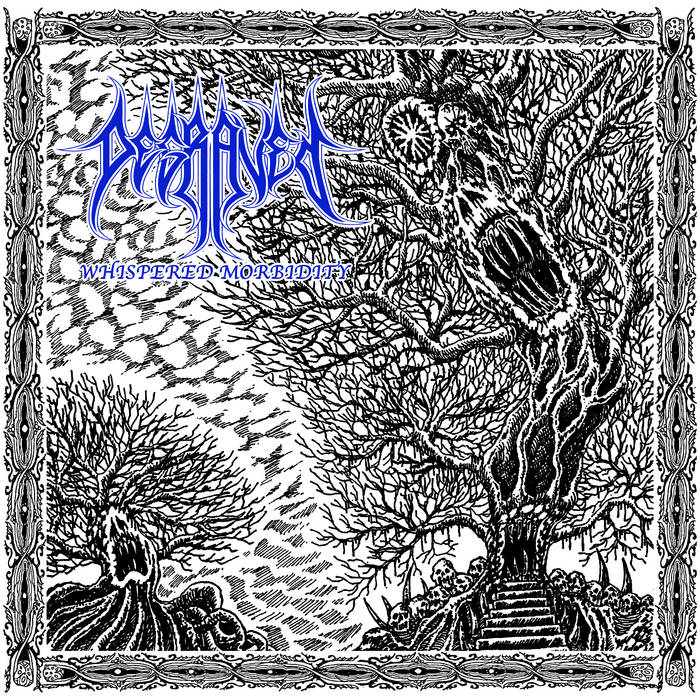
First demo and EP from yet another revoltingly young new old school death metal outfit. Degraved deserve praise for achieving a sense of novel coherence across their material, where many aesthetically comparable outfits will lean into verse/chorus structuring or – in the case of Blood Incantation – no structuring whatsoever in the hopes that enough currency can be made out of aping the correct tropes (something they have been amply rewarded for by an undiscerning scene). Degraved certainly tap into the vibe of OSDM in this regard. The earthy production retains just enough vigour to elevate the riffs, the guitar tone borrowed from sludge (which is now a thing in death metal apparently), the clear yet organic drums, and of course the guttural vocal track covered in just a little too much reverb. There’s the mix of classic death metal riffing injected with a jaunty modern groove (can’t alienate those hardcore fans after all), the occasional thrash riff because people have forgotten how else to integrate a tempo change to break up the dirge of plagiarised Autopsy riffs, and of course the humorous “lurchcore” riffing, the chief legacy of goregrind filtered through the carefully curating hands of Undergang et al. It’s all here, but presented in a tighter, neater package than we’re used to, making this only slightly less annoying than comparable OSDM landfill. If this had been released just over a decade ago it would have made serious waves. In 2024 it’s remarkable that bands are still putting this stuff out as genuine music for us to scrutinise and not just as a fun pastime.
Diabolic Oath: Oracular Hexations
Out 5th April on Sentient Ruin
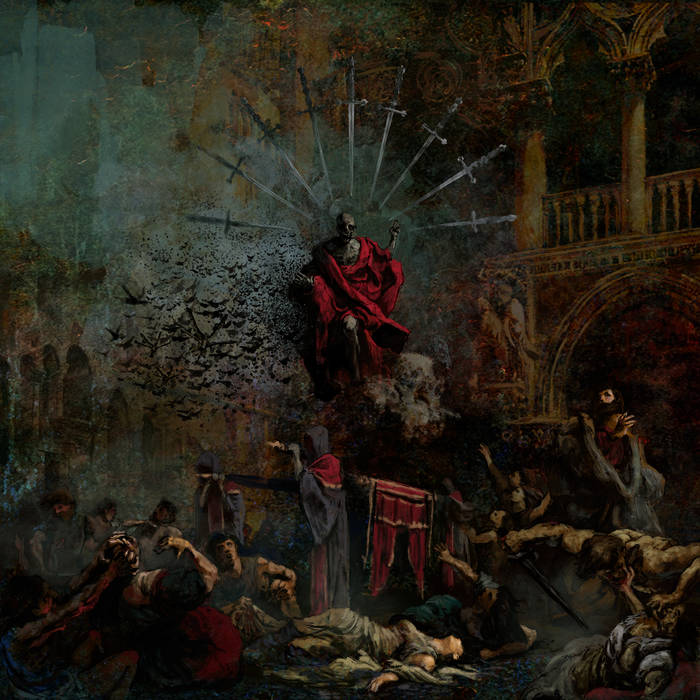
If one could point to the line in the sand that separates “modern” extreme metal from the earlier forms it so vigorously worships, it would be a focus on surface level aesthetics over the grinding slog of intelligent composition. Sure, guitar tone, mix, vocal style, tuning, and textural qualities are all key levers musicians can pull on to create the desired effect. But today they are mistaken for “things in themselves” to speak in Kantian terms. The thing in itself in this context being the patchwork of riffs, melodies, rhythms, and tonal choices that make up the underlying substance. I bring this up in relation to Diabolic Oath because a quality and surprisingly novel death metal band sits beneath a need to pander to the blackened death metal or death/black metal aesthetic. A latent caverncore influence haunts ‘Oracular Hexations’, as does the need to create an oppressively evil vibe that I imagine is one of the chief legacies of bands like Belphegor. But these elements do not totally detract from enjoying this album. Fragments of dissonant black metal are present for sure, but they are deployed as tasteful accents, juxtaposed against more straightforwardly chromatic riff architectures. Odd melodic flourishes lurch out of the mix, enhancing the cloying darkness stretched across this album. The combination of guttural and mid-range vocals is par for the course for the stylistic allegiances. Required filler that adds little but is no doubt serviceable. But tracks like ‘Winged Ouroboros Mutating unto Gold’ speak to this album’s strengths. As the more abstract elements bind themselves together over the course of the piece, slowly building to a finale that hints at traditional melodic forms before devolving into the most basic, atonal grind to close. Clever touches like this speak to a real substance beneath the at times obnoxious presentation.
Manasseh: Tunnelling to Paradiso
Out 5th April on I, Voidhanger

Patrick Brown’s dungeon synth project. Although at this point the term is really becoming a catch all for any ambient/neofolk/electronica outfit that happens to be a side project of a metal artist. Brown clearly prides himself on presenting as a leftfield voice within contemporary extreme metal, a self image not entirely unwarranted. Here, dark ambient meets tentative folk refrains, half formed vocalisations from distant croons to close range spoken word passages lifted from gothic horror. The explicitly peripheral manner in which this music is presented is perhaps a little overplayed. Any substantive musical content – whilst clearly present – is interrupted, sacrificed in order to create this ghoulish, distorted aftershock effect as one might experience toward the end of a horror film or as an interlude on obscurantist black metal EPs. Whilst the intent is understandable, it works more on an intellectual level as sound art or even sound archaeology (hauntology?) than it does a truly immersive experience. Lacking the space here to descant on the purpose of music in a given context, suffice to say that this is not a release one can get lost in. One can appreciate the frustrated momentum, the teasing nature of the acoustic guitars, the ambient swells of creeping malevolence, but the ambiguous phrasing is just as liable to provoke frustration at the lack of substantive development. Whilst criticising an artwork for what is clearly its chief intention is redundant, a case could still be made for Manasseh leaning into these elements harder, making the musicality less developed, the drone sequences more abrasive, the prematurely euthanised phrasing even more disruptive. There is much to recommend ‘Tunnelling to Paradiso’, but it remains by degrees frustrating even on its own terms.
Tenebrific: Labyrinth of Anguish
Out 8th April, self-released
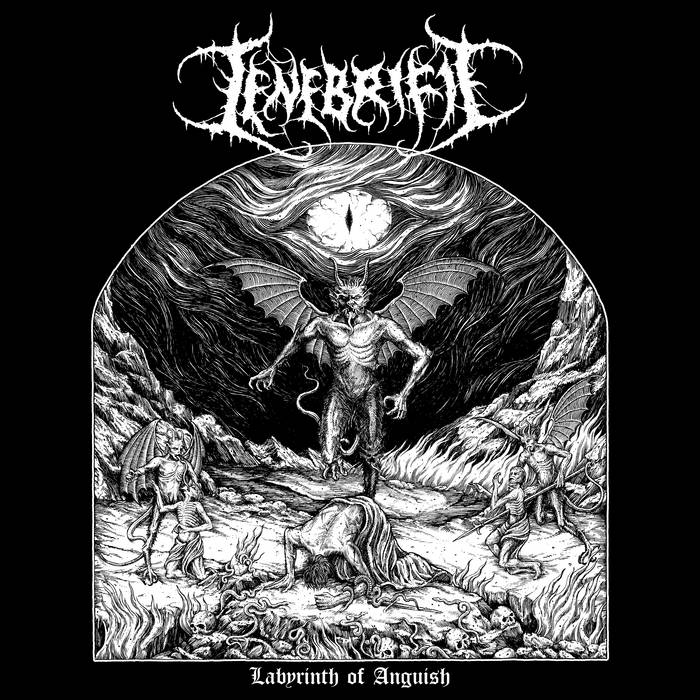
Tenebrific bill themselves as blackened death metal. The misapplication of genre tags continues apace it seems. This is essentially drone/sludge metal with additional dissonance, and serves as a reminder of just how boring modern iterations of said genres can be at times. The opening track ‘Harmony ov Suffering’ is over six minutes long, but consists of a single droning chord and a basic linear drumbeat, with layers of dissonance slowly coalescing over the course of the piece. For vibe driven music the effect would be so-so were it not for the fact that we have heard this technique hundreds of times before, and bands continue to lean on it when at a loss as to how to kill airtime, in the hope that dramatic import can be contrived out of hammed up sparsity. Nearly three minutes into the second track (on a three track EP mind) ‘Tormenting Shadows’ we are finally treated to some riffs, which are essentially the same repackaged Incantation spare parts, this time with some additional traditional melodic contours deployed to lend a sense of melancholia beneath the browbeating brutality. And to that extent, they have at least outdone the likes of Grave Miasma for working in some degree of substance for us to latch onto. In this respect the frontloading of filler is something of a shame. Despite the coverncore dog whistles Tenebrific achieve above par for fluid, engaging riffcraft once they actually pick up the momentum. But the runtime is padded with excess fluff to the extent that considerable patience is required for a somewhat limited reward.
Magistraal: Fantoom van de Deemsterburcht
Out 16th April, self-released

Magistraal appear unclear on who or what they are. But there is enough to go on beneath the stylistic obfuscation that we can begin to piece together an interesting picture. ‘Fantoom van de Deemsterburcht’ reinvigorates black metal with unapologetic camp via the meshing of spooky undertones lifted straight from the gothic tinged style of earyl Gehenna, which in turn give way to jarring chord sequences that call to mind DSBM, only to round off into strikingly traditional sequences hinting at blackened thrash at one end and ambient black metal at the other. It should be noted that whilst Magistraal hardly excel in any one of these fields, they achieve a marked balance between all these competing themes, and therefore deserve praise for their ability to marshal the rich history of black metal into a convincing statement, leaving ample room for outright silliness in the process. The latter of which can be forgiven or even celebrated owing to the fact that Magistraal have put the leg work into cementing these pieces together with an internal coherence. The production is on the raw side but by no means unclear, washed out by a standard trebly guitar tone, unadorned drums, and mid-range distorted vocals. Light synths haunt the background, adding harmonic provocations at moments of dramatic import. Indeed, in terms of presentation alone ‘Fantoom van de Deemsterburcht’ is beyond typical. But all this is merely a jumping off point for what is essentially tightly written melodramatic black metal that earns its camper indulgences thanks to an underlying architecture that many fans of this style have been utterly starved of in recent years.
 Hate Meditations
Leave a comment