Becoming a father last summer reeked a disruption to my rigorous and longstanding listening schedules as dramatic as it was expected. Parenthood is many things. But at its most basic, pragmatic level, it means fielding constant demands on time and attention. The knock-on effect for anyone whose chief pastimes are reading and listening to music are predictable.
That being said, the new year has seen the bedding in of a workable routine. One that allows some space for focused listening. Aware that the swift development of children in the early years requires constant renegotiation of how free time is spent, I have not squandered this opportunity, however brief it turns out to be.
The last three months have allowed me to continue the Beats and Yelling roundups whilst plugging some gaps I was aware of but had never bothered to fill. Such as a recent Necropolis Podcast tier list on “non”-extreme metal forcing me to confront Blind Guardian.
For a fan who views the sonic landscape through the lens of extreme metal, taking the temperature of power metal is a little like receiving a telegram from beyond the wall. One way of viewing Blind Guardian and their ilk is as the purest and most unapologetic inheritors of heavy metal. But this is a limited reading. In many ways it’s a closer cousin to thrash, sharing a common ancestor in the form of speed metal. In fact, one could go so far as to say that power metal is heavy metal re-founded with a thrash metal architecture, simply borrowing the melodic language and epic euphoria of chorus driven heavy metal to round smooth over the rough edges.
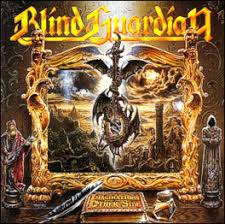
Blind Guardian from the early to mid-90s are remarkable in this respect. Not just because they were unapologetically making this music in the mid-90s when many outside of Germany had abandoned high fantasy as too kitsch, but also that they melded an astute understanding of how to flirt with commercialism without sacrificing vaulting compositional ambition.
It’s this, alongside the ability to invoke chaos when foregrounding their speed metal DNA that generates a durable cross appeal. The power metal hallmarks of hymnlike choruses, ballading, and adolescent boner geek metal are all here, but there’s a vestigial substance beneath the 90s Blind Guardian run from ‘Somewhere Far Beyond’ onwards that extreme metal fans ought to pay heed to. Not least because it offers an alternative orientation by which to approach the riff language of extreme metal handed down to it from speed metal via thrash.
At the other end of the spectrum we have an encounter with Terminally Your Aborted Ghost’s ‘Slowly Peeling the Flesh from the Inside of a Folded Hand’, recommended in the Instagram comments following a discussion on Demilich. I caveat my remarks here by highlighting that this form of borderline mathcore tech death generally leaves me cold. But if we read this mid-2000s oddity as a late stage aftershock of death metal’s mature phase, it offers wonderful bolts of inspiration for the academically inclined.

Gauche slam breakdowns and hardcore adjacent “quirks” sit happily alongside mutated riffing from late thrash, Suffocation, and even some black metal. The vocals are equally indecisive, for the most part sticking with the comical pig squeal style that pervaded the pornogrind obsessions of this era (metal’s own unique contribution to the nasty naughties), but even here variety is rife.
This album sits on the wrong side of the line between experimentation and short attention spans. One wishes they would unpack certain ideas more, but equally it has to be acknowledged that the anarchic, self-interrupting philosophy is a feature of this style, not a bug. And by today’s standards this relic looks honestly eccentric for all its foibles, and as a result comes off as far more idiosyncratic to a weary modern ear.
One lost gem that is receiving some much deserved latter day airtime is Japan’s Intestine Baalism, and their 1997 classic ‘An Anatomy of the Beast’, another Necropolis Podcast talking point raised by Rafael on the Underrated Bands episode. Intestine Baalism are best approached through the filter of Swedish death metal. In particular, the melodic turn from the mid-90s onwards.

An amalgamation of d-beat punk and NWOBHM high melodicism, the style in its purest form is perhaps one of the most restrictive iterations of first wave death metal, reaching its apex on albums like Dismember’s ‘Like an Everflowing Stream’. Given the limited percussive or even tonal language, the temptation to lean into very traditional and by extension accessible melodic forms is perhaps understandable. Hence the popularity of post 93 At the Gates, Carcass’s Michael Amott era, and of course Gothenburg. Outliers of sophistication in the “melodic” sphere (it’s impossible not to scare quote it given the limited definition of melody in this context) such as Dark Tranquillity or Necrophobic achieved only limited success in rebutting the overwhelming pull toward pop accessibility baked within the style.
It’s therefore fitting perhaps that we must look well beyond Northern Europe for an artist able to salvage the style, perhaps with a degree of academic lucidity afforded by their distance from the style’s cradle. And that’s precisely what Intestine Baalism achieve here. Meshing the not completely worthless bouncy primitivism of Grave with the galloping d-beat barrages of Dismember, seamlessly integrating this punk DNA into sophisticated melodic runs expressed by longer than average riff cycles defined by traditional tonal centres, delaying gratification by deploying riffs that tease at cadences. This makes for a fitting counterpart to the majority of death metal still engaged in tonally stateless chromatic play.
These fundamentals are enhanced by adept lead guitar work that walks the line between euphoric virtuousity that could match the best in populist heavy metal whilst remaining grounded in the compositional development, never railroading a piece into a mere platform for guitar acrobatics, and always deployed with a view to achieving maximum dramatic impact.
 Hate Meditations
Leave a comment