Epic
Out 15th March on Season of Mist
If we measured albums purely in terms of communicating artistic intent, ‘Epic’ would be considered a triumph. It simultaneously showcases the abilities – such as they are in their present state – of its renowned clientele whilst satisfying the expectations of metal’s increasingly casualised fandom, who understand artistry as a checklist of tropes. Because Vltimas have met these needs, and only these needs, it will be regarded as a success. Anyone looking for hints of a world beyond this playpen of sanitised superficiality will be sorely disappointed (and were grossly mistaken in looking for it in an act such as Vltimas).
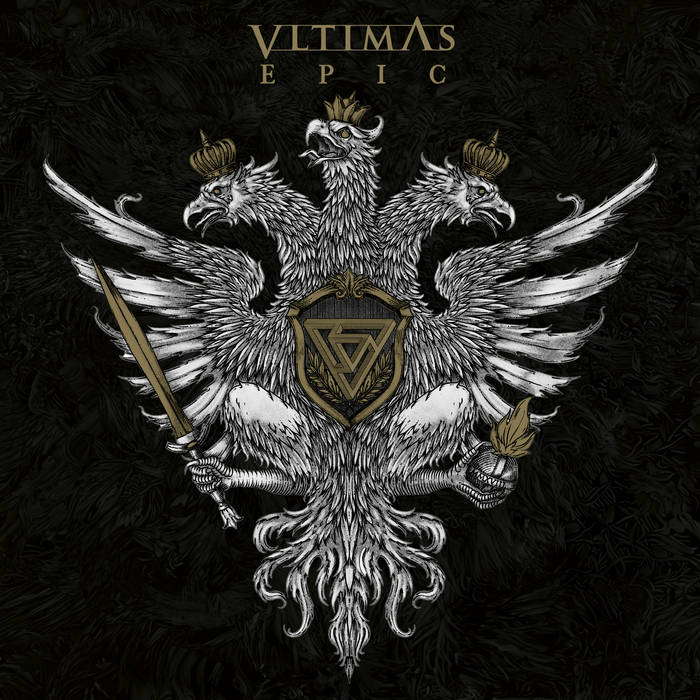
Context matters when discussing Vltimas because supergroups are nothing but context. As well as cashing in on the remaining goodwill of their fanbases, they stand or fall based on whether they position themselves in confrontation or continuity with their legacy. This posturing is an important way of drumming up publicity in any new project, and will determine fan responses before anyone has hit a note. It may therefore be beneficial to dispense with my usual instinct to confront the music head on, and instead base any critique of ‘Epic’ explicitly on who Vltimas are.
History is baked into an album like this. We are too familiar and invested in the works of David Vincent, Blasphemer, and Flo Mounier as artists and people to even bother pretending that we should treat this as “new” music in a total sense (arising from fresh perspectives, places etc.).
It is from a purely contextual place therefore, that I state that ‘Epic’ is almost a perfect album. It offers no surprises, no creative stretches, performances adequate only to the needs of the music, it does nothing but totally and completely fulfil the expectations we previously had of these musicians. I therefore won’t even bother pretending that I can assess this “in a universe emptied of context” and list its shortcomings or successes as a work of modern extreme metal.
The production is almost too perfect. Polished, crystalline, deep, with more than mere lip service paid to that earthy organism now part of the furniture of mixes following the clinically triggered naughties. This shores ‘Epic’ up from any accusations of sterility or soullessness, making them seem totally disingenuous. It is also dynamic, able to switch from spacious soundscaping deployed to elevate moments of dramatic import to a tight, precise articulation of the music’s jagged, technical edges.
Blasphemer works between the patented blackened thrash of Aura Noir, working in that stilted, ponderous dissonance that defined his tenure with Mayhem. But he integrates these contours into a stadium rock predictability – think Blasphemer rewriting ‘Domination’ era Morbid Angel riffs – to suit David Vincent’s increasingly operatic vocal style. On that, Vincent is undeniably one of the most talented vocalists of the original death metal generation. For all the indignities of his career since his initial departure from Morbid Angel, Vltimas is clearly an outlet to exercise his vocal breadth (both clean and distorted) in a space metalheads will still be comfortable in, allowing them to regain respect for his abilities. Mounier’s performance provides the required framing, but exercises a degree of creative restraint, allowing the slower, anthemic extreme metal room to breathe whilst still delivering memorable patterns.
The variant of populist extreme metal on display here is common currency for many legacy acts, and invariably leaves me utterly cold. But the naked efficiency and effortless fluidity exercised by Vltimas is relentlessly disarming. This style is tough to pin down, recognisable by a certain polished, high budget presentation, and a temporal and genre agnosticism. Some call it the funderground, I call it casualised. The fun, metal-by-focus-group aura of ‘Epic’ has an audience precisely because of the expectation feedback loop between fan and artist.
Vltimas are hardly unique in this regard, but they expose the superficiality of this endeavour with remarkable efficiency. Familiar dog whistles are voiced, a plethora of riff styles, techniques, intervals, even down to the pacing and use of tempo, all are placed exactly where they should be.
All are traits developed by Vltimas’s generation in their halcyon youth, once daring and avant-garde, now domesticated, familiar, part of the furniture for casualised metal. Vltimas are well versed in this dialect, expertly manipulating them into the perfect entertainment product.
I sense no cynicism however. This is not trying to present itself as anything other than what it is. Every element, from the production, the performance, the writing, pacing, and arrangements, all are placed exactly where they should be to please casualised fans of stateless extreme metal. The result is an entertaining, harmless, and totally unenlightening experience.
But the casualised metal articulated by Vltimas is harmful by virtue of its proximity to what remains of a genuine underground. It uses up oxygen reserved for spaces where genuine risk taking is still a possibility. Where a listening experience still has the potential to be “harmful” in some way. Frontiers of discovery are being slowly abandoned for the sake of familiar pastimes. A process accelerated by the self-affirming, algorithmic favouritism lavished upon casualised fandom that demands nothing more than the same thing they enjoyed yesterday, and the critical negligence of what remains of a music “press”. As a result, this pop metal will likely be mistaken for something of genuine value, even if Vltimas themselves seem very comfortable with their role as light entertainers.
 Hate Meditations
This complaint seems connected to your view of Hellfest as a Theme Park, better compared to Disney World than to the origins of metal as a middle finger in the face of the powers that wanna-be. And I agree.
And yet I worry that maybe the fault is with us old-timers, who keep insisting that the music that saved our lives once upon a time has to continue to mean something.
Could it be meaning is perceived as either a threat or a redundancy in this day and age? (If so, who will save us from our selves?)
LikeLike
I think I’m (futiley) trying to deprograme anyone that’ll listen, trying to convince people that there could be more to metal than the current common sense narrative. I still hear the occasional new release that gives me hope, but I also accept that ossification is pretty bedded in now, and nothing we do will hold back the tide.
LikeLike
I don’t think it’s merely a question of meaning. It’s mainly a logical outcome of how genres evolve. The radicalism/middle fingers of yesterday becomes recuperated as a style by epigones, and after a few decades the epigones’ number is bigger than that of the radicals, to the point that radicals need to start new genres to be truly radical. The same thing happened in jazz, in punk, in rock. It even happened in genres with zero commericial succes, like power electronics or death industrial. So indeed, in that sense you are right that the meaning of today’s metal has shifted: away from true radicalism. Maybe our culture has become immune to middle fingers. There hardly seems any threat in ‘meaning’ left. (Maybe there never was? Has metal ever been a real threat? Did metal really change society, or did metal arise because society changed? I guess it’s not a black&white issue, but I’m inclined to think culture tends to follow material/technological/economical stuff, and generally speaking not the other way around.)
So the problems for the radical today are different than those of the 80ies-90ies. It seems finding formal new ground becomes harder and harder to do every decade that passes – the result of an aging culture. Also on the part of content the same could be said: who cares for another song about Mengele or environmental collapse? Who cares for another record like Con-Dom’s How Welcome is Death To I Who Have Nothing More To Do But Die, or Jason Lescalleet’s The Pilgrim? (On a sidenote, two very different records from very different scenes dealing with similar subject matter, that paradoxically aren’t too dissimilar auditory for a ‘normie’ – two scenes converging to the same stuff, illustrating the creative well isn’t a bottomless pit.)
So can we really be saved by radical middle fingers? Radicals have a harder time today to find a format and a voice – artistic permutations aren’t endless, saturation closes off lots of paths already taken. New technology might bring a bit of fresh air – just like the electric guitar and the computer did.
So I don’t know about old-timers. What’s their agenda? What’s the meaning they look for? What do they need saving from? Do oldtime metalheads want the same radicalism they experienced as a teen when they put on Altars of Madness? Probably impossible to achieve within metal itself. Over the last decade, I’ve experienced the ‘new’ and the ‘radical’ occasionally, in other genres, but still, it’s not the same as radical metal, even though it can be as artistically rewarding. And of course I’ve sometimes discovered radical art stuff from the past that I was unfamiliar with.
So I end up listening mostly to metal classics, and lots of other genres, and at times I’m still moved by new records like Adrianne Lenkers’ new album – not because that’s radical, but just because her songs are beautiful and her lyrics full of meaning. Her stuff really ‘means’ something, but at the same time it won’t change a thing to the powers that be. So maybe you are on to something in your comment, and contemporary metal doesn’t really mean something anymore to you because it is detached from it’s radical origins.
How would contemporary radical metal sound? Or radical music in general? And what would be true radical artistic content? By definition, anything diverging enough of the middle, but such a measure generally only makes sense within a genre or a topic, because when you compare radical X to radical Y from another sphere, it tends to lose its radicalness. You could say that 20 Days in Mariupol is more radical than any Bolt Thrower because they partially inhabit the same sphere – but how to compare it to 4’33”? The documentary is both more and less radical, depending your point of view. But Cage’s work sure was a middle finger too, and maybe a bigger one than Slayer’s early records. But how to measure their effect? I don’t even know how to begin to answer that question.
So even though I still crave it (I guess my brain is wired to look for novelty & meaning) I think as an oldtimer I’ve given up hope for ‘real’ radicalism in art – btw, don’t we all have to admit we were probably too easily impressed as teenagers as well? – and have started looking for meaning in other places too. That’s not necessarily in contrast with young ones that do still find their version of a saviour middle finger in today’s metal.
LikeLike
an ossified tide
LikeLike