Deathlike Dawn: Among the Graves of the Archetypes
Out 27th February on Putrid Cult
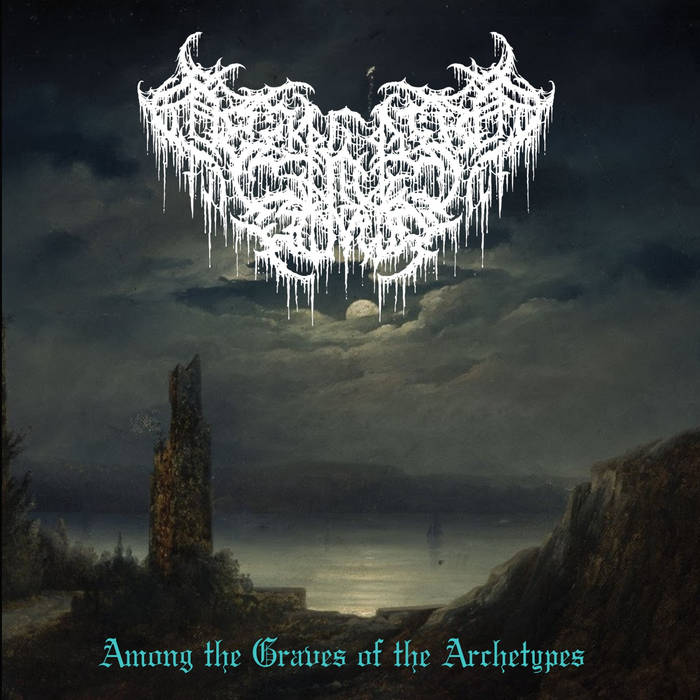
Bucks the trend for riff based black metal by treating jagged dissonance as a starting point and not an end in itself. Disorientating chromatic runs, articulated through staccato chord punches and flourishes of dissonance are resolved into fluidity and consonance, defined by a highly conditional optimism. The result is haunting in the truest sense of the word. The familiar made strange. Monstrosity invading the sanctuaries of domesticity. This plays out via the interchange of highly abstract riffing – borrowed from various currents of contemporary technical death metal – and surprisingly rudimentary melodic forms, assisted by sparse keyboard harmonies as if to hammer home the simplicity of the central threads running through these pieces, despite the complex of ornamentation following in their wake. Like all good metal, Deathlike Dawn makes great currency out of a binary interplay (light and dark, good and evil etc.), caveating each theme with its opposite in frequently renewed forms. The ghoulish, arhythmical vocals add another conflicting dimension to this anomic stew, whilst drums are kept low in the mix despite their expressiveness, choosing to align themselves with the contours of each riff as opposed to taking up arms against them. The resulting unipolar sonic picture offers insights and intrigues that constantly renew themselves as the album progresses.
Vorus: Desolate Eternities
Out 1st March on Loud Rage Music (cassette version available from Macabre End Prods 15th March)

Austere death metal builds a platform out of an absurdly basic approach to riff construction, and uses this to launch loosely defined melodic material taking the form of licks more than fully articulated sentences. The approach is not unwelcome however. The backbone may be basic, but it’s not lacking for creativity. As if to smooth out the contours of early Suffocation, it conducts the process of world building from below, forcing rudimentary musicianship to reach for something beyond its means in order to imply complexity as opposed to spelling it out for the listener. In this context, lyrical lead material functions as commentary on the shifting sonic corridors beneath, working through expressions of alarm and joy in equal measure. In this light, Vorus present an honest front of transparent death metal, smuggling in a surrealist and at times even epic undercurrent beneath this unassuming guise. The guitar tone makes up in clarity what it lacks in body. Guttural vocals compensate for lack of punch in the bass. And drums provide only the rhythmic content that is absolutely necessary to motivate this music, an interesting exercise in creative restraint presenting a very different kind of challenge to technical excess. The same could be said of ‘Desolate Eternities’ as a whole. Modest, death metal frugality by all accounts, but does just enough to suggest heavier, abstract themes lurking behind the raw content.
Cyclopean Forge: Blood Under the Glass
Out 1st March, self-released

Evinces a little too much presence to be considered ambient, thus allowing us to partition this brief EP as a variant of futurist drone. Although most obviously a late ancestor of the Berlin school, this synth duo updates the package of artificial formalities that defined Tangerine Dream and much ambient besides by the late 1970s, using a similar array of synth patches, but weaponizing them into tense, unpredictable pulses of droning notes and echoey decay. Whilst too ambiguous to be classed as dark ambient, there is an unsettling entropy to Cyclopean Forge that feels entirely fitting. Connecting a – by now – wildly outdated tech optimism with our more anomic era, bypassing the vaguely pacifist new age divergences running as a counter thread to the brutalist lineage within ambient. This EP manages to offer cold comfort in the form of naïve melodic threads, cathartic releases of noise, and eerie waves of energy. But the overarching impression is one of ambiguous dread. The knowledge that all is not well, and the underlying causes are directly tied to technology we can no longer unshackle ourselves from, instead leveraging it as the very medium through which we express this dread. Where once technology presented as many threats as it did opportunities, it is now an oppressive habitus, an inescapable reality whose effects are felt everywhere, but whose very ubiquity affords us no way to conceptualise our lives beyond the algorithmic binds.
Curse all Kings: Feral Earth
Out 8th March on Breath Sun Bone Blood/Cyclic Claw
Liminal dark ambient makes use of post metal as a means of increasing the textural and dynamic range of what is essentially militant drone. Pieces pivot around a basic interchange of two or three notes, with distant synth chords providing the bare minimum of landscaping required to give the music a sense of size and scope. But the music, for the most part, remains committed to a half existence, even by ambient standards these pieces are striking for their sparsity. One could admire the ability to work in subtle developments in texture and theme that remain in keeping with the eerie, tentative flow of the music were it not for the reliance on metal ephemera – namely simple flows of trebly guitars and high pitched distorted vocals – as a shortcut to achieving variation. This is chiefly because although this artist probably thinks these elements align it to a black metal ideal, the effect is more evocative of the redundant optimism of post rock/metal, thus stripping the dark ambient framing of its lurking dread. Whilst ambient often structures itself as darkness progressing toward light, Curse all Kings attempt to cheat-code their way into achieving this dramatic effect, instead of evolving these pieces in a more natural and by extension rewarding manner.
Compress: The Final Level of Consciousness
Out 15th March on Eternal Death
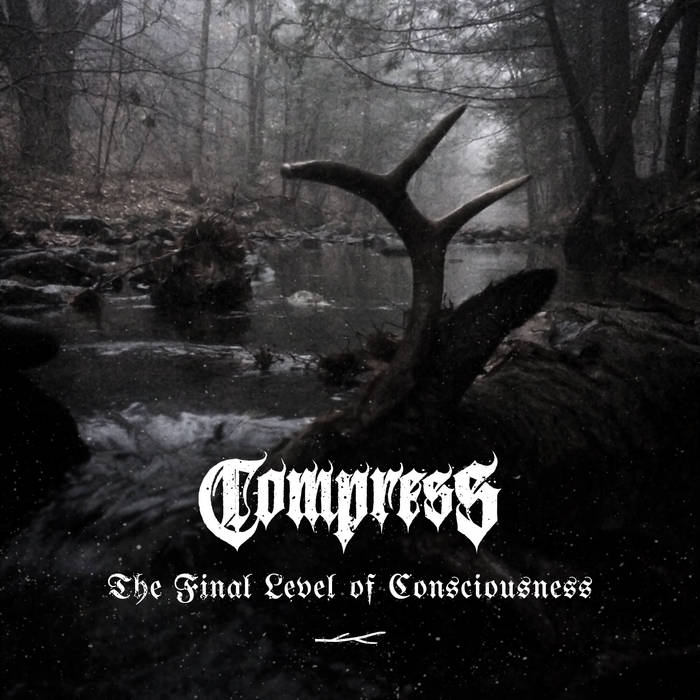
Compress are more successful in marrying black metal and sludge than the vast majority of similar efforts. It suffers from the same circularity via shifting tom rolls and attempts to contrive mood through repetitions that imply a forward direction without ever articulating a destination. But embedded within these shortcomings is the suppression of hardcore DNA as a motor chiefly of rhythmic energy, allowing the rich melodic material room to breathe in passages segregated from the impotent ejaculations of sludgy desperation. In this sense one imagines that Compress have achieved something that Krieg have been reaching for over many years now, but have always fell short due to Jameson’s limited understanding of melodic construction. Questions remain as to whether Compress have merely managed to contain their post hardcore influences, or actually leveraged them in a way that uplifts the material. As we wait for another misplaced groove or overtly emotive outburst to give way to tremolo grace however, questions remain over whether fans of both post hardcore and black metal will see this EP as only half aimed at them (aside from the usual PR stenographers on social media desperately trying to appear open minded). Despite successfully meshing the frigid atmosphere of black metal with the meaty energy of sludge, one cannot help but wonder how much currency there is to mine from this self-imposed handicap.
Chapel of Samhain: Black Onyx Cave
Out 18th March on Nuclear Winter Records

Follows the same pattern as a lot of blackened death metal straddling the grindcore line, in that it constructs riffs from the melted down detritus of death and thrash metal, adds a seasoning of “evil” sounding intervals, and articulates this via the atmospheric flair of Profanatica, Blasphemy, or Beherit. Although ‘Black Onyx Cave’ does not sink as low as a Teitanblood (there is actually an attempt to string some riffs together here), one cannot but tire at the flat repetitions and painfully formulaic developments, packaged within bloated tracks that do little to justify their length. Eccentric ambient tangents fail to quell the desire for something more from this album. By the time track four ‘Delerium’ kicks in one welcomes the farming out of lead instrumentation to a church organ, but in reality, little is expressed beyond ascending harmonic material atop the inert rhythm guitar riff. If Chapel of Samhain want to sustain a simplistic package of occult primitivism, they would need to lean into the raw surrealism or eccentric atmospheres in a way comparable to Beherit. Equally, if they wanted to expand into something with at least a degree of musical sophistication they would need to inject some life into their currently flaccid riff package. Despite rooting for this album on a spiritual level, its worst-of-both-worlds approach leaves naught but exasperation in its wake.
 Hate Meditations
Leave a comment