Pestilength: Solar Clorex
Out 16th February on Debemur Morti Productions
Enigmatic death/doom/black metallers Pestilength return for an album wide in scope yet compact in execution. The latter feature certainly deserves accolades, not least because they temper their ever expanding horizons with an awareness and dedication to their own identity. Their strength lies in transferring the older language of death/doom into a modern context in a way that avoids both mere replication and an over reliance on swelling chasmic dirge at the expense of all content.

‘Solar Clorex’ presents a much more direct, modest front than previous effort ‘Basom Gryphos’. The production leans into an intimate organicism, light on reverb, even a little frugal with distortion, allowing the guitars to undulate around more complex, meandering riff patterns, background mechanics in full view. Pestilength mimic and in large part outdo the majority of self professed Lovecraftian metal of recent years in this regard. The riff package lurks somewhere between Incantation (as one would expect), supplemented by eerie Finnish surrealism. Modest percussive punches provide much needed contouring given the fact that the tempos for the most part lurk a few notches lower than modern death metal listeners are used to.
Pestilength give themselves licence to shine within the intersection of the celebrated “mid-pace” supplemented by riffs richer in information than the usual bargain basement OSDM act. One is reminded of ‘Soulside Journey’ in spirit if not in content for a similar approach to death metal. It eschews doom as a project of merely bludgeoning the listener with funereal aplomb, and instead reaches for the eldritch via unpredictable riff shapes, rendered naked and knowable in their laboured delivery, but always adopting unexpected or unsettling forms, holding on refrains for longer than is comfortable before dwelling on a convoluted link phrase of opaque but never redundant teleology.
This is not a flawless effort however. A surplus post rock breakdown in ‘Enthronos Wormwomb’ immediately arrests the momentum of the album, sapping both the rich arrangements and uncanny riff shapes of their mojo. ‘Dilution Haep’ attempts a recapitulation of Steve Tucker era Morbid Angel through its aggressively depressed pacing and its unpredictable microcosms packed within reliably consistent meta sequences, but Pestilength’s approach to this is too linear and transparent to bring the material to life. The mid section of the album is scattered with other such moments where repetition becomes a crutch for want of direction, relying on drum variations or limited dynamics to bring the overworked material a new lease of life.
Ultimately though, Pestilength deserve praise for pushing, teasing, or otherwise disrupting the borders of their chosen field whilst performing a rearguard action of impressive creativity, not just raising questions but furnishing us with possible answers. Despite a lacklustre mid section, they do enough across ‘Solar Clorex’ to convince us that this remains a death metal outfit worth watching. One conversant in the language of genre, and willing to take risks in order to stretch its well worn grammar to breaking point.
Departure Chandelier: Satan Soldier of Fortune
Out 12th January on Nuclear War Now
Following a debut that bored more than it intrigued despite the mild hype it managed to generate, Departure Chandelier dodge the very real danger of melting into a cutesy novelty act with the follow up ‘Satan Soldier of Fortune’. Here, they have their cake and eat it, maintaining the Napoleonic garb but leaning into their real talents as black metal revivalists par excellence.
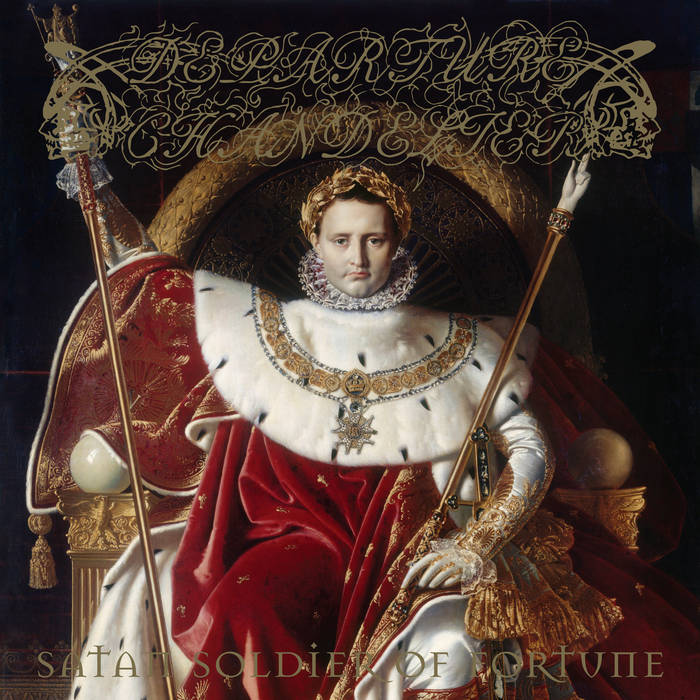
Reaching to a form of Celtic Frost derived black metal that thrived before Norway reigned supreme (referenced maybe only by Darkthrone out of the big names of the Nordic set), Departure Chandelier operate with a laser like focus on simple melodic themes, expressed via intermittent guitar hooks sitting atop a foundation of basic, punk derived power chord play, finding their harmonic counterpoint through clever but highly accessible use of keyboards.
It is perhaps fitting that – despite being Canadian – they lift most of their influence from Continental European black metal from the early to mid-90s. The rich, flowing militarism, the marching tempos, the pageantry supplemented with the moral ambiguity of power chord driven black metal. Successfully working with these elements seems to elude most contemporary voices, despite their utterly rudimentary form. Music both dignified and simple is often the hardest craft to grasp for experienced and beginner musicians alike.
In this sense, although Departure Chandelier may at first appear to be nothing more than a cheap novelty on which to hang some disposable black metal, there is at second glance something of real value at work, at the meeting point of composition and thematic inspiration.
French history – and by extension European history – in the years immediately following the French revolution is often overlooked by metal, with the vast majority of bands preferring to linger in antiquity or the cataclysms of post industrial military horrors. But the period roughly following the American Revolution up to the start of the long peace in 1815 was replete with religious anxiety, the fruits of the scientific revolution beginning to ripen via industrialism’s reengineering of society, new forms of warfare on a scale not seen before, and of course all manner of new political propositions – beginning to coalesce around their left and right wing orientations – filling the void left by the rolling heads of the old aristocratic order.
But Departure Chandelier are not utterly at the mercy of this intoxicating miasma of inspiration. Their focus is limited, preferring to imply grandeur and chaos rather than frame it in concrete. The riffs are austere but focused, the keyboards sprinkle the primal soup of linear guitar and drum patterns with hints of scale and melodramatic import, never falling into the trap of an obvious intentionality. By cultivating this relatively modest interpretation of black metal, it allows Departure Chandelier to truly immerse themselves – and by extension the listener – in a project of retelling macro historical events in sonic form, events that are too large and multi-dimensional for one single artwork or discipline to frame satisfactorily.
This is a reappraisal of a historical period through a medium that has largely ignored it until now. It displays an adept understanding of black metal as an evolutionary process. A relatively modest form of music as far as raw content goes. But a vehicle uniquely situated to retell events too large for the individualist perspective. This process is then inserted into the thematic material, allowing the two competing dimensions to interact and enhance one another. Late first wave black metal at the intersection of early symphonic forms is therefore given a new lease of life, and a well trodden period of history receives a fascinating retelling through a medium still grappling with its contours.
 Hate Meditations
Leave a comment