Anyone immersed in a niche subculture has an obligation to treat it with utter contempt. It’s probably the one thing I have in common with all metal fans. But it’s also something that metal “content creators” are losing sight of (including this platform at times). An aversion to visceral negativity, once the very stuff of quality music criticism.
Writers who actually express opinions (as opposed to regurgitating promo blurbs) will tend toward ignoring the bad and supporting the good for fear of attracting too much ire. But that’s precisely the problem. “Supporting the good” can quickly turn into a nod to the average, a plug for the forgettable, until your posts mutate into a relentless groove of covering every scrap of new material, discernment and critical purpose jettisoned in favour of mindless stenography.
This degeneracy is baked into the process of growing an online platform. Despite the column inches dedicated to the negative siloing effects of the algorithm, the public ecosystem of metal presents the image of an unending carousel of good vibes.
Antagonism between artist and critic is a good barometer of a culture’s health. And for metal, this boundary – between the generators of content (i.e. the artist and associated pluggers) and the critics charged with evaluating said content – has all but collapsed, intertwined in a symbiosis of sponsorship deals, information sharing, and mutual platforming. Whilst a strong case could be made that this informal, spontaneous, organic form of networking is the very stuff of an underground renaissance, it comes at a price. Namely the ejection of negativity in any and all coverage through fear of ostracization. The unpredictable and unaccountable views of underground platforms are anathema to the constant stream of positivity required to grow a brand. Until you end up with sites like Brooklyn Vegan’s Invisible Oranges gaining hegemonic traction, whose recent 43 Metal Albums We’re Anticipating in 2024 reads like a who’s who of tedious indie dilettantes.
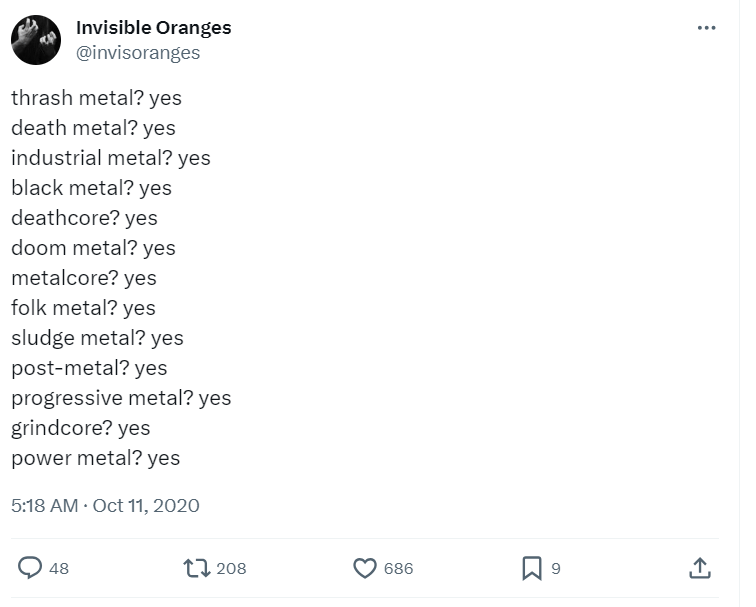
The result is the pretence that all content is good content. And it is a pretence. But the need to garner shares and build a network encourages us to act “as if” it were true. Thus smaller platforms look for a leg up by creating endless summaries and digests of the latest releases with little in the way of critical meat. A guide to this month’s black metal releases, for example, operates under the dubious assumption that more than one quality black metal album is released in a single month (this has not been true since at least 1996). The individual’s relationship to the artform is reduced to a duly homogenised and processed stream of content stuffed directly into the gullet. But if everything has value, nothing has value.
The dustbin of history is equally suitable fodder for the dark satanic content mills. Countless blogs, Youtube channels, zines, and review sites publish guides to lost demos from forgotten scenes, exhaustive lists of overlooked bands, or entirely redundant genre primers. See Banger TV’s Overkill Global series, presented with the light-hearted professionalism of a kid’s TV programme. Or Punk Rock MBA’s superfluous metal starter packs. A banally dispassionate list of albums that no one (no one) genuinely seeking a beginner’s guide to death metal is actually watching. Or (to take a non-metal example) the Trash Theory Youtube channel. All forms of slick, (sometimes) well researched content. But little more than Wikipedia pages with charisma for all the novel perspectives they bring to the subject matter.
This format is ideal for anyone wishing to maintain a regular churn of posts. Any half decent writer can, with a cursory glance over Metal Archives and a few hours of listening, create a façade of expertise on the nichest of topics. Whether anyone uses these “beginner’s guides” for their intended purpose is by the by. For the creator, they are easy content, allowing them to play into the contemporary “metal celebrating itself” public image.
This public image is just that, a front projected out as a form of cultural (or more accurately marketing) propaganda. But for the populace actually expected to consume all this content, an undercurrent of discontent bubbles away, festering like an old sore. Beneath the bright lights and fanfare there remains the deep bowels of the comment thread, where the hopeful flames of disagreement, tension, and division are still possible. Indeed, there was once a time when chat forums dominated the online discourse, and metal fans acted like sworn enemies trapped in a room together, forced to interact. It was deeply unpleasant. It was also the stuff of creativity and new ideas. Unity is not a virtue, communal self-hatred not a vice.
Based on no research, I’d be willing to bet that the average metal fan despises at least 90% of music classed as metal. This is because the music we hate often occupies the same space as the music we love. Classical music aficionados despise Ludovico Einaudi far more than they do the latest chart topper. The amount of space he takes up actively shifts the orientation and direction of the classical music world to a blander, tamer place. Ed Sheeran by contrast, has no centre of gravity within this space. Ditto for a Blood Incantation’s standing within discerning branches of death metal. As with Einaudi, they draw on the raw materials of art to create a facsimile which, to the laymen, is indistinguishable from the genuine article. Thus a trickster hijacks the airwaves and speaks on behalf of a community, usually to the horror of its grassroots.
Ultimately, the infrastructure of digital exchange has led us to misconstrue what our accountability to new music looks like. The public face of metal, from the largest print magazine holdout to the smallest microblogger, plays into this idea of metal as a perpetual carnival of joy. Every new release is nurtured, fenced off, protected, celebrated as worthy of existence. But in this context such unconditional love is not only damaging, but near terminal.
In light of this, there has never been a more pressing need for public displays of contempt. Contempt toward the majority of bands claiming to speak to or for us. Contempt for the affirmative noises vomited down our social media timelines by their affiliated content creators. Contempt for fellow grassroots fans buying into this charade in the hopes of growing their platform into the next Brooklyn Vegan. Our accountability to new music should rest on nothing more than a premise of contempt. Only when we are confronted with art worthy of the name should we let our guard down.
The appropriation of music into marketing is nothing new. But the cynicism behind it used to be explicit, naked, obvious. Now these same market forces are not only covert, but actively co-opting grassroots support and participation, disguised as a bubbling underground vibrancy. The only antidote is ceaseless contempt and suspicion.
 Hate Meditations
Agreed. It’s disheartening to see how every time Metallica release a new album, eight out of ten “reviewers” award top marks and drone about a “return to thrash days”, while missing the central point that it’s thrash metal itself, which stopped being meaningful in the late 80s, when Metallica were wise enough to abandon the sinking ship.
Makes you wonder what qualifications these people believe they have.
Fortunately, though, there is vox populi on the Metal Archives. While no name niche bands score preposterously high marks from a reviewer or two, at least marks for the big names’ albums tend to arrive at realistic levels, thanks to swarm intelligence.
LikeLiked by 1 person
The hosts of Banger TV look like baristas. Wouldn’t be surprised if it was a subsidiary of Starbucks.
LikeLiked by 1 person
In Mortimer J. Adler’s “How to Read a Book”, the author outlines multiple stages, in various detail, to teach the reader how to get a complete and full understanding of any given book, thereby unlocking its potential. One of the stages is called “inspectional reading”: in this stage, one is instructed to quickly read through a book, not only to get a sense of the author’s tone and terms but also to simply decide if the book is worth an analytical reading (the section he details the most). He says a very large majority of books do not – should not – make it past this stage. With the glut of metal we’re inundated with, the large majority of music we consume is inspectional. We decide which ones are worth spending our time on, time being the last barrier in a world of free-to-listen-not-to-own distribution models. How else could you possibly go about it?
The critic’s job is exceedingly difficult, as he is asked to perform an analytical reading of any album that lands on his desk in a very short amount of time. Thus, he has to resort to a more cumulative knowledge as a result of thorough inspection of many works over a longer period of time. Adler also details something similar as the fourth stage: the syntopical reading. I was deliberate with my word choice in the second sentence, because the inspectional and syntopical reads share some similarities with a few key differences. One must be very proficient at the former to master the latter.
What I feel has happened is the critic, in an effort to make his job much easier, has mistaken the inspectional for the syntopical. If you completely relinquish your analytical eye and only ever inspect, you can convince yourself that any album you listen to is of acceptable quality (“it’s pretty good”, “I liked that one song”). So, armed with the typical review vocabulary the critic has absorbed, he arrives at the conclusion that anything and everything is good, and uses that vocabulary to persuade his readers of the same thing.
This phenomenon is parallel to the current content economy favoring far more direct-to-consumer output and algorithmic gaming. A more cynical perspective is that those most guilty of this practice; your BrooklynVegan’s; are maliciously exploiting this, a kind of marketing propaganda, to net them the most views with the least amount of work. I am pretty cynical.
LikeLiked by 1 person
I’ll play with your need for antagonism – a curious need indeed, and perhaps not as productive as you make it out to be, but moving on – and say this : I doubt contempt is necessary. In my view, most metal is formulaic and trivial, and indeed I suppose most genres of music calcify in some way or another at some point. This is how a culture (or “sub-culture”) appears, how it takes form, and of course one must want this form to evolve. But to have contempt for the form does not mean directly producing the new. If we take things philosophically, it would be very problematic to think that from the negative the new will emerge, that becoming is a kind of nothing or destruction of being. But perhaps this too much of a metaphysical point. To put it otherwise and more directly, to say that critics have the key to the new is, well, to inflate the role of the critic. I doubt there is a fertile antagonism between artist and critic, as you say – indeed, I don’t know what serious artist takes any critic seriously. The listener or the consummer is the one that has to do with the critic, unfortunately ; the critic is not some kind of muse (he’s probably far too ugly to be that). Maybe we can say, like Wilde, that the critic can indeed produce the new, but only by making his critic a kind of art, or an art about art. Anyway, in the end I would say that the new comes from some kind of tension or pain, for sure, but these things aren’t negative per say (in fact they are positive in some sense, even if not recognized by the marketing team ; in the end even suicidal impulses can be sold with a smile). The point perhaps is that there is something that is inhibited, attention, hearing or intelligence, and indeed one can muster everything that has been said about the culture industry since the Francfort school. The question becomes how to break that inhibition ; with contempt? Contempt elevates. It forms judgement. But is judgement even necessary, and for who? The critic, the composer, or the listener? Do these all have the same judgement? Is judgement multiple or one? When you say “we” in the piece, who are you even talking about? The members of the subculture? Jesus fucking christ, man. I guess I should get out of this shithole. I mean I will ultimately follow your advice and have contempt – for the critic, at least.
LikeLiked by 1 person
I wouldn’t go so far as saying that critics create the new, but they certainly have a responsibility for creating the conditions for the new, and contempt has an important part to play here. It’s not the mcguffin it’s made out to be in the article (hyperbole has it’s place), but a healthy disunity is necessary for cultural progress. A critic is just an articulate fan whose opinions are respected, and uses this to inform culture’s dialog with itself. But I disagree that the critic is audience facing not artist facing, i believe artists make for ill judges as to the meaning and significance of their work, more on that here (apologies for the shameless self plug): https://hatemeditations.com/2022/11/12/criticism-as-an-act-of-creation/
The “we” refers to no less than the metal community, loosely defined as a high participation, high self-knowledge culture, one that has recently diverged too far into a love of its own mythology, and has thus shed a healthy suspicion of itself that again, i believe to be a hallmark of cultural progress (but certainly not the only hallmark).
LikeLike
I do agree with the base idea but cannot see how it could be applied in practical terms. Recalling every once in a while that 95%/most metal is not good? That’s an obvious statement for any kind of art form. Writing negative reviews à la SMR? That’s fun to do sometimes, but not really interesting as a regular activity. Actively campaigning against certain commercial darlings that are spoiling the good name of the underground? For any small-size medium, that would mean spending precious time and effort putting bad music in the spotlight. I guess focusing on “supporting the good” can have its flaws as a strategy, but no one could stand longer periods almost exclusively centered on defiling the bad… Besides DMU, of course.
LikeLike
I’ve pretty much long since abandoned professional reviews of basically anything for the same reasons you’re discussing here. Whether it’s books, cinema, music, or even cosmetics (yes, I am female. No, it doesn’t really matter. I am simply illustrating a point) – professional reviewers seem to be mainly fulfilling a role of promoter or cheerleader for a brand. In the US this is really egregious. If you look at mainstream news sites to see reviews of common household goods, half the time the reviews are sponsored by Amazon. It’s all corporate shilling. The problem is when the public can’t see beyond the smokescreen of “review” or “criticism” and simply accepts the promotion. It’s no different with extreme metal nowadays. Everyone is buying what is being sold to them. Things the only way I can explain how nu metal (or post-metal, or metalcore, etc)became a thing. So I bypass all the music press and go straight for Metal Archives, or any other amateur source of discussion, to get a sense of what is worth my time and money. Even better, I talk to actual people and ask them what they recommend. Even YouTube and the average blog has become an echo chamber, rah rah rah cheerleading section for extreme metal. It’s really sad that I see more serious criticism of mascara and makeup brushes online than I do of metal. It feels hopeless.
LikeLiked by 1 person