Having finally completed Midnight Tides, the fifth instalment in Steven Erikson’s Malazan Book of the Fallen, it feels like a good time to scrutinise the deranged culture surrounding this fantasy series.
Erikson is most appropriately positioned as a competent writer of pop fiction. He can string together a well paced beach read. His stories take enough twists and turns to keep the reader engaged. As far as character growth, drama, morality tales, political intrigue, or good old fable are concerned, the Malazan series has little in the way of originality or insight to offer, but that doesn’t detract from them being entertaining reads.
But when we turn to the position of this series in the pantheon of great fantasy literature it’s apparent that something odd is going on. The Malazan books are billed as the most complex, dense, epic, and fully realised fantasy world going, not entry level, on par with Tolstoy or Shakespeare for their nuanced treatment of macro historical forces and individual character development. A small but vocal minority begs to differ, arguing that Eriksen’s writing is a jumbled, cluttered, jargon ridden nightmare.
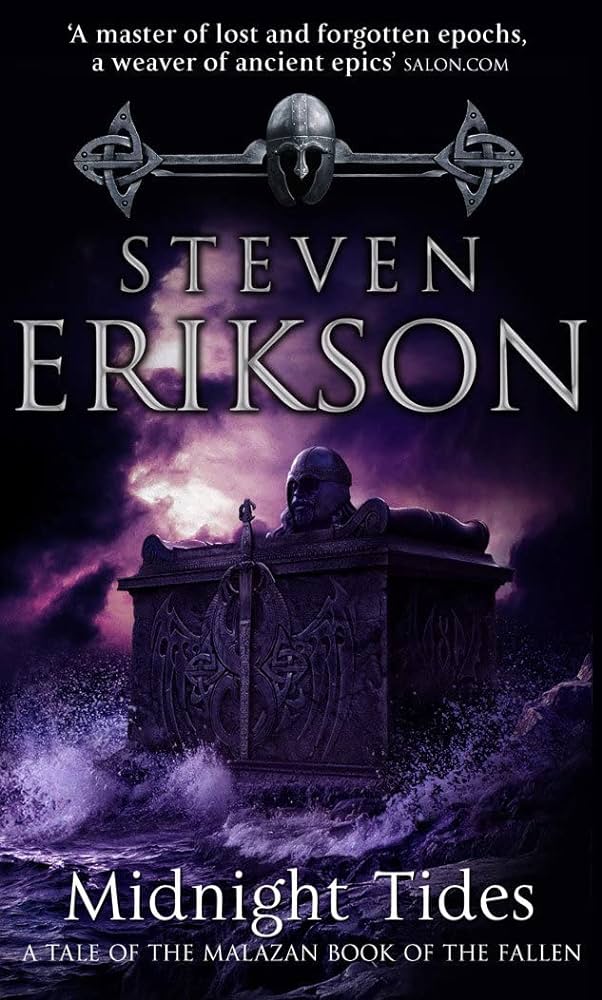
In analysing this online discourse, curiosity is peaked by the fact that at the cosmetic level, Erikson’s champions take a consolatory tone whilst his critics come across as the fanatical sect. Yet in looking at the meat of their positions, his champions are clearly on the shakier ground. All manner of unfounded hyperbole is nestled within their measured rebuttals toward Malazan dissenters (“Shakespearean” gets thrown around far too liberally).
This series illuminates the skewed priorities of fantasy literature’s underbelly, perhaps betraying their lack of literariness outside of this niche genre. What matters to fantasy readers is not the craft of tight prose or philosophical rumination via a fictional delivery mechanism, but a massive world building project, the more complex and obscurantist the better, at the cost of sucking all joy and artistry from the mechanics of storytelling.
Fans fully acknowledge that his writing is inaccessible, not entry level, that it will take two run throughs at the least to fully grasp, as if this were a good thing (for a series made up of ten weighty tomes mind). The very thing they value in writing is, to others, a tragic dereliction of literary duty. Dostoyevsky or Conrad can be dense, and multiple passes certainly garner greater insight, but their work is perfectly digestible after a single read, as with Tolkien (we had to mention him!). Accessible complexity should be the gold standard of high literature.
Equally, detractors who claim that the Malazan world is incomprehensible, cluttered, incoherent, they are only half right. No doubt Erikson’s writing should have undergone a vigorous polish at the editor’s desk before it was inflicted on the public, but it is not entirely without value. In short, as with any deeply polarised debate, talk at cross purposes conceals what’s truly at stake.
Erikson is hampered by – and held in unduly high regard because of – the mores of the fantasy genre, namely the requirement to build a world so complete, realised, and immersive that it appears to mirror or even surpass real history for its complexity. The eminently accessible toilet book is smothered in lore, lost in background static, to the point that picking out a story is akin to discerning a fragmented message over shortwave radio. The expectations of hardcore fantasy readers are the very thing impeding a wider audience from enjoying this series. Unlike Tolkien, who took a gradualist approach to guiding the reader into their world, Erikson throws every demon, deity, mythology, and timescale at the reader as quickly as he can, everything takes place on a macro scale, everything is amped up to extreme proportions, losing all proportion in the process.
This observation could apply to many fantasy series were it not for the fact that Erikson appears so impatient to spit out his mythology at the cost of any narrative build, and all this undue and unearned complexity is avidly celebrated by his readers. Pointing out that the lore is too loud, not well constructed, hampers the story, is thrown at the reader in a contextless word jumble with little in the way of dramatic structure, all are met with the rebuttal that we have missed the point. The Malazan lore is the most complexist, the biggestist, spanning the mostist time, the most locations, the most characters, cultures, customs, and dialects. Erikson is billed as advanced level fantasy writing. This is true only insofar as a monolith of surplus content cloaks what is otherwise agreeably populist writing. It’s an overcompensation.
Midnight Tides is the best point to lay out these observations because it is the first book in the series to behave like a coherent story. Previous volumes, despite their charm, creaked under the weight of disjointed descriptions of pantheons, mysticism and magic (the mechanics of which were not fully explained until book five), or political and character intrigue we are constantly told is technical and multifaceted at the cost of allowing a complex and multifaceted story to play out organically.
But even Midnight Tides suffers from a common ailment of b-tier writing, namely the same transparency in its narrative techniques. Character’s inner monologues are still given in italics, spelling out plot points, motivation, or again drawing attention to how twisted and multilayered the power struggles are. Avoiding such obvious expository techniques is rudimentary stuff for any fiction writer.
Erikson may have also realised that the rhythm of action scene, travel sequence, meeting of characters to discuss the plot points, surreal vision quest, rinse and repeat may have grown stale by Midnight Tides. Here, he attempts to inject humour and civic intrigue through the scenes in the city of Lether, which follow the characters Tehol and Bugg. Praise for effort maybe, but the woeful attempts at wry Pratchett-esque exchanges are if anything more tedious than the laboriously unfurled pantheon.
Eriskson’s detractors are correct that he is liable to incoherence, an inferiority complex when it comes to the size and scale of the world his characters roam in, but they go too far – and ultimately undermine their point – in claiming no value here. Equally, his fans seem fixated on this idea that complexity, culture, lore, and history are literary ends in themselves, forgetting that without a well thought out, measured delivery mechanism or meaningful metaphorical import they are simply background static, smothering any fledgling narrative before it can blossom. It’s not the size of the world you build, it’s what you do with it. All the lore, theology, power struggles, mythology, and custom must be deployed for some narrative purpose, some message the author wishes to convey, even if the purpose is simply good story telling. Erikson is a b-tier storyteller in spite of, not because of, the ridiculously convoluted world he sets these stories in.
 Hate Meditations
Do you recommend any good High Fantasy from the last 10 years? The quality has really gone down compared to the previous 30 years.
LikeLike
Despite the above tirade it’s really not my forte, I rarely read fiction published after 1950. I was recommended Malazan as top tier fantasy, dread to think what b-tier fantasy is like based on the experience.
LikeLike