SARMAT: Determined to Strike
Out 16th June on I, Voidhanger
Despite being semi-improvised (a faux pas par excellence as far as death metal is concerned), despite being produced by Colin Marston of Krallice and Behold The Arctopus fame (who is, to be fair, a better producer than he is a composer), despite interpreting progressive death metal as the gradual incursion of free jazz (brass section and all) onto territory that should be occupied by imaginative riffcraft, despite taking some risks as far as the “right” kind of experimentation is concerned, coming pretty close to obnoxious noise at times, despite being the worst kind of meandering fusion of progressive death metal offcuts and musical esoterica from the depths of the New York jazz scene that belong nowhere near a metallic setting, despite all this, I don’t hate it.

If I were to put my finger on why, I would say it is because this is a group of jazz musicians trying to make a death metal album, rather than a group of technically accomplished metal musicians trying to make an experimental fusion album. The latter often results in endless drones of complex dissonance and diminished chords, with little rhyme or reason behind the construction despite the overbaked thematic material. The last two Gorguts releases come to mind here. Add to this formula a horn section, and I would honestly need to put a condom over my brain before attempting to experience this music.
But the resulting cacophony is salvaged by a couple of intriguing features not necessarily unique to ‘Determined to Strike’. One is thanks to producer Carlin Marston. His approach is not just organic, but muddy, rotten, he lends the instrumentation a sludgy dynamism that calls to mind some repulsive brew of organic material swelling with disease, life, and proboscises. This cloying, sweaty, claustrophobic aesthetic stands in stark defiance to the mechanical rigidity that defines tech death, and the cold, sometimes overly clinical approach taken by progressive metal as a whole. It lends all a sense of threatening menace, a punk driven dirt that colours the showy musicianship with an effulgent, grounded layer of grease.
Secondly, the fact that this is the product of jazz that just happens to leverage elements from death metal lends these compositions a fluidity and motion lacking in many comparable avant-garde metal releases. Indeed, we are actually so far from metal here that SARMAT have not been added to Metal Archives. This is telling. Because ‘Determined to Strike’ is every bit as random, dense, and meaningless as many comparable releases that come at this style from a metal perspective. But SARMAT have a way of doubling down on the worst aspects of this style, making virtues out of vices. Where there is disorder, they place hooks into the wound and pull it further apart. Riffs, such as they are, make a point of leading nowhere. Improvisational segments insist on collapsing the flow of the music entirely. That is their function.
Once one accepts this fact, the logic of jazz takes over, and one can listen to this album as it was intended. A multi-dimensional discussion between the instrumentation, with each shifting from combative stances to brief alliances, introducing opinions only to be dropped just as quickly, and raising the pitch and intensity in natural flows of energy. From this perspective, any connection to death metal is purely incidental. It borrows some of its vocabulary for sure, but make no mistake, ‘Determined to Strike’ is a highly peripheral release for metal fans, likely to rub as many people up the wrong way as it manages to ingratiate.
Anhaguama: Formula of Zos Vel Thanatos
Out 26th October, self-released
Take the loose chaos of blackened grind, add a distinctively mournful sense of wonder, and knit it all together with bombastic death metal aggression and some well placed yet surprising heavy metal triumphalism, and you get the latest EP from Brazil’s Anhaguama. ‘Formula of Zos Vel Thanatos’ lurches from utter disorder, to the point where the music threatens to fall apart entirely, to relatively tight tremolo segments of black metal wonder, all commented on by some well placed licks that could almost be described as catchy.

Production is of demo quality, but decidedly clear, with each instrument shining through clearly. Drums are tinny, but the combination of rigid blast-beats and loose chaos is captured well, with toms and bass given enough clarity to frame the raw snare sound. The guitars are defined by a surprisingly domesticated rock tone. Distortion is clear and crisp, and would probably be at home on a garden variety rock release. But this suits the stylistic travails of the riff department well, providing the requisite bite required to land the more primal passages whilst fully articulating the wealth of catchy hooks on display here. Vocals follow the lead of the music by bouncing between guttural goregrind crooning through to passionate black metal screeches. They tend to avoid being overly rhythmic, instead favouring the informality of theatrical performance art, colouring the music with a threatening sense of animalism.
Anhaguama do a good job of stitching together their uncanny brew of influences, without making an overly explicit show of what they’re doing. The result is a work that – for all its vulgarity and aggression – is surprisingly subtle in its artistic import. The muddier aspects of grindcore and death metal pose as a background discord, constantly threatening to pull the music back into the mire of dirt ridden primitivism. But the brighter elements defined by their striking melodic character, traditional cadential structure, and proto formalism, are forever trying to wrest the music in a listener friendly direction.
The experience is akin to watching an entity trying to pull itself out of a bog whilst being dissolved in the process. An ongoing and deeply distressing attempt to retain a solidity that is slowly eroded away by one’s environment. Despite this being a rather binary experience, the dynamic interplay between the two competing motivations stretched across ‘Formula of Zos Vel Thanatos’ keep the listener guessing by constantly refreshing the music, whilst never allowing it to split apart into an unfocused mess.
Embodied Torment: Archaic Bloodshed
Out 21st July on New Standard Elite/Transylvanian Recordings
Boasting a greater degree of fluidity and contrast than your standard brutal death metal package, California’s Embodied Torment offer up a brief but refreshing EP of dense chaos metal. It straddles the border between the mechanistic tech death of Devangelic or Putridity and a more organic, intuitive lineage akin to a hyper fast Morbid Angel. Having said that, Embodied Torment make scant use of tempo changes, favouring instead an array of consistent bursts of speed, culminating in a sense of chaos, as ordered information is packed into the smallest pockets possible, until any semblance of organisation is stripped away, leaving nothing but a swirling stream of chaos.
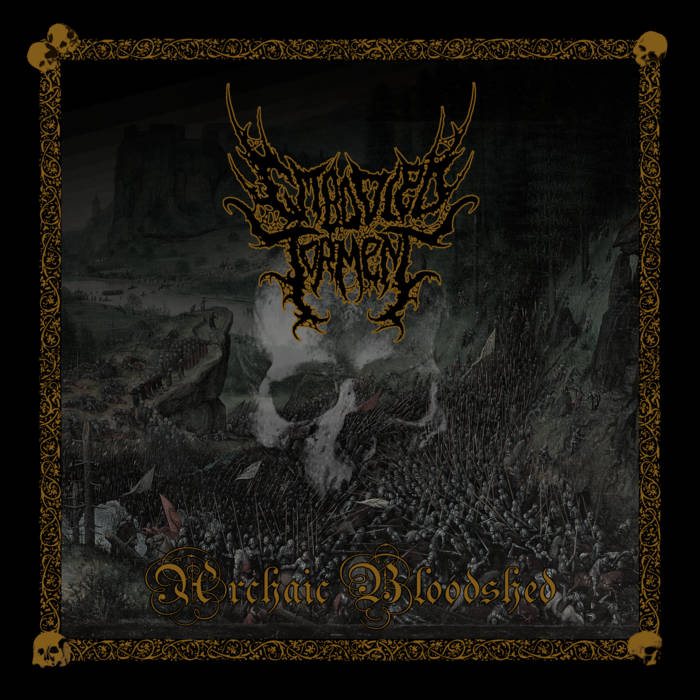
Atop this muscular foundation are placed strikingly melodic guitar leads flowing from the peripheral shape of the rhythm section. Whilst Embodied Torment create context and space for this facet of their character to grow, as on the clean breakdown on the opening track ‘Deconsecration of the Monolith’, for the most part the lead guitar acts as a welcome antagonist to the explicitly disordered motion of the rhythm section. Soaring guitar leads are provided with additional framing by the jagged contrast to their surroundings, lending the swirling darkness a surprising glimmer of light and moral purpose.
Drums list wildly between oddly emphasised blast-beats, to jazz shuffles, and the choppy, staccato punches typical of garden variety tech death. They embody a welcome freeform structure, able to jump from the rigid technical interplay of the style to flowing, ambient swells of percussive noise. Vocals stick with the requisite guttural growls of the genre, bottoming out the textural offering with a welcome degree of deadpan violence.
‘Archaic Bloodshed’ refreshes the format of tech death by destabilising the strictures of its foundation and seasoning the brutalist aesthetic with some highly traditional and not unpretty accents, brightening the landscape with the promise of hope.
 Hate Meditations
Leave a comment