Sammath: Grebbeberg
Out 16th June on Hammerheart Records
Sammath are one of those hidden shibboleths in black metal. We are given license to judge another’s credentials based on their attitude toward (or ignorance of) this band. Those that know, know. Having formed back in the 1990s they have remained a firm holdout of Dutch black metal ever since. Their debut ‘Strijd’ remains the black sheep of their discography for its use of keyboards and a more pronounced melodic core. Since that time they have been consistently putting out material displaying an increasingly violent, visceral rumination on the nature of conflict. As a result, it’s tempting to lump them into the war metal category (or worse, make superficially motivated comparisons to Marduk). But Sammath’s treatment of war goes far beyond a simple statement of chaos or performatively crooning about how awesome military iconography is.

Sammath warrant comparison to early Bolt Thrower in that both artists play a kind of warfare program music. This differs from garden variety war metal in that each compositional choice serves as a metaphor for some specific aspect of battle. Whereas the bulk of war metal, in seeking to create a perpetual sense of chaos, more often than not ends up as a homogenous blob that is ironically devoid of activity.
Since 2014’s watershed release ‘Godless Arrogance’, the Sammath template has focused specifically on the Western Front during World War II. ‘Grebbeberg’ continues in this vein, focusing on the titular battle that saw a major Dutch defeat in 1940 at the hands of the advancing Nazi forces.
The specific form of warfare that embroiled the European powers in the 1940s saw the cold, mechanistic reality of advanced nations marshalling the extent of their industrial, administrative, scientific, and natural resources to one end only. Any intersection with the tragic human cost of achieving this end was bitterly shrugged off. The resulting conflicts created a completely new, multifaceted hyper object, one that requires artistic forethought to properly frame. A task the bulk of the war metal canon (soz) is incapable of. Whilst Sammath’s approach is undeniably every bit as brutal, chaotic, and combative as war metal, it leaves room for reflection and nuance. Beyond the barrage of blisteringly fast blackened thrash comes soaring tremolo picked riffs hinting at light and colour, and expressive melodic refrains both commenting on, and knitting themselves into, the anomie below.
‘Grebbeberg’ sees Sammath take their flirtation with sonic metaphor even further by imitating the sounds of battle through their instruments. This is most explicit on the track ‘Murderous Artillery’, which presents a development section brought to bear by an idiosyncratic drum solo accompanied by samples of shell fire, thus blurring the lines between the inherent ambiguity of music as an artform and the blunt reality being conveyed. An artform that deals primarily in metaphor bleeds into frank realism.
Similar moments are scattered throughout the album, as the music works itself into a frenzy of choppy, staccato punches played with such speed and fury that they threaten to tear themselves apart entirely. This is contrasted by measured, calculating moments of clear harmonic intent, set to drums that imitate the gradualist inevitability of battalions moving into position. Jan’s distinctive vocal style also reaches new heights of fury. Although his voice sits comfortably within the black metal oeuvre, it takes on an aggressive, arhythmic quality that captures the sense of nihilistic despair and anguish engendered by a state of total war.
With ‘Grebbeberg’, Sammath have well and truly surpassed themselves. They have achieved that rare thing for artists at a similar stage in their career. A statement that sits in clear continuity to their body of work to date. But one that adds considerably to the vocabulary and potential of the format. It is therefore both a triumph of the established form we have come to expect from this artist, whilst uploading subtly new expressive dimensions to the format. ‘Grebbeberg’ will fire up Sammath’s base certainly, and hopefully garner them some new fans along the way. But the sad fact is that the vast majority within black metal – even those partial to the extreme flavour on offer here – will remain criminally ignorant of this longstanding pillar of the Dutch scene.
Vile Ritual: Caverns of Occultic Hatred
Out 16th June on Sentient Ruin
The debut album from Maryland’s Vile Ritual furnishes muscular, dark death/doom with an injection of the “weird”. Not in the strictest Lovecraftian sense of the word, but a latent theme of twisted revelry that haunts many of death metal’s best loved releases as an unspoken meme. In the literal sense, ‘Caverns of Occultic Ruin’ meshes elements of The Chasm and Incantation with more progressive leanings borrowed from Timeghoul and Demilich, a union officiated by subtle undercurrents of blackened grind with a marked (if warped) melodic character.
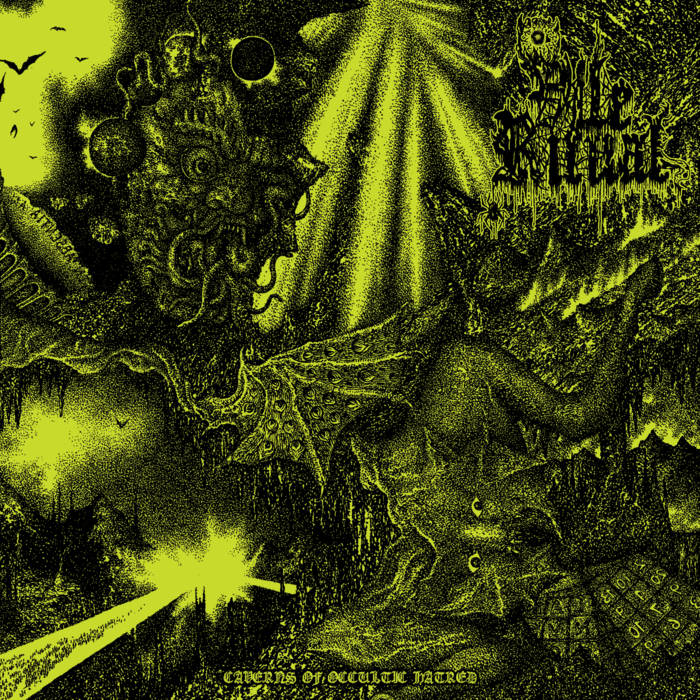
The production immediately envelopes the listener in vast cathedrals of liminal gloom. Despite the dominance of the bass driven guitar tone, solidity is retained, allowing full articulation for some of the more idiosyncratic riffs. Drums are pitched a little low in the mix, but make their presence felt through a sharp snare sound and weighty toms. Guttural vocals complete the picture, embodying a humanist monstrosity that adds additional layers of creep to the picture.
Superficially, this will likely get compared to the “brainy” arm of the OSDM revival in the likes of Grave Miasma, but the packaging of this album disguises a far more eccentric beast than many of its peers. It starts from a place of drone driven doom, but quickly solidifies into coherent atmospheric death metal defined by its ability to create its own language through the cumulation of riffs. In this regard it warrants comparison to Demigod for its ability to draw out the simplest theme in cyclical measures, adding layers of complexity with each recapitulation. Simple lead refrains are deployed to add a hint of delicacy and nuance to the structure, before the whole thing is exploded back into chromatic chaos once again.
But the music is just as liable to breakdown into bizarre-ist tangents borrowed from progressive and experimental metal, here given new purpose in the context of these macro structures. In this context, ‘Caverns of Occultic Hatred’ can be read as a curious meeting point between the old and the new. The “old”, meaning the form of death metal expressed at the genre’s apex in around 1992, which furnishes the landscape and philosophical orientation of this album. The “new”, meaning elements of progressive and experimental music, which are free to wander this landscape, adding trills, accents, opinions, and ornamentation to a pre-existing narrative thesis. Both serve and important purpose, and both coalesce on this album to create an experience notable for its vibrancy.
Autumn Nostalgie/Hænesy: Awakening Mechanon
Out 2nd June on Purity Through Fire/Northern Silence
A split of post black metal that sees Hænesy bookend the EP, with Autumn Nostalgie filling out the middle. This only serves to further expose the stark contrast in how each artist treats their self-appointed roles as the advancing army of black metal’s creative front.
Autumn Nostalgia play a vacuously bland variant of stadium rock with all the jeopardy of a Coldplay album. The riffs are obvious and flat, cycling around the most simplistic anthemic hooks imaginable, utterly failing to express a statement that could even approach the trivial. Drums plod beneath, rarely deviating from a lacklustre 4/4. This in itself would be forgivable. But considering the drivel this percussion is put in service of it could at least make a show of raising the stakes beyond the boiler plate fills served up here. In the space of sixteen minutes Autumn Nostalgie manage to showcase all the worst aspects of post black metal (post Deafheaven), and its insistence on taking one of the most creatively fertile pockets of contemporary music and appropriating it back into the tedium of business-as-usual culture industry cliché, neutering it with commonplace musical forms that have defined Western pop and rock since the 1950s.
Ok, now that’s out of our system.
Hænesy continue their unique and eerie brand of atmospheric black metal expressed via predominantly clean guitars lifted straight from goth and jangle pop. Here the delicate arpeggios are lent muscle through a strong bass tone and underlayers of distorted rhythm guitar. This, strictly speaking, sits within the post metal milieu for its foregrounding of sparsity, atmosphere, minimalism, and catharsis.
But this is a superficial reading. Beneath the surface level tranquillity the music is rife with activity. Novel narrative developments play out atop proto contrapuntal melodic lines that constantly flow and build to moments of release. Rhythmic diversity aides in this endeavour by adopting a subtle progressive flavour. When not engaged in lightning fast blast-beats the drums weave and flow between the multifaceted guitar work.
Hænesy blend moments of abrasive anguish with the cold comfort of richly realised guitar lines to great effect, never tipping over into overworked sentiment, never sacrificing compositional integrity for the sake of an atomised, individualistic expression. This is music that sees tight writing and carefully curated atmospheres meet for the betterment of both. Fixed on the heavens, hampered by the earth, Hænesy restate their claim as one of the more unique voices within extreme metal in the 2020s.
 Hate Meditations